Industry-Verified Manufacturing Data (2026)

Real-Time Clock (RTC)

Based on aggregated insights from multiple verified factory profiles within the CNFX directory, the standard Real-Time Clock (RTC) used in the Computer, Electronic and Optical Product Manufacturing sector typically supports operational capacities ranging from standard industrial configurations to heavy-duty production requirements.

Technical Definition & Core Assembly

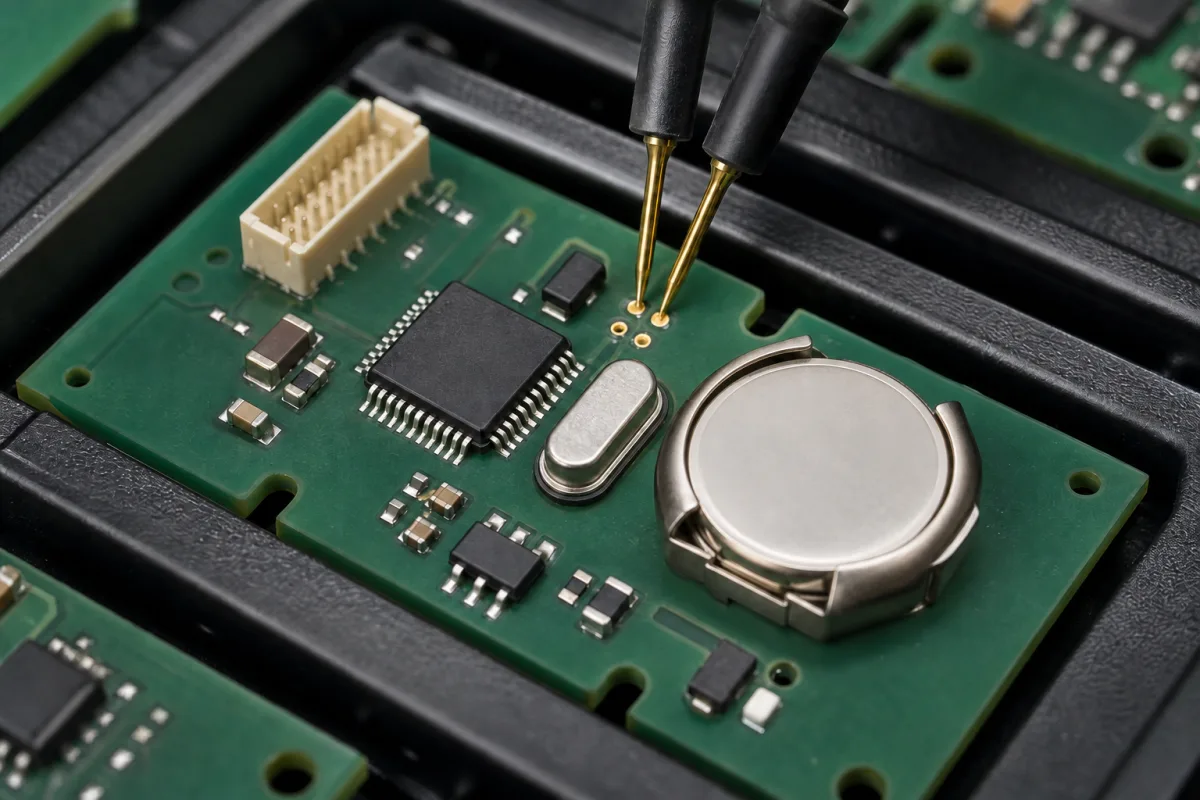
A canonical Real-Time Clock (RTC) is characterized by the integration of Quartz Crystal Oscillator and CMOS Integrated Circuit. In industrial production environments, manufacturers listed on CNFX commonly emphasize Silicon (IC) construction to support stable, high-cycle operation across diverse manufacturing scenarios.

An electronic component that keeps track of the current time and date independently of the main system power.
Product Specifications

Technical details and manufacturing context for Real-Time Clock (RTC)

Definition
A specialized integrated circuit or module within a data logger that maintains accurate timekeeping even when the main system is powered off, using a backup battery. It provides precise timestamping for logged data entries, ensuring chronological accuracy and synchronization across multiple data collection points.
Working Principle
The RTC operates using a quartz crystal oscillator to generate precise timekeeping signals. It counts seconds, minutes, hours, days, months, and years. When the main system is powered down, a small backup battery (typically a lithium coin cell) maintains power to the RTC circuit, allowing it to continue keeping time. Communication with the data logger's main processor occurs via serial interfaces like I²C or SPI to read/write time data.
Common Materials
Silicon (IC), Quartz crystal, Lithium battery
Technical Parameters
  • Timekeeping accuracy measured in parts per million deviation from actual time (ppm) Per Request
Components / BOM
  • Quartz Crystal Oscillator
    Generates precise timing pulses for timekeeping
    Material: Quartz crystal, metal electrodes
  • CMOS Integrated Circuit
    Processes timing signals and manages time/date registers
    Material: Silicon semiconductor
  • Backup Battery Holder
    Secures and connects backup power source to maintain timekeeping during main power loss
    Material: Plastic, metal contacts
  • Communication Interface Pins
    Provides electrical connection for data exchange with main processor
    Material: Copper alloy, gold plating
Engineering Reasoning
-40°C to +85°C, 1.8V to 5.5V supply voltage, ±20 ppm frequency stability
Crystal oscillator stops at 1.62V supply voltage, timekeeping fails at -55°C or +125°C junction temperature
Design Rationale: Quartz crystal piezoelectric effect degradation below minimum excitation voltage; silicon lattice damage beyond semiconductor thermal limits
Risk Mitigation (FMEA)
Trigger Electrostatic discharge exceeding 2000V HBM
Mode: CMOS latch-up causing permanent short circuit
Strategy: Integrated ESD protection diodes with 8kV IEC 61000-4-2 rating
Trigger 32.768 kHz crystal oscillator aging at 3 ppm/year
Mode: Cumulative time drift exceeding 5 seconds/month
Strategy: Temperature-compensated crystal oscillator with ±2 ppm accuracy over operational range

Industry Taxonomies & Aliases

Commonly used trade names and technical identifiers for Real-Time Clock (RTC).

Applied To / Applications

This component is essential for the following industrial systems and equipment:

Industrial Ecosystem & Supply Chain DNA

Complementary Systems
Downstream Applications
Specialized Tooling

Application Fit & Sizing Matrix

Operational Limits
voltage: 1.8V to 5.5V (typical operating range)
accuracy: ±5 ppm to ±20 ppm (typical timekeeping accuracy)
temperature: -40°C to +85°C (industrial grade), -40°C to +105°C (extended industrial)
backup current: 100nA to 500nA (typical battery backup current)
Media Compatibility
✓ Consumer electronics (smartphones, wearables) ✓ Industrial automation systems ✓ Automotive infotainment and telematics
Unsuitable: High-radiation environments (nuclear facilities, space applications without shielding)
Sizing Data Required
  • Required timekeeping accuracy (ppm)
  • Backup power source specifications (battery type/capacity)
  • Communication interface requirements (I2C, SPI, 3-wire)

Reliability & Engineering Risk Analysis

Failure Mode & Root Cause
Battery Depletion
Cause: Primary cell battery failure due to aging, temperature extremes, or manufacturing defects, leading to loss of timekeeping when main power is interrupted.
Crystal Oscillator Drift
Cause: Quartz crystal aging, mechanical stress, or temperature variations causing frequency inaccuracies and timekeeping errors.
Maintenance Indicators
  • System logs show 'CMOS checksum error' or 'RTC battery low' warnings during boot-up.
  • Clock displays incorrect time after power cycles or exhibits significant time drift (minutes/hours) over short periods.
Engineering Tips
  • Implement predictive battery monitoring by tracking voltage trends and scheduling replacements before depletion, typically every 3-5 years in industrial environments.
  • Use temperature-compensated RTC modules (TCXO) in environments with wide thermal swings and ensure secure mounting to minimize vibration-induced crystal stress.

Compliance & Manufacturing Standards

Reference Standards
ISO 9001:2015 - Quality Management Systems IEC 60747-14-1:2010 - Semiconductor devices - Part 14-1: Semiconductor sensors - Generic specification for sensors EN 61326-1:2013 - Electrical equipment for measurement, control and laboratory use - EMC requirements
Manufacturing Precision
  • Timekeeping Accuracy: +/- 2 seconds per day at 25°C
  • Operating Temperature Range: -40°C to +85°C +/- 1°C
Quality Inspection
  • Frequency Stability Test (using precision frequency counter)
  • Temperature Cycling Test (-40°C to +85°C with timekeeping verification)

Factories Producing Real-Time Clock (RTC)

Verified manufacturers with capability to produce this product in China

✓ 98% Supplier Capability Match Found

P Procurement Specialist from Singapore Feb 12, 2026
★★★★★
"Found 47+ suppliers for Real-Time Clock (RTC) on CNFX, but this spec remains the most cost-effective."
Technical Specifications Verified
T Technical Director from Germany Feb 09, 2026
★★★★★
"The technical documentation for this Real-Time Clock (RTC) is very thorough, especially regarding technical reliability."
Technical Specifications Verified
P Project Engineer from Brazil Feb 06, 2026
★★★★★
"Reliable performance in harsh Computer, Electronic and Optical Product Manufacturing environments. No issues with the Real-Time Clock (RTC) so far."
Technical Specifications Verified
Verification Protocol

“Feedback is collected from verified sourcing managers during RFQ (Request for Quote) and factory evaluation processes on CNFX. These reports represent historical performance data and technical audit summaries from our B2B manufacturing network.”

13 sourcing managers are analyzing this specification now. Last inquiry for Real-Time Clock (RTC) from Turkey (52m ago).

Supply Chain Compatible Machinery & Devices

Industrial Smart Camera Module

Embedded vision system for industrial automation and quality inspection.

Explore Specs →
Industrial Wireless Power Transfer Module

Wireless power transfer module for industrial equipment applications

Explore Specs →
Industrial Smart Sensor Module

Modular industrial sensor with embedded processing and wireless connectivity

Explore Specs →
Surface Mount Resistor

Passive electronic component for current limiting and voltage division in circuits

Explore Specs →

Frequently Asked Questions

What is the typical accuracy of this RTC module?

Our RTC modules achieve ±5ppm accuracy using high-quality quartz crystal oscillators, equivalent to approximately 2.5 minutes per year deviation.

How long does the backup battery last during power outages?

The integrated lithium battery provides 5-10 years of backup timekeeping depending on environmental conditions and usage patterns.

What communication interfaces does this RTC support?

This RTC module supports standard I2C and SPI interfaces for easy integration with microcontrollers and embedded systems in electronic manufacturing applications.

Can I contact factories directly on CNFX?

CNFX is an open directory, not a transaction platform. Each factory profile provides direct contact information and production details to help you initiate direct inquiries with Chinese suppliers.

Get Quote for Real-Time Clock (RTC)

Request technical pricing, lead times, or customized specifications for Real-Time Clock (RTC) directly from verified manufacturing units.

Your business information is encrypted and only shared with verified Real-Time Clock (RTC) suppliers.

Thank you! Your message has been sent. We'll respond within 1–3 business days.

Need to Manufacture Real-Time Clock (RTC)?

Connect with verified factories specializing in this product category

Add Your Factory Contact Us
Previous Product
Real-Time Clock
Next Product
Receiver (RX)