Industry-Verified Manufacturing Data (2026)

RAID Controller

Based on aggregated insights from multiple verified factory profiles within the CNFX directory, the standard RAID Controller used in the Computer, Electronic and Optical Product Manufacturing sector typically supports operational capacities ranging from standard industrial configurations to heavy-duty production requirements.

Technical Definition & Core Assembly

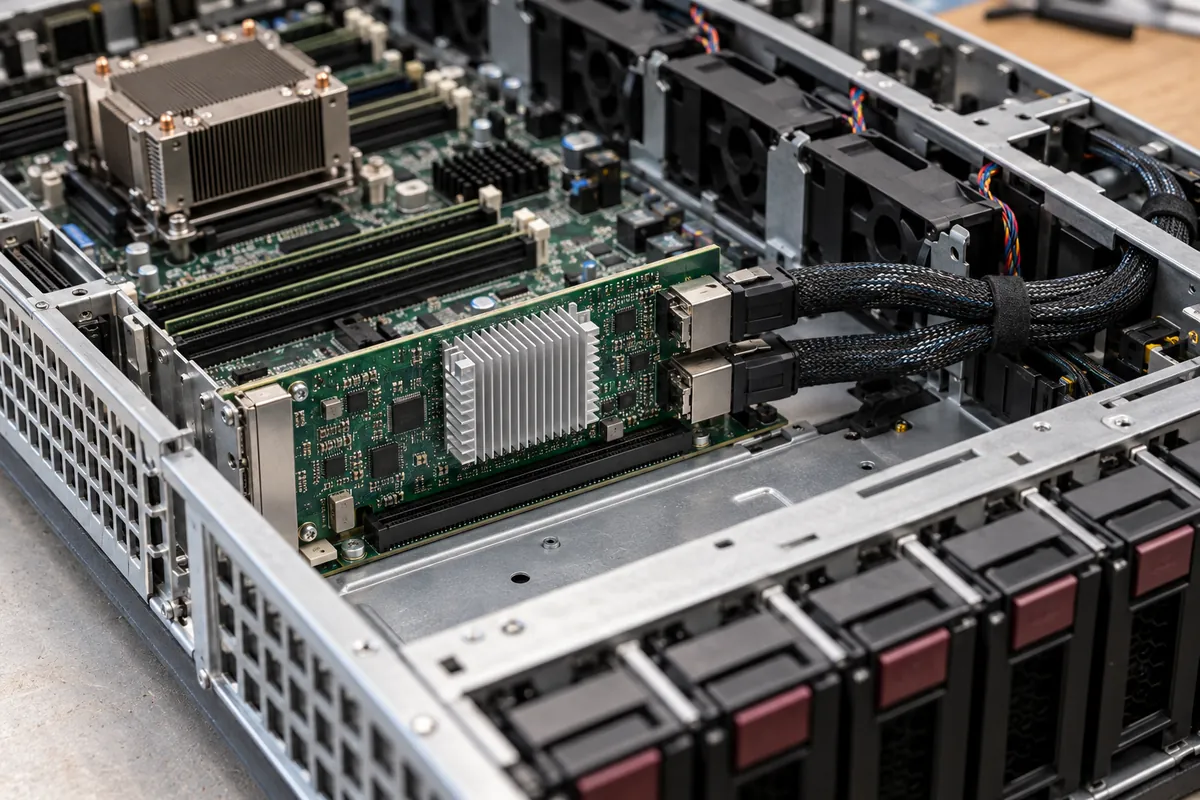
A canonical RAID Controller is characterized by the integration of RAID Processor and Cache Memory Module. In industrial production environments, manufacturers listed on CNFX commonly emphasize Printed Circuit Board (PCB) construction to support stable, high-cycle operation across diverse manufacturing scenarios.

Hardware component that manages multiple hard drives in a RAID configuration to provide data redundancy, performance improvement, or both.
Product Specifications

Technical details and manufacturing context for RAID Controller

Definition
A RAID controller is a specialized hardware component within a Database Server that manages the array of hard disk drives configured in a RAID (Redundant Array of Independent Disks) setup. It handles data distribution across multiple drives, implements RAID levels (such as RAID 0, 1, 5, 6, or 10), performs parity calculations for data protection, manages drive failures with hot-swap capabilities, and optimizes read/write operations to enhance database performance and reliability.
Working Principle
The RAID controller operates by intercepting data requests from the server's operating system. It distributes data blocks across multiple physical drives according to the configured RAID level, using algorithms for striping (spreading data), mirroring (duplicating data), or parity (error correction). For writes, it calculates and stores parity information to enable data reconstruction in case of drive failure. For reads, it can retrieve data from multiple drives simultaneously to improve throughput. The controller typically includes its own processor, cache memory, and firmware to manage these operations independently of the main server CPU.
Common Materials
Printed Circuit Board (PCB), Semiconductor chips (processor, memory), Capacitors and resistors, Heat sink (aluminum or copper)
Technical Parameters
  • Interface speed (e.g., 12 Gbps SAS, 6 Gbps SATA) (Gbps) Customizable
Components / BOM
  • RAID Processor
    Executes RAID algorithms, manages data distribution, and performs parity calculations
    Material: Semiconductor (silicon)
  • Cache Memory Module
    Temporarily stores frequently accessed data to accelerate read/write operations
    Material: DRAM chips
  • Host Bus Interface
    Connects the RAID controller to the server motherboard (e.g., PCIe slot)
    Material: Gold-plated connectors, PCB traces
  • Drive Connectors
    Physical ports for connecting hard drives (e.g., SAS/SATA ports)
    Material: Plastic housing, metal contacts
  • Battery Backup Unit (BBU)
    Provides power to preserve cache data during power failures to prevent data loss
    Material: Lithium-ion battery, plastic casing
Engineering Reasoning
0-70°C ambient temperature, 5-95% relative humidity non-condensing, 0.9-1.1 V input voltage tolerance
85°C sustained ambient temperature, 0.7 V input voltage, 10^15 bit error rate threshold
Design Rationale: Electromigration in copper interconnects at 85°C accelerates according to Black's equation (J²·exp(-Ea/kT)), where current density J exceeds 10⁶ A/cm² and activation energy Ea=0.7 eV for copper
Risk Mitigation (FMEA)
Trigger Capacitor electrolyte evaporation at 105°C ambient temperature
Mode: Voltage regulator output ripple exceeding 50 mVpp
Strategy: Solid polymer capacitors with 5000-hour lifespan at 105°C, derated to 80% of rated voltage
Trigger Thermal cycling between 20-70°C at 2 cycles/hour
Mode: Solder joint fatigue cracking after 5000 cycles
Strategy: Copper column BGA packaging with 0.8 mm pitch, SAC305 solder with 12% strain relief

Industry Taxonomies & Aliases

Commonly used trade names and technical identifiers for RAID Controller.

Applied To / Applications

This component is essential for the following industrial systems and equipment:

Industrial Ecosystem & Supply Chain DNA

Complementary Systems
Downstream Applications
Specialized Tooling

Application Fit & Sizing Matrix

Operational Limits
pressure: N/A (electronic component)
other spec: Humidity: 10% to 90% non-condensing, Vibration: 5-500 Hz at 0.25G, Power: 12V DC ±5%
temperature: 0°C to 55°C (operating), -40°C to 70°C (storage)
Media Compatibility
✓ Enterprise SAS/SATA hard drives ✓ SSDs (SAS/SATA/NVMe via adapters) ✓ High-performance server environments
Unsuitable: High-vibration industrial environments without proper shock mounting
Sizing Data Required
  • Number and type of drives (SAS/SATA/NVMe)
  • Required RAID level (0,1,5,6,10, etc.)
  • Desired throughput and IOPS performance targets

Reliability & Engineering Risk Analysis

Failure Mode & Root Cause
Controller Chip Failure
Cause: Thermal stress from inadequate cooling or prolonged high-temperature operation leading to semiconductor degradation or solder joint fatigue.
Cache Battery/Capacitor Failure
Cause: Battery depletion or capacitor degradation over time, causing loss of write-back cache data during power interruptions.
Maintenance Indicators
  • Audible beeping or alarm from server indicating RAID controller failure detected
  • LED status lights showing amber/red on controller or drive array indicating degraded/failed state
Engineering Tips
  • Implement proactive thermal management with proper server airflow and regular cleaning of heatsinks/fans to prevent controller overheating
  • Schedule regular cache battery/capacitor health checks and replacement before end of service life, typically every 2-3 years

Compliance & Manufacturing Standards

Reference Standards
ISO/IEC 14776-113:2002 (SCSI-3) ANSI/INCITS 376-2003 (Fibre Channel) CE Marking (EMC Directive 2014/30/EU)
Manufacturing Precision
  • PCB Trace Width: +/-10%
  • Connector Pin Alignment: +/-0.15mm
Quality Inspection
  • Signal Integrity Testing (Eye Diagram Analysis)
  • Environmental Stress Screening (Temperature Cycling)

Factories Producing RAID Controller

Verified manufacturers with capability to produce this product in China

✓ 96% Supplier Capability Match Found

S Sourcing Manager from Australia Mar 01, 2026
★★★★★
"As a professional in the Computer, Electronic and Optical Product Manufacturing sector, I confirm this RAID Controller meets all ISO standards."
Technical Specifications Verified
P Procurement Specialist from Singapore Feb 26, 2026
★★★★☆
"Standard OEM quality for Computer, Electronic and Optical Product Manufacturing applications. The RAID Controller arrived with full certification. (Delivery took slightly longer than expected, but technical support was excellent.)"
Technical Specifications Verified
T Technical Director from Germany Feb 23, 2026
★★★★★
"Great transparency on the RAID Controller components. Essential for our Computer, Electronic and Optical Product Manufacturing supply chain."
Technical Specifications Verified
Verification Protocol

“Feedback is collected from verified sourcing managers during RFQ (Request for Quote) and factory evaluation processes on CNFX. These reports represent historical performance data and technical audit summaries from our B2B manufacturing network.”

8 sourcing managers are analyzing this specification now. Last inquiry for RAID Controller from Poland (34m ago).

Supply Chain Compatible Machinery & Devices

Industrial IoT Gateway

Edge computing device connecting industrial equipment to cloud platforms.

Explore Specs →
Modular Industrial Edge Computing Device

Rugged computing platform for industrial data processing at the network edge

Explore Specs →
Industrial Smart Camera Module

Embedded vision system for industrial automation and quality inspection.

Explore Specs →
Industrial Wireless Power Transfer Module

Wireless power transfer module for industrial equipment applications

Explore Specs →

Frequently Asked Questions

What are the main benefits of using a hardware RAID controller?

Hardware RAID controllers provide dedicated processing for RAID operations, reducing CPU load on the host system while offering superior performance, data protection through redundancy, and hot-swap capabilities for drive maintenance.

How does the battery backup unit (BBU) protect data?

The BBU provides temporary power to the cache memory during unexpected power loss, ensuring that cached data is safely written to permanent storage once power is restored, preventing data corruption.

What RAID levels are typically supported by these controllers?

Most enterprise RAID controllers support RAID 0, 1, 5, 6, 10, and 50 configurations, balancing performance, capacity, and data protection based on specific storage requirements.

Can I contact factories directly on CNFX?

CNFX is an open directory, not a transaction platform. Each factory profile provides direct contact information and production details to help you initiate direct inquiries with Chinese suppliers.

Get Quote for RAID Controller

Request technical pricing, lead times, or customized specifications for RAID Controller directly from verified manufacturing units.

Your business information is encrypted and only shared with verified RAID Controller suppliers.

Thank you! Your message has been sent. We'll respond within 1–3 business days.

Need to Manufacture RAID Controller?

Connect with verified factories specializing in this product category

Add Your Factory Contact Us
Previous Product
Radiation Therapy Simulator
Next Product
RAID Processor