Industry-Verified Manufacturing Data (2026)

Register File

Based on aggregated insights from multiple verified factory profiles within the CNFX directory, the standard Register File used in the Computer, Electronic and Optical Product Manufacturing sector typically supports operational capacities ranging from standard industrial configurations to heavy-duty production requirements.

Technical Definition & Core Assembly

A canonical Register File is characterized by the integration of Register Cells and Address Decoder. In industrial production environments, manufacturers listed on CNFX commonly emphasize Silicon construction to support stable, high-cycle operation across diverse manufacturing scenarios.

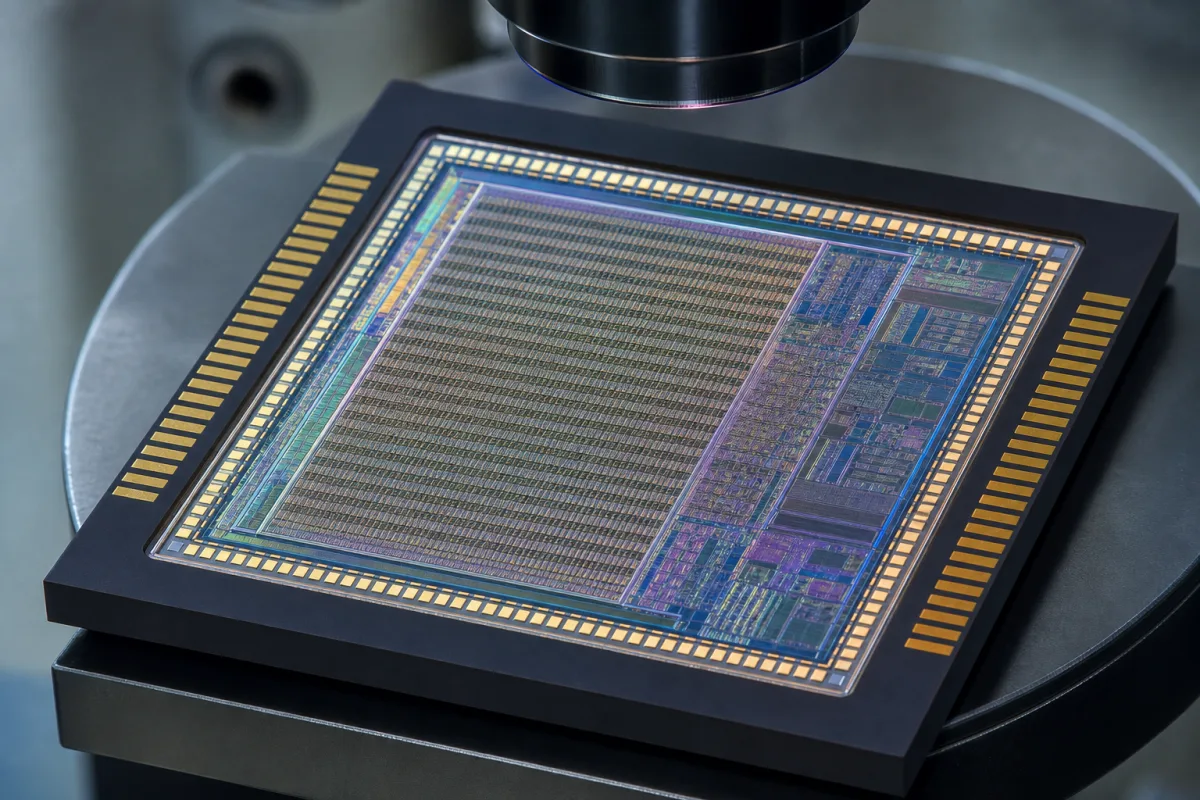
A small, high-speed memory unit within a CPU that stores data temporarily during processing operations.
Product Specifications

Technical details and manufacturing context for Register File

Definition
The register file is a critical component of the Central Processing Core (CPU) that provides fast-access storage locations for holding data, addresses, and intermediate results during instruction execution. It consists of multiple registers organized in an array structure, allowing simultaneous read and write operations to support pipelined processing and parallel execution.
Working Principle
The register file operates as a multi-port memory array with dedicated read and write ports. During CPU operation, the control unit generates addresses to select specific registers for reading operands or writing results. Data is transferred between the register file and other CPU components (ALU, control unit, memory interface) via internal buses. The register file's small size and proximity to execution units enable single-cycle access, significantly reducing latency compared to main memory.
Common Materials
Silicon, Copper interconnects, Dielectric materials
Technical Parameters
  • Register width determines the maximum data size that can be processed in a single operation (bits) Customizable
Components / BOM
  • Register Cells
    Individual storage elements that hold binary data
    Material: Silicon transistors
  • Address Decoder
    Selects specific registers based on address inputs
    Material: Silicon logic gates
  • Read/Write Ports
    Interface circuits for data transfer operations
    Material: Copper interconnects, silicon transistors
  • Control Logic
    Manages timing and coordination of register operations
    Material: Silicon logic circuits
Engineering Reasoning
1.0-1.5 V at 25°C ambient temperature, 0.8-1.2 GHz clock frequency
Electromigration occurs at current density > 1.0×10⁶ A/cm², thermal runaway initiates at junction temperature > 125°C
Design Rationale: Electromigration due to high current density causing atomic displacement in copper interconnects, exacerbated by joule heating and thermal expansion mismatch between silicon (2.6×10⁻⁶/K) and copper (17×10⁻⁶/K) coefficients
Risk Mitigation (FMEA)
Trigger Alpha particle strike from packaging materials generating 1.5-3.0 MeV energy deposition
Mode: Single-event upset causing bit flip in SRAM cell, propagating through read/write circuitry
Strategy: Error-correcting code implementation with Hamming distance ≥ 4, triple modular redundancy for critical bits
Trigger Negative bias temperature instability at electric field > 5 MV/cm and temperature > 85°C
Mode: Threshold voltage shift exceeding 50 mV in PMOS transistors, degrading read/write timing margins
Strategy: Gate oxide thickness optimization to 2.0 nm with high-k dielectric (HfO₂, κ=25), adaptive body biasing circuitry

Industry Taxonomies & Aliases

Commonly used trade names and technical identifiers for Register File.

Applied To / Applications

This component is essential for the following industrial systems and equipment:

Industrial Ecosystem & Supply Chain DNA

Complementary Systems
Downstream Applications
Specialized Tooling

Application Fit & Sizing Matrix

Operational Limits
voltage: 0.8V to 1.2V (typical core voltage range)
temperature: -40°C to +125°C (operating range for commercial/industrial silicon)
clock frequency: Up to 5 GHz (depending on process node and design)
power dissipation: Milliwatts to low watts range
Media Compatibility
✓ Digital logic signals ✓ Binary data storage ✓ CPU pipeline data
Unsuitable: High-voltage analog signals or corrosive chemical environments
Sizing Data Required
  • Number of registers required
  • Bit width per register
  • Required access ports (read/write ports)

Reliability & Engineering Risk Analysis

Failure Mode & Root Cause
Seal Degradation
Cause: Exposure to incompatible fluids, excessive temperatures, or abrasive particles leading to hardening, cracking, or swelling of elastomeric seals, resulting in leaks and loss of pressure integrity.
Internal Corrosion or Fouling
Cause: Chemical attack from process fluids, moisture ingress, or buildup of contaminants (scale, debris) within the register file, causing flow restriction, component binding, or structural weakening.
Maintenance Indicators
  • Visible fluid leakage or seepage around the register file body or connections, indicating seal failure or corrosion.
  • Abnormal audible hissing, whistling, or grinding noises during operation, suggesting internal obstruction, wear, or misalignment.
Engineering Tips
  • Implement a proactive seal inspection and replacement schedule based on fluid compatibility charts and historical failure data, using manufacturer-recommended materials.
  • Install upstream filtration or strainers to prevent contaminant ingress, and ensure proper fluid conditioning (e.g., pH control, moisture removal) to minimize corrosion and fouling risks.

Compliance & Manufacturing Standards

Reference Standards
ISO 9001:2015 - Quality Management Systems ANSI/ASME B46.1-2019 - Surface Texture DIN 5480-1:2006 - Splined connections with involute splines
Manufacturing Precision
  • Bore diameter: +/-0.02mm
  • Parallelism of mounting surfaces: 0.05mm
Quality Inspection
  • Dimensional verification with CMM (Coordinate Measuring Machine)
  • Surface roughness measurement with profilometer

Factories Producing Register File

Verified manufacturers with capability to produce this product in China

✓ 96% Supplier Capability Match Found

S Sourcing Manager from Australia Jan 24, 2026
★★★★★
"As a professional in the Computer, Electronic and Optical Product Manufacturing sector, I confirm this Register File meets all ISO standards."
Technical Specifications Verified
P Procurement Specialist from Singapore Jan 21, 2026
★★★★☆
"Standard OEM quality for Computer, Electronic and Optical Product Manufacturing applications. The Register File arrived with full certification. (Delivery took slightly longer than expected, but technical support was excellent.)"
Technical Specifications Verified
T Technical Director from Germany Jan 18, 2026
★★★★★
"Great transparency on the Register File components. Essential for our Computer, Electronic and Optical Product Manufacturing supply chain."
Technical Specifications Verified
Verification Protocol

“Feedback is collected from verified sourcing managers during RFQ (Request for Quote) and factory evaluation processes on CNFX. These reports represent historical performance data and technical audit summaries from our B2B manufacturing network.”

17 sourcing managers are analyzing this specification now. Last inquiry for Register File from Vietnam (11m ago).

Supply Chain Compatible Machinery & Devices

Industrial IoT Gateway

Edge computing device connecting industrial equipment to cloud platforms.

Explore Specs →
Modular Industrial Edge Computing Device

Rugged computing platform for industrial data processing at the network edge

Explore Specs →
Industrial Smart Camera Module

Embedded vision system for industrial automation and quality inspection.

Explore Specs →
Industrial Wireless Power Transfer Module

Wireless power transfer module for industrial equipment applications

Explore Specs →

Frequently Asked Questions

What is the primary function of a register file in computer processing?

A register file serves as a small, high-speed memory unit within a CPU that temporarily stores data during arithmetic, logic, and control operations, enabling rapid access for processing tasks.

What materials are commonly used in register file manufacturing?

Register files are typically constructed using silicon as the semiconductor base, copper for interconnects to ensure fast signal transmission, and dielectric materials for insulation between layers.

How does a register file differ from main memory or cache?

Unlike main memory (RAM) or cache, a register file is the fastest and smallest storage unit directly within the CPU, holding immediate operands and results for current instructions, with access times measured in picoseconds.

Can I contact factories directly on CNFX?

CNFX is an open directory, not a transaction platform. Each factory profile provides direct contact information and production details to help you initiate direct inquiries with Chinese suppliers.

Get Quote for Register File

Request technical pricing, lead times, or customized specifications for Register File directly from verified manufacturing units.

Your business information is encrypted and only shared with verified Register File suppliers.

Thank you! Your message has been sent. We'll respond within 1–3 business days.

Need to Manufacture Register File?

Connect with verified factories specializing in this product category

Add Your Factory Contact Us
Previous Product
Reflow Soldering Oven
Next Product
Regulation Circuit/Gate