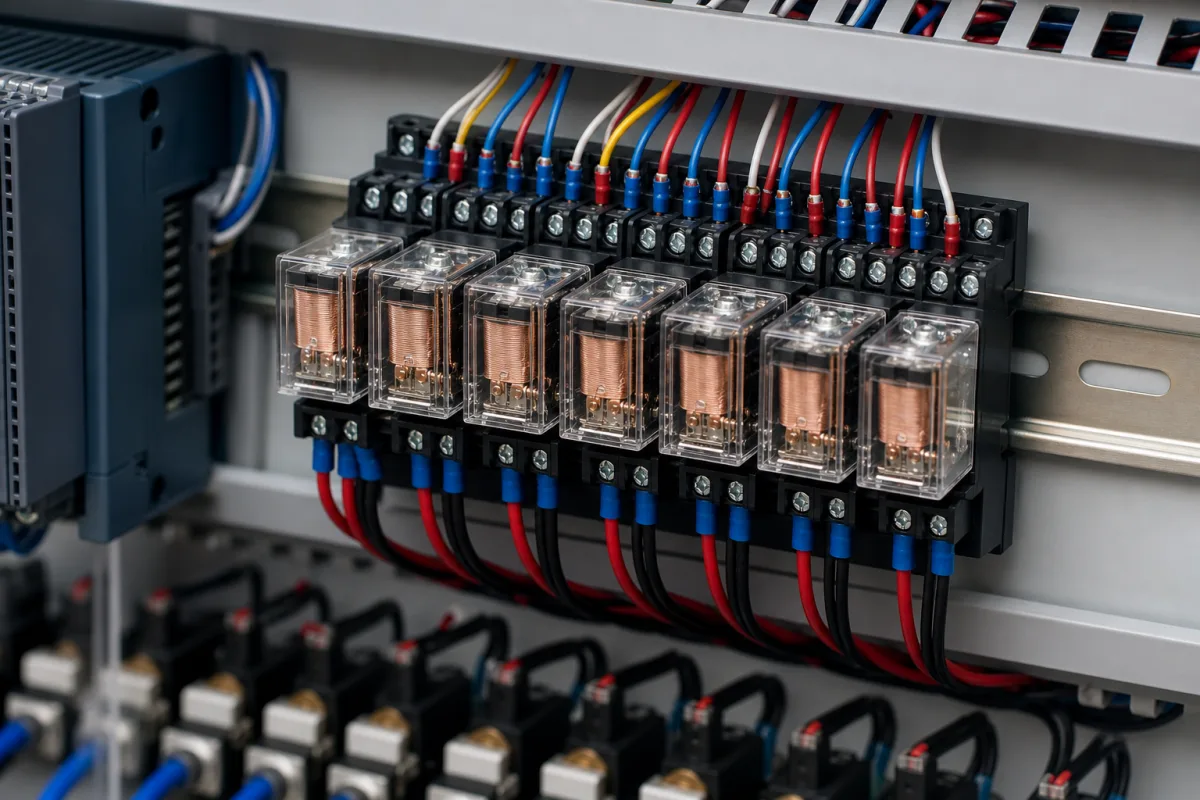
Relay output module for remote I/O: relay contacts switched over Modbus or a fieldbus
Relay outputs of remote and fieldbus I/O · Modbus coil writes and EtherCAT process bits, contact ratings from 0.5 A at 120 V AC to 5 A at 250 V AC, relay switching time and rate, watchdogs and isolation
A relay output module is the output stage of a remote or distributed I/O system: it receives on/off commands over Ethernet, RS-485 or a fieldbus and closes potential-free relay contacts that switch lamps, contactor coils, valves or alarms in the field. Choosing one means checking how the controller addresses its relays, what each contact may switch (AC and DC, resistive and inductive, minimum load), how fast and how often the relays may switch, what happens if communication stops, and the isolation between bus, supply and field.
Relay output modules and terminals in remote and fieldbus I/O systems (Modbus TCP and RTU, EtherCAT), with two or more relay channels switched by bus commands. Electromechanical power relays as components are covered on the Power relay page; slim 6 mm coupling relays and solid-state interface modules wired to PLC outputs are covered on the Interface module for PLC and DCS I/O page. Transistor (sink or source) digital output modules and safety relays are outside this page. Picking the controller, bus couplers and station layout of a remote I/O system is covered on the PLC controller with fieldbus remote I/O page.
CNFX editorial research · Sources checked October 12, 2026 · 4 sources
Modbus coils and fieldbus bits: how the controller sets each relay
In the Modbus application protocol each relay output is a coil. Function code 05, Write Single Coil, turns one output on with the value FF00 hex and off with 0000 hex; any other value is illegal and leaves the output unchanged. Coils are addressed from zero, so coil 1 is address 0. [1]
Function code 15 (0F hex), Write Multiple Coils, sets a sequence of 1 to 1,968 (07B0 hex) coils in one request, one bit per coil, with the byte count equal to the number of outputs divided by 8, rounded up. [1] Editorial calculation: an 8-relay module is written with a single data byte; a 6-relay module also needs one byte, with two bits unused.
BLIIoT's M320R shows the gateway-style module: 8 transistor outputs and 8 relay outputs, Modbus TCP, Modbus RTU over TCP and MQTT on its Ethernet port, and an RS-485 port for cascading further Modbus I/O. [4] On EtherCAT the relay is a process-image bit instead: Beckhoff's two-relay EL2622 terminal occupies 2 output bits and needs no address or configuration setting. [3]
Ask the supplier for the module's register map (coil addresses of each relay, zero-based or one-based), supported function codes, and how relay states are read back.
02
Contact ratings per channel: 0.5 A at 120 V AC up to 5 A at 250 V AC
Per-contact ratings in these four modules run from 0.5 A at 120 V AC to 5 A at 250 V AC. Advantech states its ratings for resistive loads; Beckhoff adds a lower inductive rating and a minimum load; BLIIoT gives one AC and one DC rating. [2][3][4]
Beckhoff gives the EL2622's life as at least 2 × 10⁷ mechanical operations and 1 × 10⁵ electrical operations at 5 A and 30 V DC. [3] Editorial calculation: if a relay switches its full 5 A DC load once every 10 seconds, 10⁵ operations last about 10⁶ seconds, roughly 12 days; at once a minute, about 69 days.
Editorial note: the 10 mA minimum load means a relay rated for amperes may not make reliable contact on a PLC input or other signal-level circuit; ask the supplier for the minimum switching current of the module offered.
Relay switching time, watchdogs and isolation between bus and field
Advantech lists the ADAM-6060's relay on time as 7 ms and off time as 3 ms, 10 ms in total, and an insulation resistance of at least 1 GΩ at 500 V DC. The module has a 1.6-second system watchdog and a programmable communication watchdog, 2,000 V DC isolation, power-reversal protection, a 10–30 V DC supply and 2 W consumption at 24 V DC. [2]
The data sheet does not say which state the relays take when the communication watchdog trips; ask the supplier whether each relay can be set to switch off, switch on or hold its state on loss of communication, and test it on the bench. [2]
Beckhoff states 500 V isolation between the EtherCAT E-bus and the field side of the EL2622, operation from −25 to +55 °C and 170 mA typical E-bus current. [3] BLIIoT lists surge, ESD and reverse power protection for the M320R, a 9–36 V DC supply, standby consumption of 2 W or less and operation from −20 to 70 °C in an IP30 metal case. [4]
04
Send the loads, the bus and the fail-safe state per relay
Paste it into your enquiry below or into an email to a maker, then replace every bracket.
Loads per channel: [voltage AC or DC; current; resistive, inductive or lamp; minimum current]
Switching: [operations per minute; required life]
Channels: [number; shared or separate contacts; Form A or C]
Bus: [Modbus TCP or RTU; EtherCAT; other; register map]
On communication loss: [off; on; hold, per relay]
Isolation and supply: [isolation voltage; supply voltage; ambient range]
2 companies list this product among what they make. Company figures are quoted from each
company's own website; every card states where the relationship came from.
BLIIOT
Manufacturing site to be confirmed for the order
Lists the M320R Ethernet I/O module with 8 relay outputs rated 5 A at 250 V AC or 3 A at 30 V DC and 8 sink transistor outputs, using Modbus TCP, Modbus RTU and MQTT, with an RS-485 port.
Beijing Pinghe Entrepreneurship Technology Development Co., Ltd.
Manufacturing site to be confirmed for the order
Lists the PH-LW-4JDQ-NO 4-channel relay output module in its PH series remote I/O, which also offers EtherCAT, Modbus/TCP, EtherNet/IP and CC-Link IEFB couplers.
Explore company information and manufacturing capabilities, then discuss the scope of your project with a relevant supplier.
Share this page
Compiled and source-reviewed by the CNFX editorial team.
Each manufacturer above links to the page on that company's own website where the product is listed, with the date we checked it. How we source and review
· Page last updated 13 October 2026
Buyer questions
How do I switch a relay output over Modbus?
Write Single Coil (function 05) with FF00 hex turns it on and 0000 hex turns it off; coils are addressed from zero. Write Multiple Coils (function 15) sets 1 to 1,968 coils at once. [1]
How much can a remote I/O relay switch?
Advantech's ADAM-6060 is rated 0.5 A at 120 V AC and 1 A at 30 V DC, its ADAM-6066 and BLIIoT's M320R 5 A at 250 V AC and 3 A at 30 V DC. [2][4]
Why does an inductive rating matter?
Beckhoff rates its EL2622 relay terminal at 5 A resistive but 2 A inductive per channel, with electrical life of 1 × 10⁵ operations at 5 A and 30 V DC. [3]
How fast do relay output modules switch?
Advantech lists 7 ms on and 3 ms off for the ADAM-6060, with a maximum of 20 operations per minute at rated load. [2]
Sources and what still needs a direct check
Sources checked 2026-10-12. The Modbus application protocol specification defines how coils are written; Advantech, Beckhoff and BLIIoT data give four modules' relay ratings, timing and protection. Other modules differ; ask for the data of the model offered.