Industry-Verified Manufacturing Data (2026)

Terminal Blocks

Based on aggregated insights from multiple verified factory profiles within the CNFX directory, the standard Terminal Blocks used in the Electrical Equipment Manufacturing sector typically supports operational capacities ranging from standard industrial configurations to heavy-duty production requirements.

Technical Definition & Core Assembly

A canonical Terminal Blocks is characterized by the integration of Insulating Body and Terminal Clamp. In industrial production environments, manufacturers listed on CNFX commonly emphasize Polyamide (PA66) construction to support stable, high-cycle operation across diverse manufacturing scenarios.

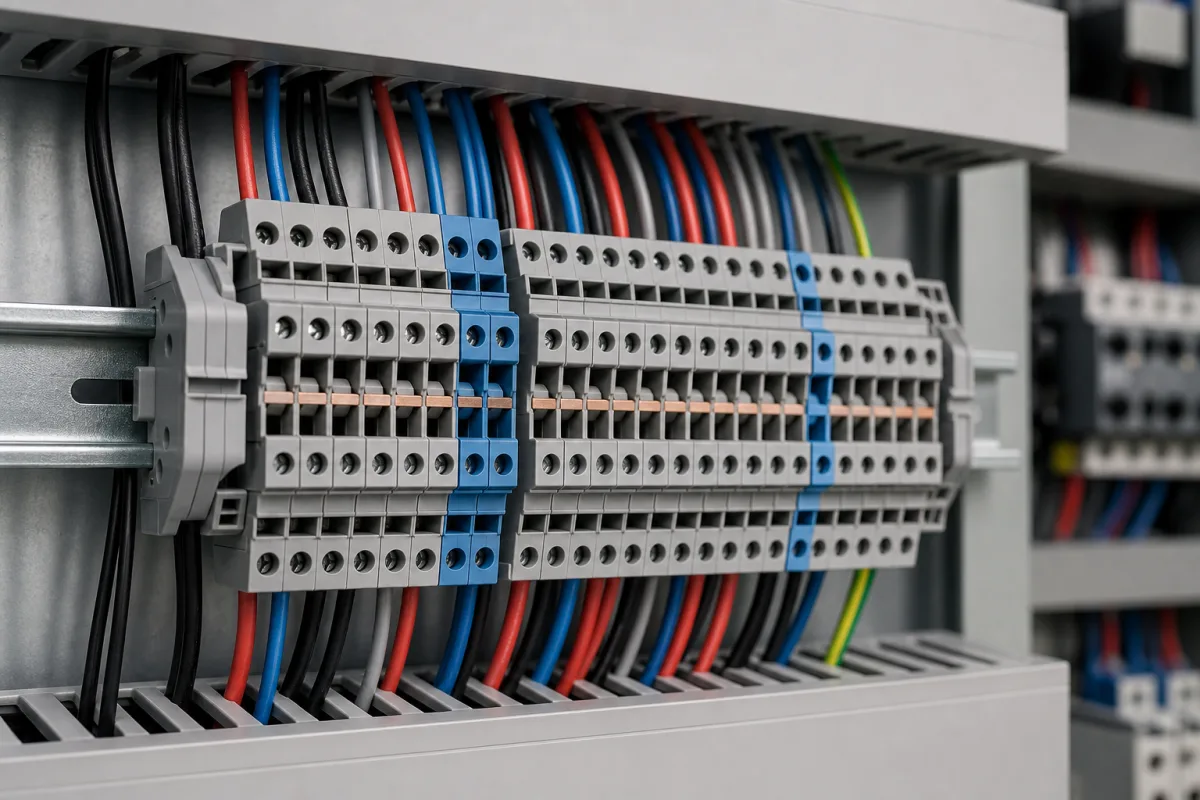
Electrical connectors used to secure and organize multiple wire connections within control panels
Product Specifications

Technical details and manufacturing context for Terminal Blocks

Definition
Terminal blocks are modular, insulated blocks that connect multiple electrical wires together within control and monitoring panels. They provide secure, organized termination points for field wiring to connect with panel components like PLCs, relays, and power supplies, facilitating maintenance, testing, and circuit modifications.
Working Principle
Terminal blocks function by providing metal clamping mechanisms (screw, spring, or push-in type) within insulated housings. Wires are inserted into designated terminals and secured by tightening screws or engaging spring clips, creating reliable electrical connections while maintaining isolation between circuits and preventing short circuits.
Common Materials
Polyamide (PA66), Copper alloy, Steel
Technical Parameters
  • Maximum wire cross-section capacity (mm²) Standard Spec
Components / BOM
  • Insulating Body
    Provides electrical insulation and mechanical support for terminals
    Material: Polyamide (PA66)
  • Terminal Clamp
    Secures wire conductor and ensures electrical contact
    Material: Copper alloy
  • Mounting Foot
    Allows secure attachment to DIN rail or panel surface
    Material: Steel
Engineering Reasoning
0-600 V AC/DC, -40°C to +105°C ambient temperature, 0.5-150 mm² wire cross-section
Contact resistance exceeding 5 mΩ at rated current, insulation breakdown at 4 kV/mm dielectric strength threshold, plastic deformation at 70 N·m torque
Design Rationale: Electromigration at current densities > 10⁶ A/cm² causing contact degradation, polymer chain scission in polyamide 6.6 at 130°C glass transition temperature, galvanic corrosion at dissimilar metal interfaces with >0.25 V electrochemical potential difference
Risk Mitigation (FMEA)
Trigger Thermal cycling between -40°C and +105°C at 10 cycles/hour
Mode: Contact spring relaxation reducing clamping force below 50 N
Strategy: Beryllium copper alloy springs with 690 MPa yield strength and 0.3% creep strain limit
Trigger Electrochemical migration at 85% relative humidity with 5 ppm chloride contamination
Mode: Insulation resistance dropping below 10¹² Ω at 500 V DC
Strategy: Polyamide 6.6 housing with 2.5% moisture absorption rate and 101⁵ Ω·cm volume resistivity

Industry Taxonomies & Aliases

Commonly used trade names and technical identifiers for Terminal Blocks.

Applied To / Applications

This component is essential for the following industrial systems and equipment:

Industrial Ecosystem & Supply Chain DNA

Complementary Systems
Downstream Applications
Specialized Tooling

Application Fit & Sizing Matrix

Operational Limits
current: Up to 300A (depending on size and material)
voltage: Up to 600V AC/DC (UL/CSA rated)
temperature: -40°C to +105°C (typical for thermoplastic materials)
wire size range: 22 AWG to 750 kcmil
Media Compatibility
✓ Copper conductors ✓ Aluminum conductors (with appropriate terminals) ✓ PVC-insulated wires
Unsuitable: High-vibration environments without vibration-resistant designs
Sizing Data Required
  • Maximum current rating required (A)
  • Wire gauge/size (AWG or mm²)
  • Number of poles/connections needed

Reliability & Engineering Risk Analysis

Failure Mode & Root Cause
Loose connections
Cause: Vibration-induced screw back-off, thermal cycling causing expansion/contraction, improper torque during installation
Corrosion and oxidation
Cause: Exposure to moisture, corrosive atmospheres, incompatible materials causing galvanic corrosion, lack of protective coatings
Maintenance Indicators
  • Visible discoloration, melting, or charring around terminal connections indicating overheating
  • Audible crackling, buzzing, or intermittent arcing sounds during operation
Engineering Tips
  • Use calibrated torque tools during installation and retorque connections during scheduled maintenance to prevent loosening from vibration
  • Apply appropriate anti-oxidation compounds (like NO-OX-ID) to copper connections and ensure proper environmental sealing in corrosive atmospheres

Compliance & Manufacturing Standards

Reference Standards
IEC 60947-7-1: Low-voltage switchgear and controlgear - Terminal blocks for copper conductors UL 1059: Standard for Terminal Blocks DIN EN 60947-7-1: Terminal blocks for copper conductors
Manufacturing Precision
  • Bore diameter: +/-0.05 mm
  • Flatness of mounting surface: 0.1 mm
Quality Inspection
  • Dielectric strength test (high-potential test)
  • Contact resistance measurement

Factories Producing Terminal Blocks

Verified manufacturers with capability to produce this product in China

✓ 92% Supplier Capability Match Found

S Sourcing Manager from United States Feb 25, 2026
★★★★★
"Impressive build quality. Especially the technical reliability is very stable during long-term operation."
Technical Specifications Verified
P Procurement Specialist from United Arab Emirates Feb 22, 2026
★★★★☆
"As a professional in the Electrical Equipment Manufacturing sector, I confirm this Terminal Blocks meets all ISO standards. (Delivery took slightly longer than expected, but technical support was excellent.)"
Technical Specifications Verified
T Technical Director from Australia Feb 19, 2026
★★★★★
"Standard OEM quality for Electrical Equipment Manufacturing applications. The Terminal Blocks arrived with full certification."
Technical Specifications Verified
Verification Protocol

“Feedback is collected from verified sourcing managers during RFQ (Request for Quote) and factory evaluation processes on CNFX. These reports represent historical performance data and technical audit summaries from our B2B manufacturing network.”

12 sourcing managers are analyzing this specification now. Last inquiry for Terminal Blocks from India (1h ago).

Supply Chain Compatible Machinery & Devices

Circuit Breaker Trip Unit

Protective control module for electrical circuit breakers

Explore Specs →
Circuit Breaker Arc Chute

Electrical component that extinguishes arcs in circuit breakers

Explore Specs →
Medium Voltage Switchgear Assembly Line

Automated production system for assembling medium voltage electrical switchgear.

Explore Specs →
Motor Terminal Block

Electrical connection interface for motor windings

Explore Specs →

Frequently Asked Questions

What are the key advantages of using PA66 polyamide in terminal blocks?

PA66 polyamide provides excellent electrical insulation, high temperature resistance (typically up to 105°C), flame retardancy (UL94 V-0 rated), and superior mechanical strength for long-term reliability in industrial environments.

How do terminal blocks improve safety in electrical control panels?

Terminal blocks isolate and secure wire connections, prevent accidental contact with live parts, provide strain relief, and enable organized wiring that reduces short circuit risks and simplifies maintenance in electrical equipment.

What factors should be considered when selecting terminal blocks for industrial applications?

Consider current rating (typically 10-300A), voltage rating, wire size compatibility, temperature range, material certifications (UL, CSA, VDE), mounting type (DIN rail, panel mount), and environmental conditions like humidity and vibration resistance.

Can I contact factories directly on CNFX?

CNFX is an open directory, not a transaction platform. Each factory profile provides direct contact information and production details to help you initiate direct inquiries with Chinese suppliers.

Get Quote for Terminal Blocks

Request technical pricing, lead times, or customized specifications for Terminal Blocks directly from verified manufacturing units.

Your business information is encrypted and only shared with verified Terminal Blocks suppliers.

Thank you! Your message has been sent. We'll respond within 1–3 business days.

Need to Manufacture Terminal Blocks?

Connect with verified factories specializing in this product category

Add Your Factory Contact Us
Previous Product
Terminal Block Assembly
Next Product
Terminal Blocks & Wiring