RF-shielded access door: knife-edge and finger-stock doors that keep a shielded room at 100 to 120 dB, and the low-frequency magnetic figures where they fall to 20–70 dB
The hinged or sliding door that closes the shield of an EMC chamber or Faraday room · knife edge into finger stock, single against double knife edge in dB by frequency, and the finger strips that wear
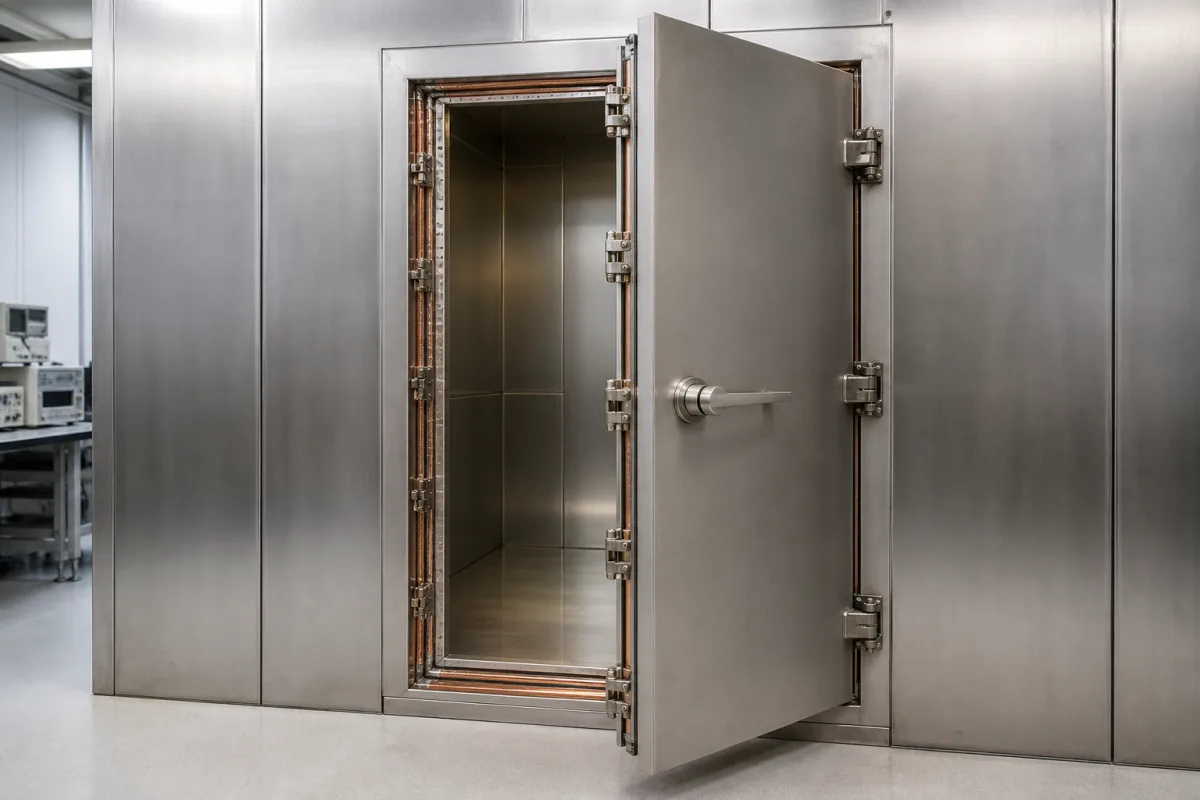
A shielded room is only as tight as its weakest seam, and the door is the seam that is opened every day. An RF-shielded access door closes the opening with a steel-clad leaf whose edge is driven into a continuous row of spring contacts on the frame, so that the leaf and the wall shield are bonded all round. Buyers compare doors by their shielding attenuation at each field type and frequency, by how the seal is made and latched, by size and drive, and by how the contact fingers are maintained, because worn or soiled fingers lower the attenuation of the whole room. The picture shows a hinged door of this kind: a brushed stainless-steel leaf with a lever handle and three heavy hinges, open on a frame lined with copper-coloured finger strips, set in a panel-built shielded room.
Hinged and sliding doors for RF-shielded rooms, EMC and anechoic chambers and Faraday cages: door leaf and frame, knife-edge and finger-stock (fingerstrip) contact systems, latching and drives, sizes, and the shielding attenuation and maintenance of the seal. Honeycomb waveguide air vents are covered on the Waveguide ventilation panel page; demountable panel-built shielded rooms as a whole on the Modular shielded enclosure page; cable bulkhead panels on the Interface panel for shielded rooms page; complete EMC test chambers on the EMI shielded enclosures and EMC test chambers page. MRI room doors with acoustic or magnetic requirements beyond RF shielding are outside this page.
CNFX editorial research · Sources checked October 13, 2026 · 5 sources
Single against double knife edge: 55 or 70 dB at 10 kHz magnetic, 110 or 120 dB for plane waves
Door datasheets give attenuation separately for magnetic fields, electric fields, plane waves and microwaves. In both tables below the lowest figures are the low-frequency magnetic ones, and the 10 kHz magnetic row shows the largest gap between the two doors.
Both datasheets quote performance when tested to MIL-STD-285, NSA 65-6/NSA 94-106, IEEE 299 (ITSG-02) or EN 50147-1. [1][2] Their summary paragraphs do not match their tables: the SKE text says 100 dB up to 10 GHz while its table gives 100 dB from 10 to 18 GHz, and the DKE text says 130 dB up to 10 GHz, 100 dB to 40 GHz and 90 dB to 100 GHz while its table gives 120 dB for plane waves to 10 GHz. [1][2] An order should fix which figures are guaranteed and at which test points.
Holland Shielding states that the reduction a fingerstrip swing door achieves depends on frequency, construction, contact condition, installation and measurement method, and that frames, contacts, locks, walls and surrounding interfaces all influence the shielding of the door as installed. [3]
Editorial calculation: the 15 dB gap between the SKE and DKE at 10 kHz magnetic (70 − 55) is a factor of about 5.6 in field strength (10^(15/20)); the 10 dB gap for plane waves (120 − 110) is a factor of about 3.2. [1][2]
State the attenuation needed for each field type at your lowest and highest test frequencies, the test standard, and whether the figure is for the door alone or the finished room.
02
Knife edge into finger stock: two rows or four, 0.13–0.18 mm beryllium copper, 25 % compression
The seal is made by a metal knife edge on the leaf that is pulled into a recessed channel of spring fingers on the frame. The number of edges and finger rows, and how hard the fingers are compressed, set its performance and its closing effort.
On ETS-Lindgren's SKE door a bronze knife-edge extrusion on the leaf seats into a Recessed Contact Mechanism lined with two rows of replaceable beryllium-copper finger stock; turning the lever handle drives a cam-roller latch that pulls the knife edge into its final position, with two-point latching. The leaf is laminated both sides with 24-gauge steel and hangs on three machined aluminium hinges with adjustable thrust bushings. [1] The DKE door has dual knife edges mating with four rows of finger stock, three-point cam latching driven by a gear-driven welded latch bar, and at least three hinges each with six thrust bearings; it comes in widths of 0.91 to 1.22 m and a height of 2.13 m, single or double leaf. [2]
Holland Shielding's 2800 series door fingers are beryllium copper, 0.18 mm thick on the 2801 profiles and 0.13 mm on the 2802 and 2803 profiles, with a tinned spring-steel 2805 profile; the 2801-03 needs 24 kg per metre of strip at 25 % compression and 46 kg/m at 50 %. [4] Uvox recommends 25 % compression for maximum contact and shielding with its beryllium-copper fingerstrip, and gives 63 dB at 10 kHz magnetic, 81 dB at 100 kHz, 130 dB at 100 MHz electric and 88 dB at 1 GHz plane wave, measured on its FS-018-127-SA-T strip. [5]
Editorial calculation: a single row of the 2801-03 strip round an example 1,200 × 2,100 mm leaf (6.6 m of perimeter, a Holland standard width and height) needs about 158 kgf, about 1.55 kN, to reach 25 % compression (6.6 × 24); a cam or lever latch supplies that force. [4][3]
Ask for the finger material, thickness and finish, the number of rows, the designed compression, how fingers are replaced, and the latch force at the handle.
03
Swing, sliding and modified doors, and the sizes Holland lists
Door type follows from opening size, traffic and how much shielding the room needs.
Door type
What the source states
Fingerstrip swing door
Single or double fingerstrip configurations chosen by required shielding and construction; used in prefabricated Faraday cages and Mu-copper systems [3]
Shielded sliding door
For larger openings or automated operation; opening sequence unlatches the contact system, moves the leaf outward, then slides it sideways; electrical, pneumatic or manual drive; repeated cycling helps clean the contact surfaces [3]
Modified wooden door
Conductive gaskets on top and sides and a conductive brush or threshold at the bottom, where a lower shielding level is acceptable (hospitals, EEG and EMG rooms) [3]
Standard sizes (Holland)
Single 800 or 1,200 mm wide; double 1,500 or 2,000 mm wide; heights 2,000, 2,100 or 2,500 mm [3]
Options on knife-edge doors
Semi-automatic electro-latch with assisted closing and emergency release handles; interlocks, panic release, contacts for power cut-off or fire closure; equipment ramp [1]
Give the clear opening, the traffic (people, carts, vehicles), the drive and interlock requirements, and the threshold or ramp needed.
04
Data for an RF-shielded door enquiry
Paste it into your enquiry below or into an email to a maker, then replace every bracket.
Room: [modular/welded; chamber type; wall construction]
Door type: [swing single/double; sliding; drive]
Clear opening: [W × H mm]
Attenuation required: [dB per field type and frequency; test standard]
Seal: [single/double knife edge; finger rows; finger material]
Latching: [manual cam; electro-latch; emergency release]
Interlocks and safety: [power cut-off; fire closure; panic release]
Threshold, ramp and absorber facing
Maintenance: [finger replacement; cleaning]
Explore company information and manufacturing capabilities, then discuss the scope of your project with a relevant supplier.
Share this page
Compiled and source-reviewed by the CNFX editorial team.
Each manufacturer above links to the page on that company's own website where the product is listed, with the date we checked it. How we source and review
· Page last updated 13 October 2026
Buyer questions
How much shielding does an RF door give?
ETS-Lindgren's single knife-edge door is rated 110 dB for plane waves from 30 MHz to 1 GHz but 55 dB for magnetic fields at 10 kHz; its double knife-edge door 120 dB and 70 dB. [1][2]
What is the seal made of?
A bronze knife edge on the leaf presses into rows of beryllium-copper finger stock in the frame: two rows on ETS-Lindgren's SKE door, four on the DKE. [1][2]
How hard are the finger strips compressed?
Uvox recommends 25 % compression; Holland Shielding's 2801-03 strip needs 24 kg/m at 25 % and 46 kg/m at 50 %. [5][4]
What sizes are standard?
Holland lists single doors 800 or 1,200 mm wide, double doors 1,500 or 2,000 mm, and heights of 2,000, 2,100 or 2,500 mm; ETS-Lindgren's DKE comes 0.91 to 1.22 m wide and 2.13 m high. [3][2]
Sources and what still needs a direct check
Sources checked 2026-10-13. Five documents from three publishers: ETS-Lindgren's single and double knife-edge door datasheets, Holland Shielding Systems' door selection page and 2800 door-finger datasheet, and Uvox's beryllium-copper fingerstrip datasheet.