Editorial Technical Reference

Signal Processing IC

This page explains how Signal Processing IC is classified within Computer, Electronic and Optical Product Manufacturing. Technical values and manufacturer relationships are research references; confirm the current specification and supplier evidence for each order.

Technical Definition & Core Assembly

Integrated circuit designed to process electrical signals within control systems
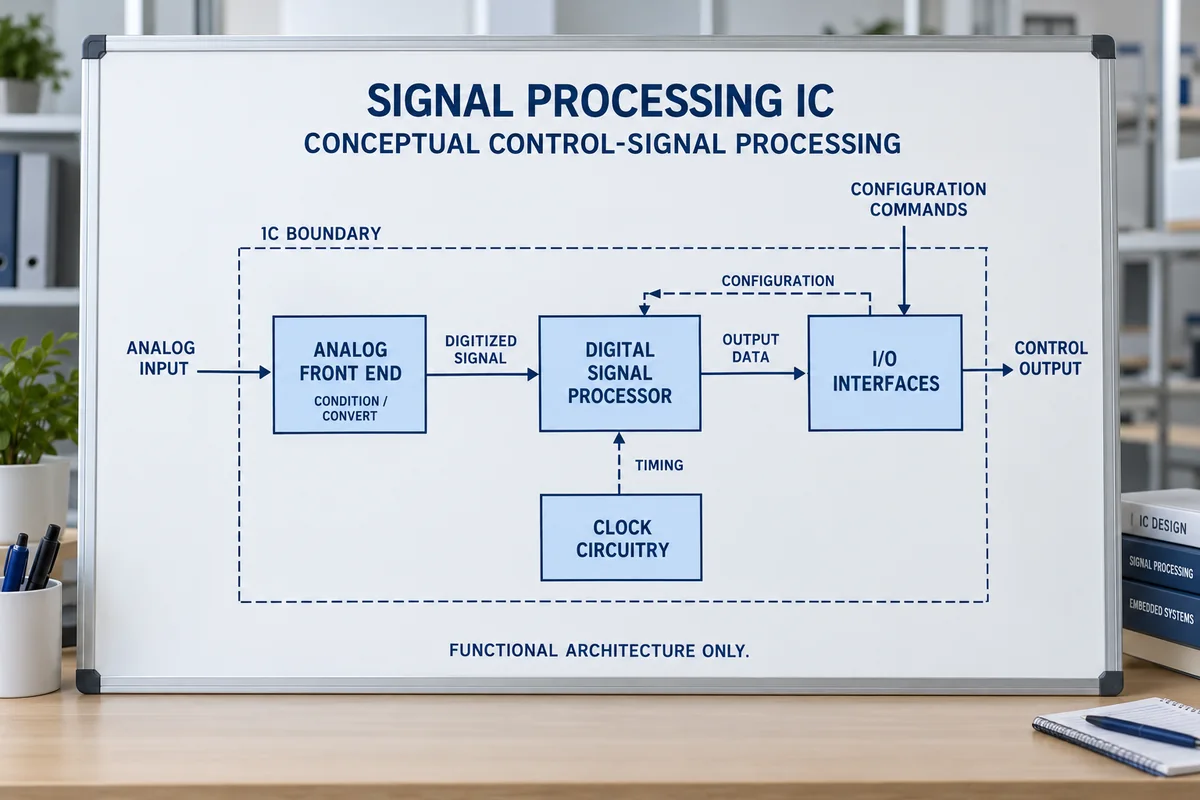
Signal Processing IC in a manufacturing environment
Representative product image. Confirm appearance and specifications with the manufacturer.

Product Specifications

Technical details and manufacturing context for Signal Processing IC

Definition
A specialized integrated circuit that performs signal conditioning, filtering, amplification, conversion, or modulation/demodulation functions as part of a Control Signal Generator system. It processes input signals to generate precise control outputs for various industrial applications. The IC operates within a supply voltage range of 3.3–5.0 V and dissipates 0.5–2.5 W under full signal processing load. It is designed for an operating temperature range of -40 to 85 °C (IEC 60747) and a non-condensing humidity range of 5–95% RH (IEC 60068-2-78). The input frequency range spans 0.1–100 MHz, with a signal-to-noise ratio of 60–90 dB and total harmonic distortion of 0.01–0.1%. Input impedance is 10–100 kΩ, and output drive capability is 5–20 mA. The device is available in surface-mount packages from SOIC-8 to QFN-32 (JEDEC MS-012). ESD tolerance is 2–8 kV (human body model, IEC 61000-4-2), and weight ranges from 0.1 to 1.5 g depending on package. Typical materials include silicon wafer, copper interconnects, dielectric materials, and package substrate. This component is intended for use in industrial control systems where precise signal processing is required. It is essential to verify model-specific parameters and standards with the legal manufacturer or supplier before procurement or integration.
Working Principle
The IC receives electrical input signals and processes them through internal analog/digital circuits, including amplifiers, filters, ADCs, DACs, or DSP cores. It outputs conditioned signals according to programmed algorithms or fixed circuitry. Functions may include noise reduction, signal shaping, frequency adjustment, or protocol conversion. The operating principle relies on the internal circuitry to modify the input signal to meet the requirements of the downstream control system.
Common Materials
Silicon wafer, Copper interconnects, Dielectric materials, Package substrate
Technical Parameters
ParameterTypical rangeNotes & selection driver
Supply Voltage3.3–5.0 VOperating range for logic and analog circuits
Power Dissipation0.5–2.5 WMaximum at full signal processing load
Operating Temperature-40–85 °CJunction temperature rangeIEC 60747
Input Frequency Range0.1–100 MHzSignal bandwidth for processing
Signal-to-Noise Ratio60–90 dBHigher is better for clean output
Total Harmonic Distortion0.01–0.1 %Lower is better for fidelity
Input Impedance10–100 kΩHigh impedance to avoid loading
Output Drive Capability5–20 mAMaximum output current
Package TypeSOIC-8–QFN-32Surface mount optionsJEDEC MS-012
Operating Humidity5–95 % RHNon-condensingIEC 60068-2-78
ESD Tolerance2–8 kVHuman body modelIEC 61000-4-2
Weight0.1–1.5 gDepends on package

Ranges are indicative industry figures for RFQ preparation, not a supplier commitment. Confirm every value and standard with the legal manufacturer before ordering.

Components / BOM
  • Analog Front End
    Conditions and prepares analog input signals for processing
    Material: Silicon with analog circuits
  • Digital Signal Processor
    Performs mathematical operations on digitized signals
    Material: Silicon with digital logic
  • Input/Output Interfaces Part
    Provides electrical connections to external components
    Material: Copper bonding pads
  • Clock Circuitry Part
    Generates timing signals for synchronous operations
    Material: Silicon with oscillator circuits

Application & selection

Application Fit & Sizing Matrix

Operational Limits
voltage: 1.8V to 3.6V supply, ±15V analog input range
temperature: -40°C to +125°C (operating), -65°C to +150°C (storage)
signal bandwidth: DC to 100MHz
power dissipation: Max 500mW at full load
Media Compatibility
✓ Industrial control systems (PLC/DCS) ✓ Automotive sensor networks ✓ Medical diagnostic equipment
Unsuitable: High-voltage arc environments (>1kV transient spikes)
Sizing Data Required
  • Required signal bandwidth (Hz)
  • Input signal voltage range (V)
  • Number of simultaneous channels to process

Risk, maintenance & compliance

Reliability & Engineering Risk Analysis

Failure Mode & Root Cause
Thermal overstress
Cause: Excessive ambient temperature or inadequate cooling leading to semiconductor junction overheating and material degradation.
Electrostatic discharge (ESD) damage
Cause: Improper handling or insufficient ESD protection during installation/maintenance causing internal gate oxide breakdown or latch-up.
Maintenance Indicators
  • Unusual thermal patterns detected via infrared thermography (hot spots or cold spots deviating from normal operating temperature profile)
  • Intermittent signal distortion or complete signal loss in connected systems despite verified external connections
Engineering Tips
  • Implement active thermal management with precision temperature monitoring and controlled cooling to maintain junction temperatures within specified operating ranges.
  • Establish strict ESD protocols including grounded workstations, proper IC handling procedures, and verification of protective circuitry during all maintenance interventions.

Indicative industry ranges for design and RFQ preparation. Confirm the exact figures and applicable standard with the manufacturer before specifying.

Compliance & Manufacturing Standards

Applicable Standards
IEC 60747-14-1 (Semiconductor devices - Integrated circuits - Part 14-1: Semiconductor sensors - Pressure sensors)

Quoted from the published standard.

Manufacturing Precision
  • Operating Temperature Range: -40°C to +85°C (+/-2°C)
  • Signal-to-Noise Ratio: ≥70 dB (typical, +/-3 dB across production lot)
Quality Inspection
  • Automated Optical Inspection (AOI) for solder joints and component placement
  • Electrical Parametric Testing (EPT) for functional verification and performance metrics
Technical documentation
Request current drawings, revision history, and a signed specification sheet.
Manufacturing capability
Verify equipment lists, process limits, capacity, and representative production evidence.
Inspection readiness
Confirm test methods, calibrated equipment, sampling plans, and traceable reports.
Supplier transparency
Check the legal entity, factory address, ownership, certifications, and direct contacts.

Compare the published product scope and source details, then include your specifications and quantity in an enquiry.

Manufacturers of Signal Processing IC

Manufacturer profiles associated with Signal Processing IC.

Sourcing Signal Processing IC from China?
Tell us your specification and target quantity — we will match it against manufacturer records and come back with the factories that fit.
Request manufacturers We manufacture this

Explore company information and manufacturing capabilities, then discuss the scope of your project with a relevant supplier.

Buyer enquiry

Request manufacturing insight for Signal Processing IC

Ask for use case, specification boundaries, supplier type, and RFQ preparation information for this product.

Where it goes
Straight to the CNFX editorial desk, and to the manufacturer if this product is linked to a claimed profile. Nothing is broadcast to a supplier list.
Your details stay here
We do not sell or rent enquiry data, and we do not add you to a mailing list. Used only to answer this request.
No commission, no middleman
CNFX is a directory. We take no cut of any order and never negotiate on a supplier's behalf.
What to include
Share your product specifications, quantity, destination and target delivery date.

Your business information is used only to process this request.

Thank you! Your message has been sent. We'll respond within 1–3 business days.
Sorry, we couldn't send your message. Please try again, or email us at [email protected].

Frequently Asked Questions

What is the typical supply voltage range for this signal processing IC?

The supply voltage range is 3.3–5.0 V, as listed in the directory. Always confirm the exact requirement for your specific model from the manufacturer's datasheet.

What is the operating temperature range?

The operating temperature range is -40 to 85 °C, referenced to IEC 60747. Verify that your application environment stays within this range and check the specific model's rating.

What package types are available?

Surface-mount packages from SOIC-8 to QFN-32 are listed, per JEDEC MS-012. The actual package options depend on the specific product variant; consult the supplier.

What is the ESD tolerance?

The ESD tolerance is 2–8 kV (human body model) per IEC 61000-4-2. This is a reference range; the exact rating for your chosen model must be confirmed with the manufacturer.

Related equipment

Applied To / Applications

This component is essential for the following industrial systems and equipment:

Industrial Ecosystem & Supply Chain Structure

Complementary Systems

Data Basis

Editorial classification, named public sources where available, and source-reviewed manufacturer records.

Preliminary Technical Classification
This page supports structured research, RFQ preparation, and supplier evaluation. It does not replace buyer-led supplier qualification, standards review, or technical approval.

Need to Manufacture Signal Processing IC?

Compare manufacturer profiles with relevant product and process capability.

Previous Product
XY Positioning Stage
Last Product
Get QuotesChat