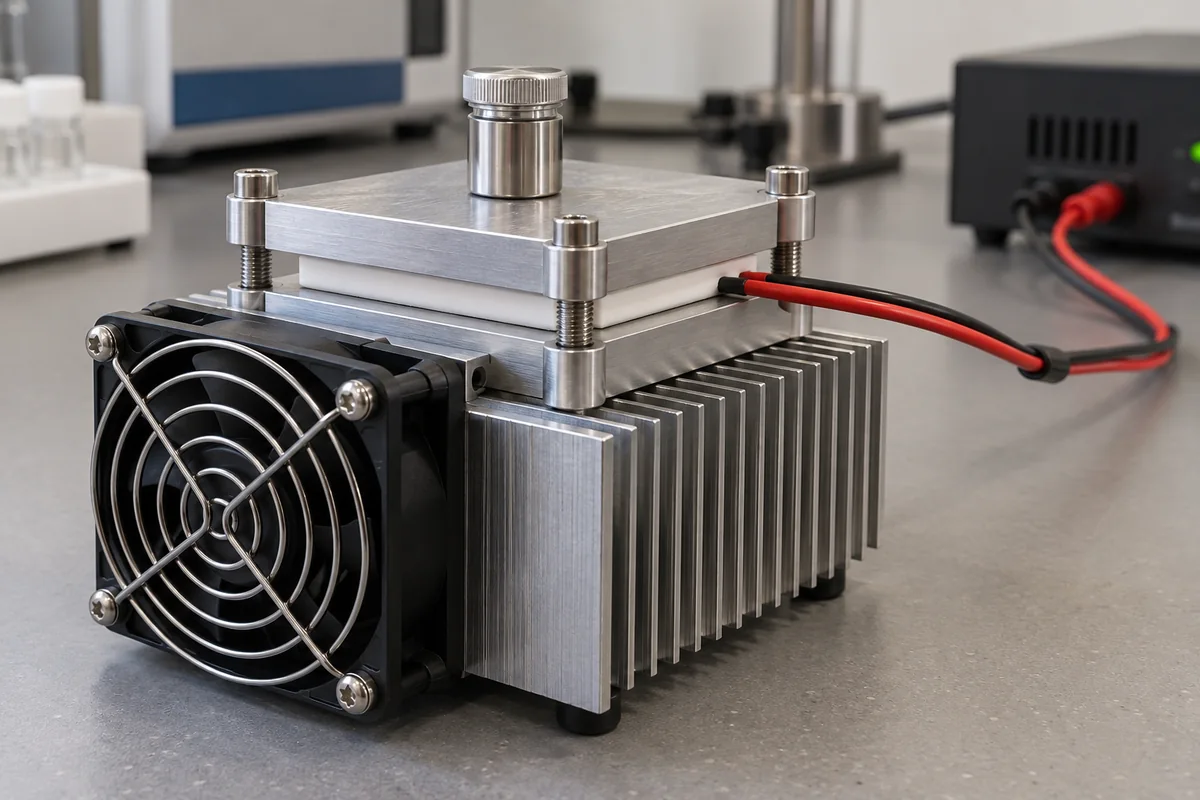
Thermoelectric cold plate cooler: a Peltier assembly that cools a plate by contact and rejects heat through a fan-cooled heat sink
Thermoelectric cold plate coolers (plate-to-air assemblies) · heat removed at the plate temperature needed, heat the fan-cooled sink must reject, cool-only cascades versus heat-and-cool units, supply current and thermostat
When an object has to be held below room temperature by contact, a sample block, a sensor, a vial rack, a detector, the cooler can be bought as one assembly: a thermoelectric module clamped between an aluminium cold plate, on which the object sits, and a finned heat sink with a fan that throws the heat into the room. The catalogue figure for such an assembly is the heat it moves with no temperature difference across it, which is never the operating point. Specifying one means reading its performance at your plate and ambient temperatures, sizing the airflow for the heat it rejects, and deciding whether it must also heat.
Thermoelectric cold plate coolers: plate-to-air (direct-to-air) Peltier assemblies with a cold plate on the cooled side and a fan-cooled heat sink on the hot side, single-stage or cascaded, supplied ready to mount with or without a temperature controller. Bare thermoelectric modules, their sizing and mounting are covered on the Thermoelectric (Peltier) module page. Air-to-air and liquid-cooled thermoelectric assemblies, electrical-cabinet Peltier coolers and thermoelectric generators are outside this page.
CNFX editorial research · Sources checked October 12, 2026 · 4 sources
Heat removed at your plate temperature, not the ΔT = 0 rating
TE Technology rates its smallest standard cold plate cooler, the CP-031, at 31 W at a 0 °C temperature difference. [2] Its data sheet's performance graph then shows how fast that falls: to hold the cold plate at 10 °C in a 35 °C ambient, the cooler can remove about 15 W. [1]
Editorial calculation: the CP-031 keeps about 15 ÷ 31 ≈ 48 % of its zero-difference rating at a 25 °C difference, and the DA-034 keeps 23.38 ÷ 34 ≈ 69 % at a 15 °C difference. [1][2][3] The heat load to count includes heat leaking into the plate from the room, not only what the object on it generates; TE Technology's example says the cooler holds the temperature only if the cooling capacity exceeds the heat gain from the ambient plus anything else generating heat. [1]
Tark says its cascade DAC-035 uses custom multistage thermoelectric modules to reach a high temperature differential, aims it at CMOS sensors and imaging, and states that it can produce up to 40 % more cooling capacity at cold temperatures than standard products of similar form factor. [4] Tark gives a ±10 % performance tolerance for both assemblies. [3][4]
23.38 W maximum, or 7.56 W at optimum COP, with 35 °C ambient and 20 °C control temperature (calculator defaults) [3]
Tark DAC-035-12-02, multistage cascade, 12 VDC
Not stated on the page reviewed
30.02 W maximum, or 6.56 W at optimum COP, at the same calculator defaults [4]
Give the supplier the plate temperature, the hottest ambient air at the fan inlet and the total heat load, and ask for the capacity read off the assembly's own curve at that point.
02
Heat the fan-cooled sink must reject, supply current and over-temperature limits
Everything pumped off the plate plus all the electrical input leaves through the hot-side fins. Tark's calculator shows the DA-034 at maximum cooling drawing 40.3 W to pump 23.38 W, dissipating 63.7 W, a coefficient of performance of 0.58; at its optimum COP of 1.28 it pumps 7.56 W for 5.9 W and dissipates 13.45 W. [3]
Editorial calculation: 23.38 W + 40.3 W = 63.68 W, matching the 63.7 W Tark lists, and for the cascade DAC-035 at maximum cooling 30.02 W + 54.6 W = 84.62 W against 84.6 W listed, a COP of 0.55. [3][4] The CP-031's typical 4.3 A at 12 V is about 52 W into the module before the fan. [1]
TE Technology bases its CP-031 performance on unrestricted airflow to the fans and from the outlets, and Tark notes its units are for indoor use only and that heat sinks and fans should occasionally be cleaned of debris with compressed air. [1][4] Editorial note: blocked inlets or a hot cabinet raise the hot-side temperature, which moves the whole performance line down.
Data
TE Technology CP-031
Tark DA-034-24-02
Tark DAC-035-12-02
Supply
12 VDC; TE 4.3 A typical, 5.4 A maximum; fan 0.18 A [1]
24 VDC nominal, 27 VDC maximum; 1.9 A running, 2.6 A start-up; 46 W [3]
12 VDC nominal, 14 VDC maximum; 4.8 A running, 5.5 A start-up; 58 W [4]
Hot-side limit
Do not operate above 70 °C heat sink or cold plate [1]
Cool-only cascade or heat-and-cool unit, and wiring to a controller
Tark states plainly that the cascade DAC-035 cannot be used in heating mode; its single-stage DA-034 calculator offers both cooling and heating. [4][3]
TE Technology's CP-031 heats and cools when driven by a heat-and-cool (bipolar) controller, to a 70 °C maximum plate temperature, with a high-temperature version for 100 °C. Its heating graph example holds the plate at 30 °C in a 0 °C ambient with up to about 68 W added to the plate. [1][2]
The CP-031 ships with four jumpers in its terminal block for continuous full-power operation; for use with a temperature controller, the jumpers between positions 2–3 and 4–5 are removed, the power supply is wired to positions 6 and 1 and the controller to positions 4 and 3, and the terminal screws are tightened to 1.0 N·m. Threaded holes in the cold plate take a temperature sensor and interface plates: four M4 × 0.7 tapped 9.7 mm deep, and an M3 × 0.5 sensor hole. [1]
04
Send the plate temperature, the ambient and the heat load
Paste it into your enquiry below or into an email to a maker, then replace every bracket.
Plate: [temperature to hold; object and contact area; mounting holes]
Ambient: [air temperature at the fan inlet; enclosure or open bench]
Heat load: [heat generated by the object; heat gained from the room]
Mode: [cooling only or heating and cooling; maximum plate temperature]
Power: [supply voltage; current available; controller]
Limits: [noise; weight; size; indoor or outdoor]
Explore company information and manufacturing capabilities, then discuss the scope of your project with a relevant supplier.
Share this page
Compiled and source-reviewed by the CNFX editorial team.
Each manufacturer above links to the page on that company's own website where the product is listed, with the date we checked it. How we source and review
· Page last updated 13 October 2026
Buyer questions
Why does my cold plate cooler remove less heat than its rating?
Ratings are at zero temperature difference. TE Technology's CP-031 is rated 31 W but removes about 15 W with the plate at 10 °C in 35 °C air. [2][1]
How much heat does the fan-cooled side have to reject?
The heat pumped plus the electrical input: Tark's calculator shows the DA-034 pumping 23.38 W with 40.3 W input and dissipating 63.7 W. [3]
Can a thermoelectric cold plate also heat?
Some can. TE Technology's CP-031 heats to 70 °C with a bipolar controller; Tark's cascade DAC-035 cannot be used in heating mode. [1][4]
What does a cascade cold plate cooler offer?
Tark says its multistage DAC-035 is built for a high temperature differential and up to 40 % more cooling capacity at cold temperatures than similar standard products. [4]
Sources and what still needs a direct check
Sources checked 2026-10-12. TE Technology and Tark Thermal Solutions (data sheets hosted on lairdthermal.com) data are for their own assemblies; the Tark values come from the online calculator at its default conditions.