Industry-Verified Manufacturing Data (2026)

Thermal Regulation System

Based on aggregated insights from multiple verified factory profiles within the CNFX directory, the standard Thermal Regulation System used in the Computer, Electronic and Optical Product Manufacturing sector typically supports operational capacities ranging from standard industrial configurations to heavy-duty production requirements.

Technical Definition & Core Assembly

A canonical Thermal Regulation System is characterized by the integration of Thermoelectric Cooler and Temperature Sensor. In industrial production environments, manufacturers listed on CNFX commonly emphasize Thermoelectric modules construction to support stable, high-cycle operation across diverse manufacturing scenarios.

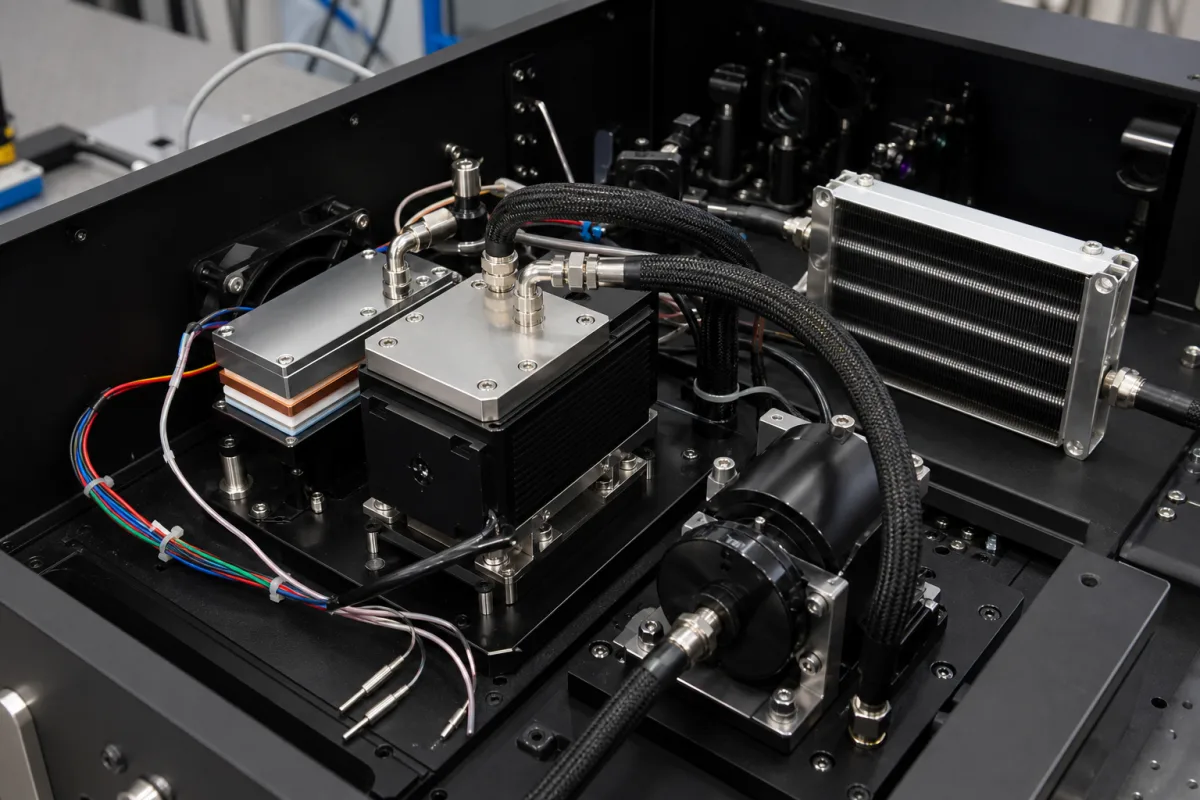
A subsystem within an optical spectrometer that maintains precise temperature control of critical components to ensure measurement accuracy and stability.
Product Specifications

Technical details and manufacturing context for Thermal Regulation System

Definition
The Thermal Regulation System is an essential component of optical spectrometers that actively monitors and controls the temperature of sensitive optical elements, detectors, and sample chambers. It compensates for environmental temperature fluctuations and internal heat generation to maintain consistent optical properties, prevent thermal drift in measurements, and ensure reproducible analytical results across varying operating conditions.
Working Principle
The system typically employs thermoelectric coolers (Peltier devices), resistive heaters, or fluid-based heat exchangers controlled by precision temperature sensors and feedback loops. A microcontroller or PID controller adjusts heating/cooling output based on real-time temperature readings to maintain the target temperature within tight tolerances (±0.1°C to ±1°C).
Common Materials
Thermoelectric modules, Copper heat sinks, Temperature sensors (thermistors/RTDs), Thermal interface materials
Technical Parameters
  • Temperature stability range and control precision (°C) Per Request
Components / BOM
  • Thermoelectric Cooler
    Provides active cooling/heating through Peltier effect
    Material: Bismuth telluride semiconductors
  • Temperature Sensor
    Measures actual temperature for feedback control
    Material: Platinum (RTD) or semiconductor (thermistor)
  • Heat Sink
    Dissipates excess heat to environment
    Material: Aluminum or copper with fins
  • PID Controller
    Processes sensor data and adjusts thermal output
    Material: Electronic components on PCB
Engineering Reasoning
20.0-25.0°C ±0.1°C
Temperature deviation >±0.5°C sustained for >60 seconds
Design Rationale: Thermal expansion coefficient mismatch between optical components (e.g., fused silica α=0.55×10⁻⁶/K vs. aluminum α=23.1×10⁻⁶/K) causing wavelength drift >0.01 nm
Risk Mitigation (FMEA)
Trigger Peltier cooler thermal runaway due to insufficient heat sink capacity
Mode: Temperature overshoot to 30°C within 15 seconds
Strategy: Active PID control with feedforward compensation and redundant NTC thermistors
Trigger Thermal grease degradation at >80°C interface temperature
Mode: Thermal resistance increase from 0.2 to 2.0 K/W
Strategy: Phase-change thermal interface material with melting point at 45°C

Industry Taxonomies & Aliases

Commonly used trade names and technical identifiers for Thermal Regulation System.

Applied To / Applications

This component is essential for the following industrial systems and equipment:

Industrial Ecosystem & Supply Chain DNA

Complementary Systems
Downstream Applications
Specialized Tooling

Application Fit & Sizing Matrix

Operational Limits
pressure: 0-5 bar (system pressure), 0-2 bar (coolant circuit)
flow rate: 0.5-5 L/min (coolant)
temperature: -20°C to +80°C (operating), ±0.1°C stability
power consumption: 50-500 W (heating/cooling capacity)
Media Compatibility
✓ Deionized water coolant ✓ Dry nitrogen purge gas ✓ Clean laboratory air
Unsuitable: Corrosive chemical vapors or conductive particulate environments
Sizing Data Required
  • Heat load to be managed (W)
  • Required temperature stability (±°C)
  • Available cooling source capacity (W)

Reliability & Engineering Risk Analysis

Failure Mode & Root Cause
Fouling and scaling
Cause: Accumulation of mineral deposits, biological growth, or particulate matter on heat transfer surfaces due to poor water quality, inadequate filtration, or insufficient chemical treatment, reducing thermal efficiency and increasing pressure drop.
Corrosion and pitting
Cause: Electrochemical degradation of metal components (e.g., pipes, heat exchangers) caused by aggressive water chemistry (low pH, high chloride content), galvanic reactions between dissimilar metals, or inadequate corrosion inhibitors, leading to leaks and structural failure.
Maintenance Indicators
  • Abnormal temperature fluctuations or inability to maintain setpoint despite normal operation, indicating reduced heat transfer efficiency.
  • Unusual noises (e.g., gurgling, knocking) or visible leaks, vibrations, or corrosion on system components, suggesting flow restrictions or structural issues.
Engineering Tips
  • Implement a comprehensive water treatment program with regular chemical analysis and dosing to control scaling, corrosion, and biological growth, tailored to the specific water source and system materials.
  • Establish a predictive maintenance routine using non-destructive testing (e.g., ultrasonic thickness measurements, infrared thermography) and condition monitoring (e.g., pressure, temperature, flow rate trends) to detect early degradation before failures occur.

Compliance & Manufacturing Standards

Reference Standards
ISO 9001:2015 - Quality Management Systems ANSI/ASHRAE 15 - Safety Standard for Refrigeration Systems DIN EN 378 - Refrigerating systems and heat pumps
Manufacturing Precision
  • Temperature control accuracy: +/-0.5°C
  • Pressure vessel weld seam alignment: +/-1.5mm
Quality Inspection
  • Hydrostatic pressure test at 1.5x design pressure
  • Leak detection test using helium mass spectrometry

Factories Producing Thermal Regulation System

Verified manufacturers with capability to produce this product in China

✓ 95% Supplier Capability Match Found

T Technical Director from Brazil Feb 27, 2026
★★★★★
"Standard OEM quality for Computer, Electronic and Optical Product Manufacturing applications. The Thermal Regulation System arrived with full certification."
Technical Specifications Verified
P Project Engineer from Canada Feb 24, 2026
★★★★☆
"Great transparency on the Thermal Regulation System components. Essential for our Computer, Electronic and Optical Product Manufacturing supply chain. (Delivery took slightly longer than expected, but technical support was excellent.)"
Technical Specifications Verified
S Sourcing Manager from United States Feb 21, 2026
★★★★★
"The Thermal Regulation System we sourced perfectly fits our Computer, Electronic and Optical Product Manufacturing production line requirements."
Technical Specifications Verified
Verification Protocol

“Feedback is collected from verified sourcing managers during RFQ (Request for Quote) and factory evaluation processes on CNFX. These reports represent historical performance data and technical audit summaries from our B2B manufacturing network.”

13 sourcing managers are analyzing this specification now. Last inquiry for Thermal Regulation System from Germany (1h ago).

Supply Chain Compatible Machinery & Devices

Industrial Smart Camera Module

Embedded vision system for industrial automation and quality inspection.

Explore Specs →
Industrial Wireless Power Transfer Module

Wireless power transfer module for industrial equipment applications

Explore Specs →
Industrial Smart Sensor Module

Modular industrial sensor with embedded processing and wireless connectivity

Explore Specs →
Surface Mount Resistor

Passive electronic component for current limiting and voltage division in circuits

Explore Specs →

Frequently Asked Questions

How does this thermal regulation system improve spectrometer measurement accuracy?

The system maintains precise temperature control of critical optical components, minimizing thermal drift that can cause measurement errors. Stable temperatures ensure consistent refractive indices and detector responses for reliable spectroscopic data.

What components are included in the thermal regulation system?

The system includes thermoelectric coolers for active temperature control, copper heat sinks for efficient heat dissipation, high-precision temperature sensors (thermistors/RTDs), PID controllers for accurate regulation, and thermal interface materials for optimal heat transfer.

Can this system be integrated into existing optical spectrometer designs?

Yes, the modular design allows for integration into new or existing spectrometer configurations. The subsystem can be customized to fit specific component layouts and thermal requirements while maintaining compatibility with standard optical mounting interfaces.

Can I contact factories directly on CNFX?

CNFX is an open directory, not a transaction platform. Each factory profile provides direct contact information and production details to help you initiate direct inquiries with Chinese suppliers.

Get Quote for Thermal Regulation System

Request technical pricing, lead times, or customized specifications for Thermal Regulation System directly from verified manufacturing units.

Your business information is encrypted and only shared with verified Thermal Regulation System suppliers.

Thank you! Your message has been sent. We'll respond within 1–3 business days.

Need to Manufacture Thermal Regulation System?

Connect with verified factories specializing in this product category

Add Your Factory Contact Us
Previous Product
Thermal Paste Dispenser
Next Product
Thermoelectric Cooler