Industry-Verified Manufacturing Data (2026)

Vibration Sensor Interface

Based on aggregated insights from multiple verified factory profiles within the CNFX directory, the standard Vibration Sensor Interface used in the Computer, Electronic and Optical Product Manufacturing sector typically supports operational capacities ranging from standard industrial configurations to heavy-duty production requirements.

Technical Definition & Core Assembly

A canonical Vibration Sensor Interface is characterized by the integration of Signal Conditioning Circuit and Connector Port. In industrial production environments, manufacturers listed on CNFX commonly emphasize Printed Circuit Board (PCB) construction to support stable, high-cycle operation across diverse manufacturing scenarios.

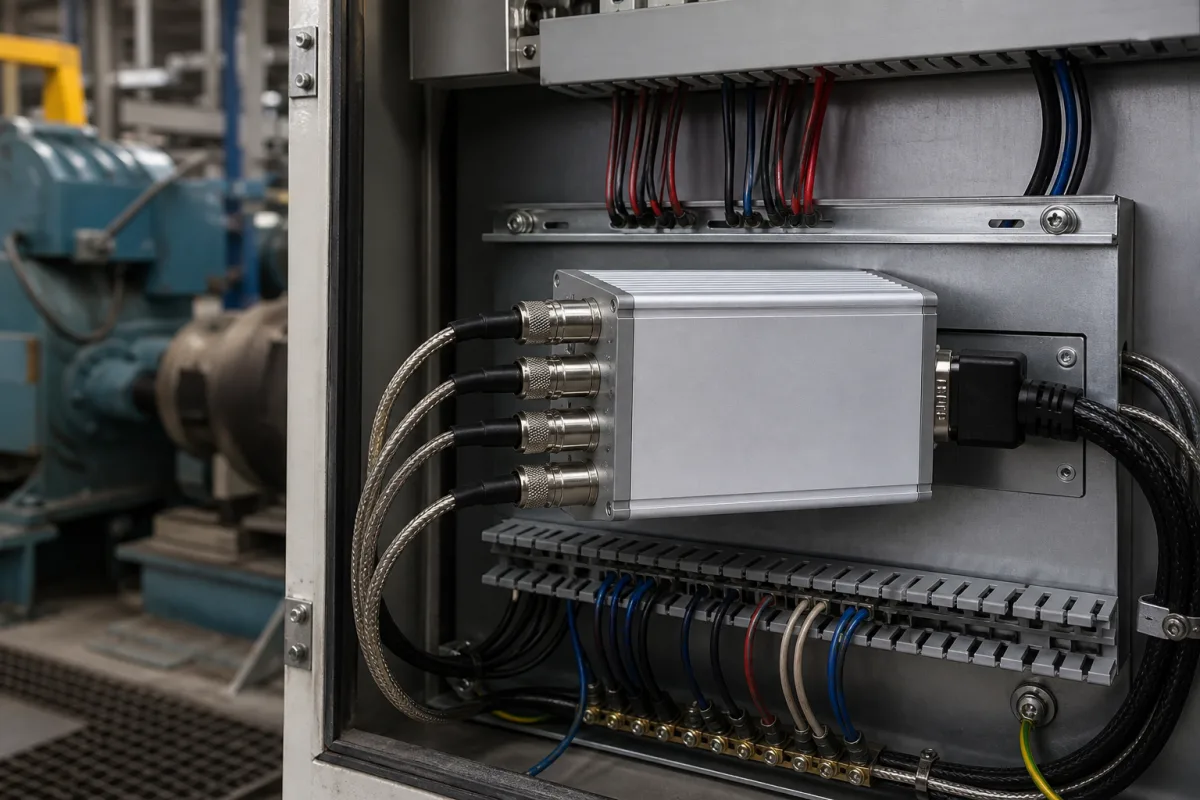
Electronic interface component that connects vibration sensors to control systems within an Electronic Assembly Module.
Product Specifications

Technical details and manufacturing context for Vibration Sensor Interface

Definition
A specialized electronic interface designed as part of an Electronic Assembly Module to facilitate communication between vibration sensors and the module's processing unit. It conditions sensor signals, provides appropriate electrical connections, and ensures compatibility between sensor outputs and the module's input requirements for monitoring mechanical vibrations in industrial equipment.
Working Principle
Receives analog or digital signals from vibration sensors (typically piezoelectric or MEMS-based), conditions these signals through amplification, filtering, and analog-to-digital conversion when necessary, and transmits processed data to the Electronic Assembly Module's controller for analysis and response.
Common Materials
Printed Circuit Board (PCB), Electronic components (ICs, resistors, capacitors), Connector housing
Technical Parameters
  • Frequency response range for vibration measurement (Hz) Customizable
Components / BOM
  • Signal Conditioning Circuit
    Amplifies and filters raw sensor signals
    Material: Electronic components on PCB
  • Connector Port
    Physical interface for sensor cable connection
    Material: Plastic housing with metal contacts
  • Microcontroller Interface
    Processes and transmits data to module controller
    Material: Integrated circuit on PCB
Engineering Reasoning
0.1-1000 Hz frequency, 0-10 VDC output, -40°C to 85°C ambient temperature
Input voltage exceeding 15 VDC causes permanent damage to signal conditioning circuitry
Design Rationale: Dielectric breakdown in operational amplifiers due to overvoltage exceeding semiconductor junction breakdown voltage of 12 V
Risk Mitigation (FMEA)
Trigger Electrostatic discharge (ESD) event exceeding 8 kV
Mode: Signal conditioning IC catastrophic failure with 0 VDC output
Strategy: TVS diode array (SMBJ5.0A) with 5 V clamping voltage on all sensor input lines
Trigger Thermal cycling between -40°C and 85°C at 10 cycles/hour
Mode: Solder joint fatigue causing intermittent signal loss
Strategy: SnAgCu (SAC305) lead-free solder with 0.5 mm pad-to-component ratio

Industry Taxonomies & Aliases

Commonly used trade names and technical identifiers for Vibration Sensor Interface.

Applied To / Applications

This component is essential for the following industrial systems and equipment:

Industrial Ecosystem & Supply Chain DNA

Complementary Systems
Downstream Applications
Specialized Tooling

Application Fit & Sizing Matrix

Operational Limits
pressure: 0 to 100 psi (non-pressurized environment)
other spec: Vibration frequency range: 5 Hz to 10 kHz, Input voltage: 24 VDC ±10%, IP rating: IP67
temperature: -40°C to +85°C
Media Compatibility
✓ Industrial machinery vibration monitoring ✓ Rotating equipment (pumps, motors, fans) ✓ Structural health monitoring in controlled environments
Unsuitable: Submerged or high-pressure washdown environments with direct fluid impingement
Sizing Data Required
  • Sensor output signal type (e.g., 4-20mA, 0-10V, IEPE)
  • Required measurement frequency range and resolution
  • Control system interface protocol (e.g., Modbus, Profibus, Ethernet/IP)

Reliability & Engineering Risk Analysis

Failure Mode & Root Cause
Sensor Drift
Cause: Thermal cycling and material fatigue causing calibration loss, or contamination from environmental ingress (moisture, dust) affecting internal components.
Signal Interference/Noise
Cause: Electromagnetic interference from nearby equipment, poor shielding, or ground loops in wiring, leading to inaccurate vibration readings.
Maintenance Indicators
  • Erratic or fluctuating vibration readings on the monitoring system despite stable machine operation.
  • Audible buzzing or humming from the sensor housing, or visible physical damage like cracks, corrosion, or loose mounting.
Engineering Tips
  • Ensure proper installation with correct mounting torque and alignment to avoid stress on the sensor, and use vibration-isolating mounts if needed.
  • Implement regular calibration checks and environmental protection (e.g., sealed enclosures, proper cable routing) to prevent contamination and interference.

Compliance & Manufacturing Standards

Reference Standards
ISO 10816-1: Mechanical vibration - Evaluation of machine vibration by measurements on non-rotating parts ANSI/ISA-51.1: Process Instrumentation Terminology DIN 45670-1: Vibration measurement - Evaluation of vibration effects on buildings
Manufacturing Precision
  • Mounting surface flatness: 0.05 mm
  • Frequency response linearity: +/- 2% across specified range
Quality Inspection
  • Environmental stress screening (temperature, humidity, vibration)
  • Electrical performance verification (sensitivity, frequency response, noise floor)

Factories Producing Vibration Sensor Interface

Verified manufacturers with capability to produce this product in China

✓ 98% Supplier Capability Match Found

P Project Engineer from Singapore Feb 26, 2026
★★★★★
"As a professional in the Computer, Electronic and Optical Product Manufacturing sector, I confirm this Vibration Sensor Interface meets all ISO standards."
Technical Specifications Verified
S Sourcing Manager from Germany Feb 23, 2026
★★★★★
"Standard OEM quality for Computer, Electronic and Optical Product Manufacturing applications. The Vibration Sensor Interface arrived with full certification."
Technical Specifications Verified
P Procurement Specialist from Brazil Feb 20, 2026
★★★★★
"Great transparency on the Vibration Sensor Interface components. Essential for our Computer, Electronic and Optical Product Manufacturing supply chain."
Technical Specifications Verified
Verification Protocol

“Feedback is collected from verified sourcing managers during RFQ (Request for Quote) and factory evaluation processes on CNFX. These reports represent historical performance data and technical audit summaries from our B2B manufacturing network.”

14 sourcing managers are analyzing this specification now. Last inquiry for Vibration Sensor Interface from UAE (1h ago).

Supply Chain Compatible Machinery & Devices

Industrial IoT Gateway

Edge computing device connecting industrial equipment to cloud platforms.

Explore Specs →
Modular Industrial Edge Computing Device

Rugged computing platform for industrial data processing at the network edge

Explore Specs →
Industrial Smart Camera Module

Embedded vision system for industrial automation and quality inspection.

Explore Specs →
Industrial Wireless Power Transfer Module

Wireless power transfer module for industrial equipment applications

Explore Specs →

Frequently Asked Questions

What is the primary function of this vibration sensor interface?

This interface component connects vibration sensors to control systems within electronic assembly modules, providing signal conditioning and reliable data transmission for monitoring mechanical vibrations in manufacturing equipment.

What materials are used in the construction of this interface?

The interface is built using a Printed Circuit Board (PCB) with electronic components including ICs, resistors, and capacitors, housed in a durable connector housing for industrial environments.

How does this interface integrate with existing control systems?

The interface features a microcontroller interface and connector port that allows seamless integration with PLCs, SCADA systems, and other industrial control architectures commonly used in computer and electronic manufacturing.

Can I contact factories directly on CNFX?

CNFX is an open directory, not a transaction platform. Each factory profile provides direct contact information and production details to help you initiate direct inquiries with Chinese suppliers.

Get Quote for Vibration Sensor Interface

Request technical pricing, lead times, or customized specifications for Vibration Sensor Interface directly from verified manufacturing units.

Your business information is encrypted and only shared with verified Vibration Sensor Interface suppliers.

Thank you! Your message has been sent. We'll respond within 1–3 business days.

Need to Manufacture Vibration Sensor Interface?

Connect with verified factories specializing in this product category

Add Your Factory Contact Us
Previous Product
Vibration Isolation Platform
Next Product
Video Scaler