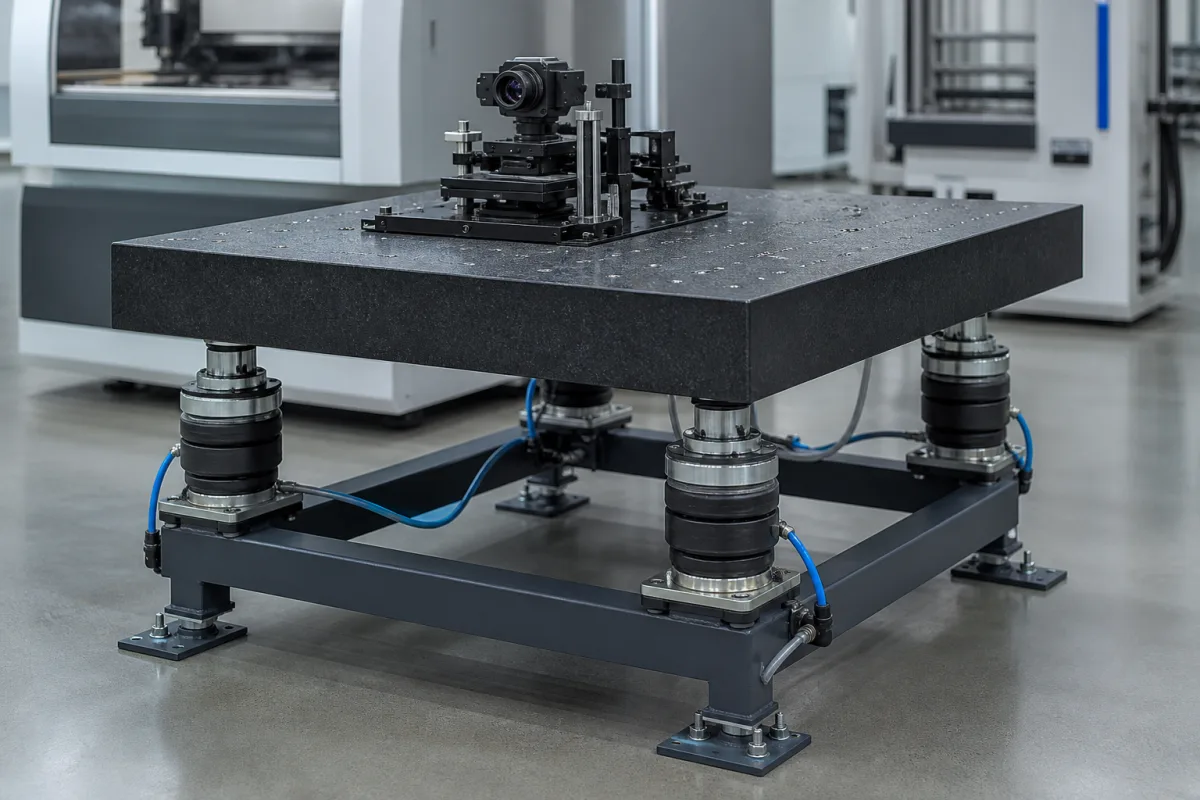
Air-spring isolated table for optics and inspection
The platform pictured is a heavy top floating on four air-spring isolators, each fed by an air line, inside a steel frame. Air springs are soft enough to put the system's natural frequency well below floor vibration from traffic, foot fall and building plant, an orifice between two chambers damps the bounce, and valves keep the top level when the load shifts. This page works through those three functions and the stability limit set by the payload's height.
Covers passive pneumatic isolation platforms and optical-table supports: air-spring natural frequency and transmissibility, two-chamber orifice damping, mechanical height-control (levelling) valves and their installation, isolator count and spacing, and tilt stability for tall payloads. Rubber and spring mounts under pumps, motors and building plant are on Vibration isolators and Bonded rubber vibration isolation mount for pump and motor baseframes; electronically driven active cancellation is outside this page.
CNFX editorial research · Sources checked October 12, 2026 · 3 sources
Optosigma's isolation guide frames passive performance with two numbers: the isolator's natural frequency and its damping.
Isolation depends on the ratio of the disturbing frequency f to the natural frequency fn. Below f/fn = 1.414 the platform amplifies vibration, with the peak at f/fn = 1; above 1.414 it isolates. An undamped coil spring isolates best above that ratio but shows the greatest magnification at resonance; adding damping lowers the peak at the expense of isolation. Optosigma describes the pneumatic isolator, an air spring with a damping chamber, as combining a low resonance peak with high isolation efficiency.
For an air spring the guide states that natural frequency is set by the ratio of piston area to the air volume behind it, so a larger reservoir per unit of piston area gives a softer, lower-frequency support. Optosigma rates its pneumatic supports as effective vertically and horizontally against the 10–60 Hz range found in ordinary laboratories.
Floor vibration
f/fn if fn = 1.5 Hz (assumed)
Undamped transmissibility 1/|1−(f/fn)²|
f/fn if fn = 3 Hz (assumed)
Undamped transmissibility
2 Hz
1.33
1.3 (amplified)
0.67
1.8 (amplified)
10 Hz
6.7
2.3%
3.3
9.9%
30 Hz
20
0.25%
10
1.0%
60 Hz
40
0.06%
20
0.25%
Editorial calculation using the textbook undamped single-degree-of-freedom form; the two natural frequencies are assumptions for illustration, not supplier values. Damping raises the high-frequency figures. Ask for the measured vertical and horizontal natural frequency and a transmissibility curve at the payload actually planned.
02
Orifice damping and automatic levelling
TMC's patent US 6,926,263 B1 describes the standard construction: a two-chamber pressure vessel with a piston sealed by a rolling flexible diaphragm. Motion of the payload pushes air through a small orifice between the chambers, and the resistance to that flow supplies vertical damping. Optosigma's supports carry the same kind of damping orifice so the top settles quickly after a push or a shift of weight.
The same patent notes that an air spring holds the payload at a set height whatever its weight, and that the isolation characteristic changes little with weight; a mechanical or electronic valve system watches the height and adds or releases air in each isolator. Optosigma fits three automatic levelling valves to a four-isolator table to hold height and level under an eccentric load, and rates four isolators for 500–2,000 kg, or 125–500 kg per isolator if the load is even (Editorial calculation).
Three valves rather than four is a geometric point: three heights define a plane, so a fourth independently controlled corner would fight the other three. In that layout two of the isolators share one valve.
The shared-valve explanation is editorial reasoning; Optosigma states the count of three valves, not the plumbing. Ask the supplier for the valve layout drawing.
03
Tilt stability for tall payloads
The camera stack in the illustration sits well above the top surface, which is where the patent's warning applies.
A payload supported below its centre of gravity is inherently unstable: as it tilts, the centre of mass moves sideways in the direction that tilts it further, and only the vertical stiffness of the isolators pushes back. US 6,926,263 B1 states that stability grows with the square of the isolator separation and falls linearly with the height of the centre of mass. The rolling diaphragm leaves the top plate free to gimbal, so the patent adds means to resist tilt of that plate while keeping vertical and horizontal stiffness soft.
The patent also flags two practical limits. Instruments for semiconductor manufacturing are pushed to the smallest footprint because cleanroom floor space is costly, which shrinks the separation term. And when isolators inflate, one edge of the payload always lifts first; this power-up tilt can put extremely high torque on the isolator top plates.
Change
Effect on tilt stability (per the patent's proportionality)
Isolator spacing × 1.5
× 2.25
Isolator spacing × 2
× 4
Centre-of-gravity height × 2
× 0.5
Spacing × 0.8 for a smaller footprint
× 0.64
Editorial calculation from the square-of-separation and linear-in-height relations; the patent gives relations, not these multiples. Send the payload mass, its centre-of-gravity height above the top and the footprint limit with the enquiry.
04
Installing height-control valves
Firestone's Technigram 107 covers height-control valves on Airmount isolators, naming optical tables and shaker isolation platforms as examples.
Firestone names wide load variation and off-centre loading as the main cases that call for these valves. Its standard time-delay valve responds more slowly on purpose, giving the system time to damp out unwanted motion, and Firestone warns against mixing time-delay and immediate-response valves on one base.
Each standard valve has three ports: exhaust at the top, air supply at the bottom and the air spring on the centre port. The valve body goes on a stationary surface with the control arm linked to the moving load; all valves must sit in the same plane relative to the air springs with equal linkage length. No antifreeze or solvents in the air lines, since they damage seals.
Firestone also says never to use Airmount isolators to lift equipment into place: rest the equipment on stops set slightly below design height, then raise it into position for isolation.
Port
Connection
Top
Exhaust
Centre
Air spring
Bottom
Air supply
Firestone's linkage settings (arm travel about ±1 in, linkage torque 12–24 in·lb, lock nuts 2–4 ft·lb) apply to its own valves; ask the platform supplier for the equivalent figures.
05
What to send when asking about an isolation platform
Paste it into your enquiry below or into an email to a maker, then replace every bracket.
Give the payload mass and footprint, the height of its centre of gravity above the top, the top size and material, the floor vibration spectrum or the disturbing frequencies of concern, and the shop air pressure available. Ask for the vertical and horizontal natural frequency at that load, a transmissibility curve, the damping method, the number and layout of levelling valves with their height repeatability, and the rated load per isolator.
Explore company information and manufacturing capabilities, then discuss the scope of your project with a relevant supplier.
Share this page
Compiled and source-reviewed by the CNFX editorial team.
Each manufacturer above links to the page on that company's own website where the product is listed, with the date we checked it. How we source and review
· Page last updated 13 October 2026
Buyer questions
At what frequency does a pneumatic platform start isolating?
Above 1.414 times its natural frequency; below that ratio it amplifies, with the peak at resonance. Optosigma rates its pneumatic supports for the 10–60 Hz range of ordinary laboratories. [1]
Why do four isolators have only three levelling valves?
Optosigma fits three automatic levelling valves to its four-isolator tables to hold height and level under eccentric load. Three heights define a plane, so a fourth independent valve would fight the others (editorial reasoning). [1]
Can a tall camera or instrument tip a pneumatic table?
Yes. TMC's patent states that stability rises with the square of isolator spacing and falls linearly with centre-of-mass height, and that payloads supported below their centre of gravity are inherently unstable. [2]
Should a levelling valve respond quickly?
Firestone's standard time-delay valve responds more slowly so the system can damp out unwanted motion, and Firestone says not to mix time-delay and immediate-response valves on one base. [3]
Sources and what still needs a direct check
Sources checked 2026-10-12. An optics supplier's isolation guide, a pneumatic isolator patent and an air-spring maker's valve installation note.