Industry-Verified Manufacturing Data (2026)

Bus Bar Assembly

Based on aggregated insights from multiple verified factory profiles within the CNFX directory, the standard Bus Bar Assembly used in the Electrical Equipment Manufacturing sector typically supports operational capacities ranging from standard industrial configurations to heavy-duty production requirements.

Technical Definition & Core Assembly

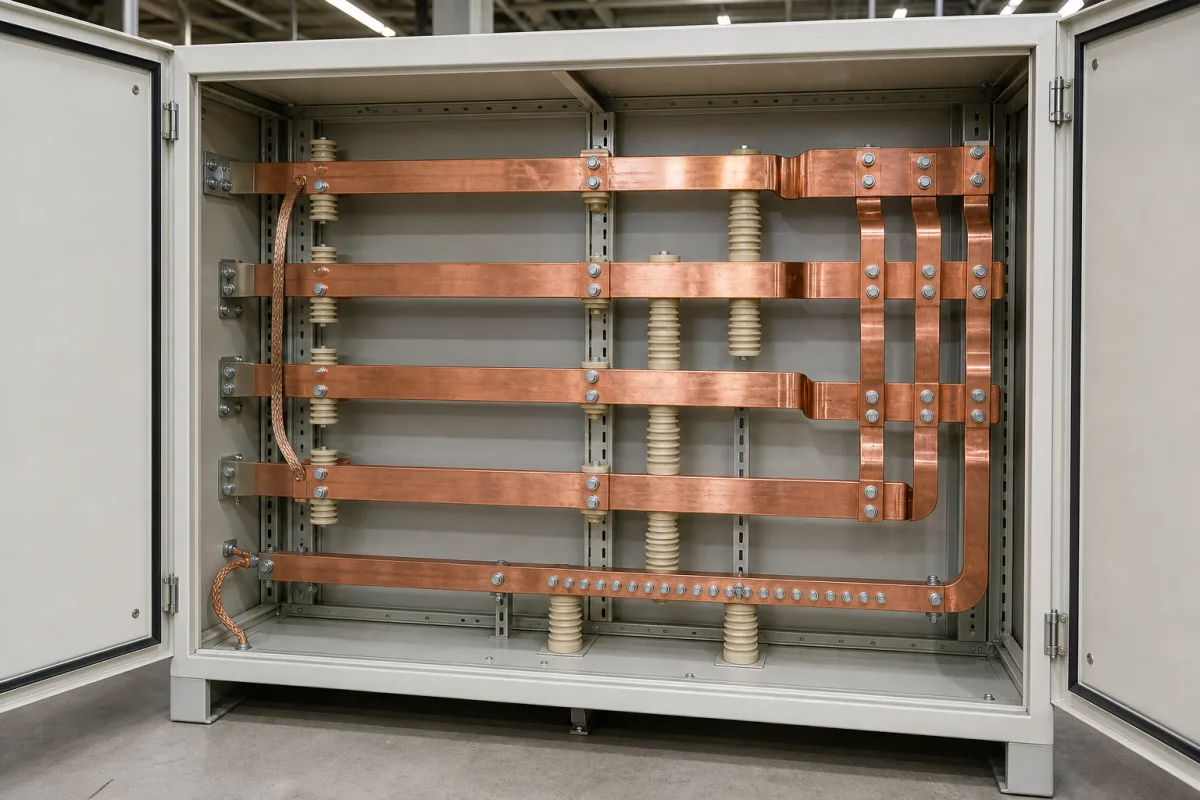
A canonical Bus Bar Assembly is characterized by the integration of Main Bus Bars and Neutral Bus Bar. In industrial production environments, manufacturers listed on CNFX commonly emphasize Copper construction to support stable, high-cycle operation across diverse manufacturing scenarios.

A conductive assembly that distributes electrical power within a circuit breaker panel by connecting multiple circuit breakers to the main power source.
Product Specifications

Technical details and manufacturing context for Bus Bar Assembly

Definition
The bus bar assembly is a critical component within a Smart Home Circuit Breaker Panel, serving as the central power distribution backbone. It consists of rigid copper or aluminum bars arranged in a specific configuration to efficiently route electrical current from the main service entrance to individual circuit breakers. In smart home applications, this assembly may integrate with monitoring systems to track power distribution and load balancing.
Working Principle
The bus bar assembly operates by providing a low-resistance conductive path for electrical current. When main power enters the panel, it connects to the bus bars, which then branch out to supply multiple circuit breakers simultaneously. The assembly's design ensures proper phase distribution (in multi-phase systems), minimizes voltage drop, and maintains electrical isolation between phases and neutral/ground conductors.
Common Materials
Copper, Aluminum
Technical Parameters
  • Cross-sectional dimensions of bus bars (width x thickness) determining current-carrying capacity (mm) Standard Spec
Components / BOM
  • Main Bus Bars
    Primary current-carrying conductors that distribute power to branch circuits
    Material: copper
  • Neutral Bus Bar
    Provides common return path for neutral conductors from all circuits
    Material: copper
  • Ground Bus Bar
    Collects and bonds all equipment grounding conductors for safety
    Material: copper
  • Insulating Supports
    Mount and electrically isolate bus bars from the panel enclosure
    Material: thermoplastic
  • Connection Lugs
    Termination points for main power input and large branch circuits
    Material: copper alloy
Engineering Reasoning
600-1000 A continuous current, 50-60 Hz frequency, 240-480 V AC, -40°C to +85°C ambient temperature
Temperature exceeds 105°C at conductor surface, current density surpasses 3.2 A/mm², voltage drop exceeds 2% of nominal voltage across any segment
Design Rationale: Joule heating (I²R losses) causing thermal expansion mismatch between copper/aluminum conductors and insulating materials, leading to contact resistance increase and localized hot spots
Risk Mitigation (FMEA)
Trigger Corrosion at bolted joints due to galvanic action between dissimilar metals (copper-aluminum)
Mode: Increased contact resistance (from <0.1 mΩ to >5 mΩ) causing localized overheating and insulation degradation
Strategy: Apply silver-plated copper bus bars with bimetallic transition washers, torque monitoring during assembly to 35 Nm ±10%
Trigger Electromagnetic forces during short-circuit events exceeding 50 kA for 3 cycles
Mode: Mechanical deflection >5 mm causing insulator cracking and phase-to-phase arcing
Strategy: Install laminated bus bar design with 12 mm minimum phase spacing, reinforced epoxy supports rated for 100 kA momentary withstand

Industry Taxonomies & Aliases

Commonly used trade names and technical identifiers for Bus Bar Assembly.

Industrial Ecosystem & Supply Chain DNA

Complementary Systems
Downstream Applications
Specialized Tooling

Application Fit & Sizing Matrix

Operational Limits
pressure: N/A (electrical component, not fluid handling)
other spec: Current rating: 100A to 5000A typical, Voltage rating: up to 600V AC/DC
temperature: -40°C to 105°C (ambient operating range)
Media Compatibility
✓ Copper conductors ✓ Aluminum conductors ✓ Insulated electrical panels
Unsuitable: Corrosive environments with high moisture/chemical exposure
Sizing Data Required
  • Maximum continuous current (Amps)
  • System voltage (Volts)
  • Number of circuit breaker poles/connections

Reliability & Engineering Risk Analysis

Failure Mode & Root Cause
Overheating due to loose connections
Cause: Thermal cycling, vibration, or improper torque during installation leading to increased electrical resistance and localized heating
Corrosion and oxidation
Cause: Exposure to moisture, contaminants, or corrosive atmospheres degrading contact surfaces and increasing resistance
Maintenance Indicators
  • Visible discoloration, charring, or melting of insulation/bus bar material indicating overheating
  • Audible buzzing, crackling, or arcing sounds during operation suggesting loose connections or insulation breakdown
Engineering Tips
  • Implement regular infrared thermography inspections to detect abnormal heating patterns before catastrophic failure
  • Apply appropriate anti-oxidation compounds and ensure proper environmental sealing to prevent corrosion

Compliance & Manufacturing Standards

Reference Standards
ISO 9001:2015 - Quality Management Systems ANSI C119.4 - Electrical Connectors for Use Between Aluminum-to-Aluminum and Aluminum-to-Copper Conductors DIN 43671 - Copper Busbars for Electrical Installations
Manufacturing Precision
  • Flatness: +/- 0.1mm per 100mm length
  • Hole Diameter: +/- 0.05mm for mounting/connection points
Quality Inspection
  • Electrical Resistance Test - Verify conductivity and joint integrity
  • Visual/Dimensional Inspection - Check for surface defects, corrosion, and dimensional accuracy

Factories Producing Bus Bar Assembly

Verified manufacturers with capability to produce this product in China

✓ 94% Supplier Capability Match Found

T Technical Director from United Arab Emirates Jan 02, 2026
★★★★★
"Impressive build quality. Especially the technical reliability is very stable during long-term operation."
Technical Specifications Verified
P Project Engineer from Australia Dec 30, 2025
★★★★☆
"As a professional in the Electrical Equipment Manufacturing sector, I confirm this Bus Bar Assembly meets all ISO standards. (Delivery took slightly longer than expected, but technical support was excellent.)"
Technical Specifications Verified
S Sourcing Manager from Singapore Dec 27, 2025
★★★★★
"Standard OEM quality for Electrical Equipment Manufacturing applications. The Bus Bar Assembly arrived with full certification."
Technical Specifications Verified
Verification Protocol

“Feedback is collected from verified sourcing managers during RFQ (Request for Quote) and factory evaluation processes on CNFX. These reports represent historical performance data and technical audit summaries from our B2B manufacturing network.”

9 sourcing managers are analyzing this specification now. Last inquiry for Bus Bar Assembly from Mexico (1h ago).

Supply Chain Compatible Machinery & Devices

Circuit Breaker Trip Unit

Protective control module for electrical circuit breakers

Explore Specs →
Circuit Breaker Arc Chute

Electrical component that extinguishes arcs in circuit breakers

Explore Specs →
Medium Voltage Switchgear Assembly Line

Automated production system for assembling medium voltage electrical switchgear.

Explore Specs →
Motor Terminal Block

Electrical connection interface for motor windings

Explore Specs →

Frequently Asked Questions

What are the main advantages of copper vs aluminum bus bars?

Copper bus bars offer superior conductivity and corrosion resistance, while aluminum provides lighter weight and lower cost. The choice depends on application requirements and budget constraints.

How do insulating supports enhance bus bar assembly safety?

Insulating supports prevent electrical shorts by maintaining proper spacing between bus bars and grounded surfaces, ensuring safe operation and compliance with electrical codes.

What specifications should I consider when selecting a bus bar assembly?

Key specifications include current rating, voltage rating, material type (copper/aluminum), dimensions, insulation class, temperature rating, and compliance standards like UL or IEC.

Can I contact factories directly on CNFX?

CNFX is an open directory, not a transaction platform. Each factory profile provides direct contact information and production details to help you initiate direct inquiries with Chinese suppliers.

Get Quote for Bus Bar Assembly

Request technical pricing, lead times, or customized specifications for Bus Bar Assembly directly from verified manufacturing units.

Your business information is encrypted and only shared with verified Bus Bar Assembly suppliers.

Thank you! Your message has been sent. We'll respond within 1–3 business days.

Need to Manufacture Bus Bar Assembly?

Connect with verified factories specializing in this product category

Add Your Factory Contact Us
Previous Product
Breather
Next Product
Busbar Processing Module