Industry-Verified Manufacturing Data (2026)

Circuit Breakers

Based on aggregated insights from multiple verified factory profiles within the CNFX directory, the standard Circuit Breakers used in the Electrical Equipment Manufacturing sector typically supports operational capacities ranging from standard industrial configurations to heavy-duty production requirements.

Technical Definition & Core Assembly

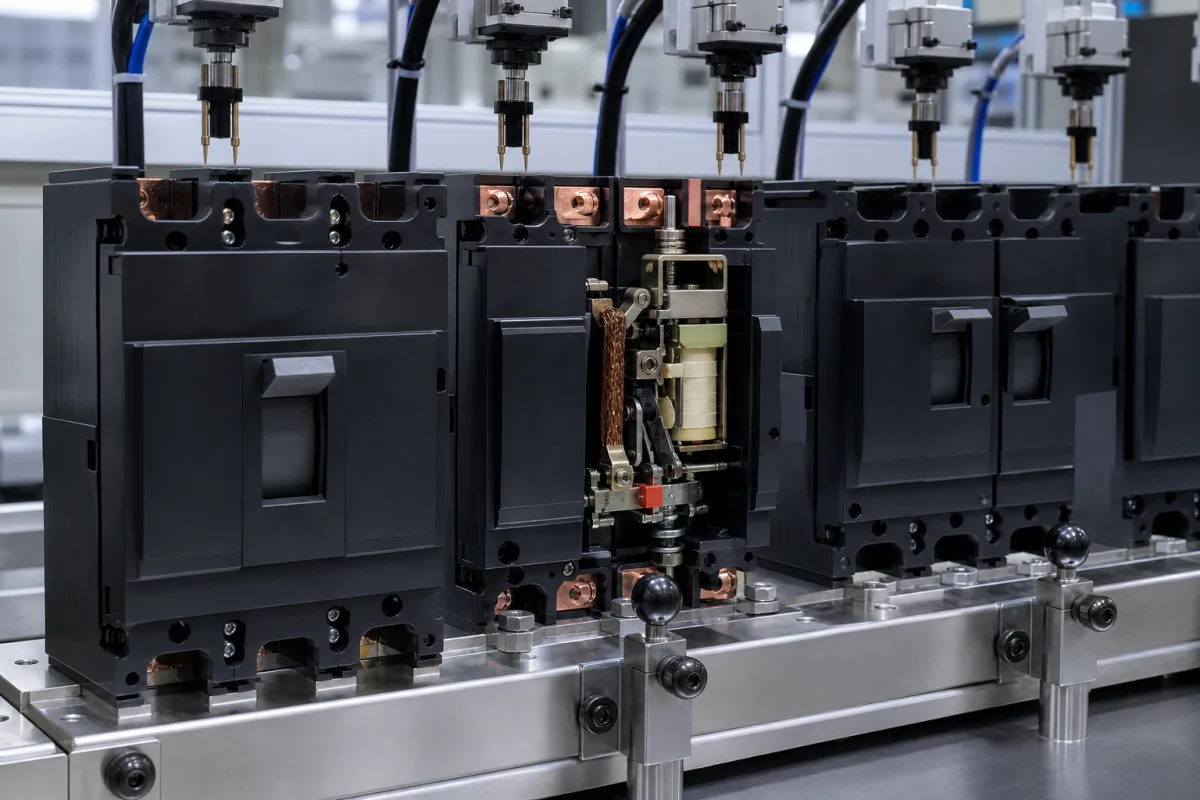
A canonical Circuit Breakers is characterized by the integration of Contacts and Trip Mechanism. In industrial production environments, manufacturers listed on CNFX commonly emphasize Copper construction to support stable, high-cycle operation across diverse manufacturing scenarios.

Electrical safety devices that automatically interrupt current flow to protect circuits from overload or short circuit conditions.
Product Specifications

Technical details and manufacturing context for Circuit Breakers

Definition
Circuit breakers are critical protective components within PLC control panels that monitor electrical current flow and automatically disconnect circuits when abnormal conditions such as overloads or short circuits are detected, preventing damage to equipment and ensuring operational safety.
Working Principle
Circuit breakers operate using thermal-magnetic or electronic trip mechanisms. Thermal elements respond to sustained overloads by heating and bending to trigger disconnection, while magnetic elements react instantly to short-circuit currents. When abnormal conditions are detected, the breaker's contacts separate, interrupting the circuit until manually reset.
Common Materials
Copper, Thermoplastic, Steel
Technical Parameters
  • Rated current capacity (A) Per Request
Components / BOM
  • Contacts
    Carry current when closed and separate to interrupt circuit when tripped
    Material: Copper alloy
  • Trip Mechanism
    Detects abnormal current conditions and triggers the opening of contacts
    Material: Bimetallic strip (thermal) or electromagnetic coil (magnetic)
  • Arc Chute
    Extinguishes electrical arc formed when contacts separate
    Material: Deionizing plates
  • Operating Handle
    Manual control for resetting and operating the breaker
    Material: Thermoplastic
Engineering Reasoning
0.1-100 kA (interrupting capacity), 100-600 VAC (voltage rating), -40°C to +85°C (ambient temperature)
Current exceeding 110% of rated interrupting capacity for >100 ms, dielectric breakdown at >1.5× rated voltage, contact erosion beyond 3 mm material loss
Design Rationale: Joule heating (I²R) causing thermal runaway in conductors, dielectric breakdown via Townsend avalanche at >30 kV/cm, arc plasma erosion of contact materials at >5000 K
Risk Mitigation (FMEA)
Trigger Current inrush exceeding 10× nominal rating during motor startup
Mode: Contact welding due to arc persistence >15 ms
Strategy: Integrate current-limiting fuses with I²t characteristic matching motor thermal capacity
Trigger Moisture ingress raising humidity >85% RH inside enclosure
Mode: Surface tracking across polymer housing at >0.5 kV/mm
Strategy: Hermetic sealing with IP67 rating and silica gel desiccant chambers

Industry Taxonomies & Aliases

Commonly used trade names and technical identifiers for Circuit Breakers.

Applied To / Applications

This component is essential for the following industrial systems and equipment:

Industrial Ecosystem & Supply Chain DNA

Complementary Systems
Downstream Applications
Specialized Tooling

Application Fit & Sizing Matrix

Operational Limits
pressure: Atmospheric to 3000 psi (depending on enclosure rating)
other spec: Current Rating: 0.5A to 6300A, Voltage Rating: 240V to 38kV, Interrupting Capacity: 10kA to 200kA
temperature: -40°C to +85°C (standard), up to +125°C (specialized)
Media Compatibility
✓ Indoor electrical panels ✓ Outdoor substations (with proper enclosures) ✓ Industrial control cabinets
Unsuitable: Explosive atmospheres (unless specifically rated for hazardous locations)
Sizing Data Required
  • Maximum continuous current (Amps)
  • System voltage (Volts)
  • Available fault current (kA)

Reliability & Engineering Risk Analysis

Failure Mode & Root Cause
Contact Erosion
Cause: Arcing during operation causes material degradation and pitting on contacts, leading to increased resistance, overheating, and eventual failure to interrupt current.
Mechanical Binding/Sticking
Cause: Corrosion, contamination, or wear in the operating mechanism (linkages, springs, pivots) prevents proper opening/closing, often due to lack of lubrication, environmental exposure, or aging.
Maintenance Indicators
  • Audible buzzing, humming, or crackling from the breaker enclosure indicating arcing or loose connections
  • Discoloration, scorching, or overheating signs (e.g., thermal imaging hotspots) on the breaker body or terminals
Engineering Tips
  • Implement regular infrared thermography inspections to detect abnormal heating patterns before failure occurs
  • Perform periodic contact resistance testing and timing tests to verify operational performance and schedule maintenance before degradation causes failure

Compliance & Manufacturing Standards

Reference Standards
IEC 60947-2 (Low-voltage switchgear and controlgear - Part 2: Circuit-breakers) UL 489 (Molded-Case Circuit Breakers, Molded-Case Switches and Circuit-Breaker Enclosures) CE Marking (EU compliance for electrical equipment under the Low Voltage Directive 2014/35/EU)
Manufacturing Precision
  • Contact Resistance: +/- 10% of specified value
  • Operating Time: +/- 20% of rated tripping time
Quality Inspection
  • Dielectric Strength Test (high-potential test)
  • Calibration Test (trip unit verification for time-current characteristics)

Factories Producing Circuit Breakers

Verified manufacturers with capability to produce this product in China

✓ 93% Supplier Capability Match Found

P Procurement Specialist from Germany Jan 31, 2026
★★★★★
"Standard OEM quality for Electrical Equipment Manufacturing applications. The Circuit Breakers arrived with full certification."
Technical Specifications Verified
T Technical Director from Brazil Jan 28, 2026
★★★★★
"Great transparency on the Circuit Breakers components. Essential for our Electrical Equipment Manufacturing supply chain."
Technical Specifications Verified
P Project Engineer from Canada Jan 25, 2026
★★★★★
"The Circuit Breakers we sourced perfectly fits our Electrical Equipment Manufacturing production line requirements."
Technical Specifications Verified
Verification Protocol

“Feedback is collected from verified sourcing managers during RFQ (Request for Quote) and factory evaluation processes on CNFX. These reports represent historical performance data and technical audit summaries from our B2B manufacturing network.”

7 sourcing managers are analyzing this specification now. Last inquiry for Circuit Breakers from Thailand (1h ago).

Supply Chain Compatible Machinery & Devices

Circuit Breaker Arc Chute

Electrical component that extinguishes arcs in circuit breakers

Explore Specs →
Medium Voltage Switchgear Assembly Line

Automated production system for assembling medium voltage electrical switchgear.

Explore Specs →
Motor Terminal Block

Electrical connection interface for motor windings

Explore Specs →
PLC Control System

A digital industrial computer control system that monitors inputs, makes decisions based on a custom program, and controls outputs to automate industrial processes.

Explore Specs →

Frequently Asked Questions

What are the main components of a circuit breaker?

Key components include the arc chute (extinguishes arcs), contacts (conduct current), operating handle (manual control), and trip mechanism (detects faults to trigger interruption).

How do circuit breakers differ from fuses?

Circuit breakers are reusable protective devices that can be reset after tripping, while fuses are single-use and must be replaced. Breakers offer more precise protection and easier restoration.

What materials are commonly used in circuit breaker construction?

Circuit breakers typically use copper for conductive parts, thermoplastic for insulation and housing, and steel for structural components and mechanisms to ensure durability and safety.

Can I contact factories directly on CNFX?

CNFX is an open directory, not a transaction platform. Each factory profile provides direct contact information and production details to help you initiate direct inquiries with Chinese suppliers.

Get Quote for Circuit Breakers

Request technical pricing, lead times, or customized specifications for Circuit Breakers directly from verified manufacturing units.

Your business information is encrypted and only shared with verified Circuit Breakers suppliers.

Thank you! Your message has been sent. We'll respond within 1–3 business days.

Need to Manufacture Circuit Breakers?

Connect with verified factories specializing in this product category

Add Your Factory Contact Us
Previous Product
Circuit Breaker/Switch
Next Product
Circuit Breakers / Fuses