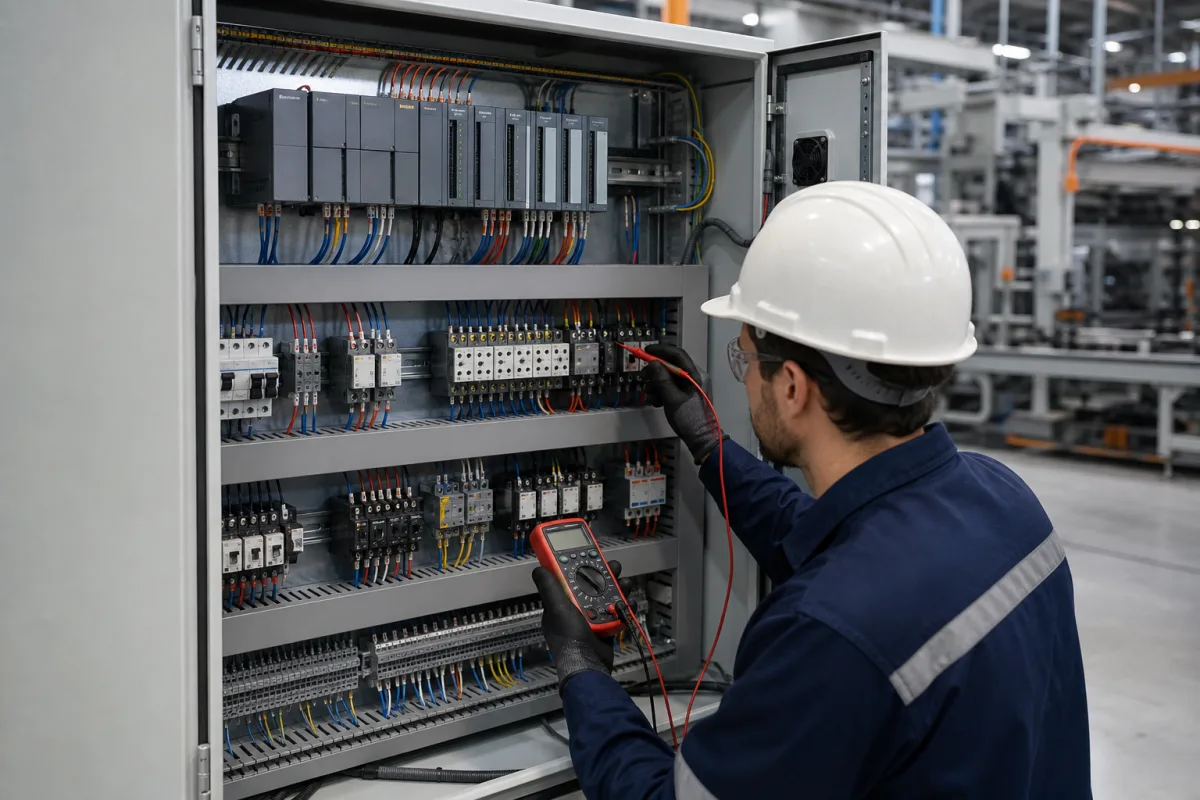
PLC control panel (wiring segregation, grounding and noise suppression inside the panel)
PLC control panels · conductor noise categories and spacing, grounding to a central bus, surge suppression of inductive loads, I/O and integration
A PLC control panel is an enclosure built around a programmable logic controller, with its power supplies, I/O modules, terminals, protective devices and, in some panels, an HMI, wired to the machine or process it controls. Ask three things first: how the panel builder separates power, I/O and communication wiring inside the panel, how every chassis and the back panel are bonded to ground, and how inductive loads switched by the outputs are suppressed.
Control panels built around programmable logic controllers, including local PLC panels, remote I/O panels and PLC plus drive panels, and the wiring, grounding and noise practice inside them. Enclosure ratings, heat dissipation and short-circuit current ratings of cabinets as a whole are covered on the Control cabinet page; PLCs sold alone and medium-voltage switchgear are outside this page.
CNFX editorial research · Sources checked October 12, 2026 · 3 sources
Rockwell Automation's Industrial Automation Wiring and Grounding Guidelines (publication 1770-4.1, February 1998) group conductors by noise: category 1 is ac power and high-power digital I/O, which tolerate noise but may also couple it to adjacent conductors; category 2 is analog I/O, dc power for analog circuits, low-power digital I/O and communication cables between processors, I/O adapters and terminals; category 3 is low-voltage dc backplane power and communication cables within the same enclosure. Category-1 conductors may share a tray or raceway with machine power conductors of up to 600 V ac feeding up to 100 hp devices. [1]
Category-2 conductors should cross power feed lines at right angles, run at least 5 ft from high-voltage enclosures or rf and microwave sources, and be routed in a raceway separate from category-1 conductors. In a contiguous metallic wireway or conduit the guideline spacing is at least 0.08 m (3 in) from category-1 conductors under 20 A, 0.15 m (6 in) from ac power lines of 20 A or more up to 100 kVA, and 0.3 m (1 ft) from lines above 100 kVA; outside contiguous metallic wireway it doubles to 0.15 m, 0.3 m and 0.6 m. Each wireway segment must be bonded to the next and to the enclosure at the entry point. [1]
Editorial note: these figures are from a 1998 maker guideline that it says assumes its surge-suppression guidance is followed; check them against the standard your panel is certified to and the drive and PLC makers' current installation manuals.
Give the panel builder the PLC platform and I/O list with spare capacity, field devices and cable types, drives and other noise sources in or near the panel, supply and earthing system, communication networks, HMI, standards and certification needed, enclosure and environment, drawings and testing before shipment.
02
Ground every chassis to a central bus and suppress inductive loads
The same guidelines call for good bolt or stud connections between each chassis and the back panel, scraping paint or anodising at mounting holes and using star washers, and, in addition, 1-inch copper braid or 8 AWG minimum stranded copper wire to connect each chassis, enclosure and the central ground bus mounted on the back panel, with a grounding-electrode conductor from the bus to the grounding-electrode system. [1]
For inductive loads switched by outputs, Rockwell states that surge suppressors "are usually most effective when connected at the inductive loads", and still usable but possibly less effective at the switching devices; it lists RC networks and varistors for different loads, and warns against some suppressor types on 1746 and 1747 triac outputs, which should use varistors instead. Near excessive electrical noise generators it describes an isolation transformer to further suppress interference, with output actuators fed from the same ac source as the isolation transformer but not from its secondary. [1]
Panel builders describe the integration side: Weimiao lists design, manufacture and electrical integration of custom PLC and PLC plus drive panels, with PLC programming and panel integration support and cabinets laid out for ventilation, modular PLC and drive mounting and cable routing to the project's bill of materials and schematics. [2] Dalian Yinlu lists local PLC panels and remote I/O panels with modular design, multi-protocol compatibility, custom IP rating and flexible expansion. [3] Editorial calculation: 8 AWG copper is about 8.4 mm² in cross-section.
03
Weimiao and Dalian Yinlu PLC panel builds
Weimiao lists custom PLC and PLC plus drive control panels with integration support; Dalian Yinlu lists local PLC and remote I/O control panels and sheet metal enclosures. Ask each how wiring is segregated, how chassis are bonded and what tests are run before shipment.
04
PLC rack, supplies, wireways, ground bus and suppressors
Wireways and the ground bus carry the noise rules of this page into hardware: separate raceways by wiring category and one central bus that every chassis bonds to.
Part
Role
Fix in the order
PLC and I/O modules
Control and field signals; I/O wiring is category 1 or 2 by power. [1]
Platform, I/O count, spares.
Power supplies and transformers
Supply logic and I/O; isolation transformer near noise. [1]
Explore company information and manufacturing capabilities, then discuss the scope of your project with a relevant supplier.
Share this page
Compiled and source-reviewed by the CNFX editorial team.
Each manufacturer above links to the page on that company's own website where the product is listed, with the date we checked it. How we source and review
· Page last updated 13 October 2026
Buyer questions
How far should analog wiring be from power wiring in a panel?
Rockwell's guidelines give at least 0.08 m (3 in) from category-1 conductors under 20 A in contiguous metal wireway, 0.15 m outside it. [1]
How should PLC chassis be grounded?
Rockwell calls for 1 in copper braid or 8 AWG minimum stranded copper from each chassis and enclosure to a central ground bus, plus good bolted connections. [1]
Where should surge suppressors for inductive loads go?
Rockwell states they "are usually most effective when connected at the inductive loads", and still usable at the switching devices. [1]
What do PLC panel builders supply besides wiring?
Weimiao lists design, fabrication, integration and PLC programming support for custom PLC and drive panels. [2]
Sources and what still needs a direct check
Sources checked 2026-10-12. Rockwell Automation's 1998 wiring and grounding guidelines describe panel practice for its controllers; Weimiao and Dalian Yinlu are panel builders describing their own services.