Structured Manufacturing Data (2026)

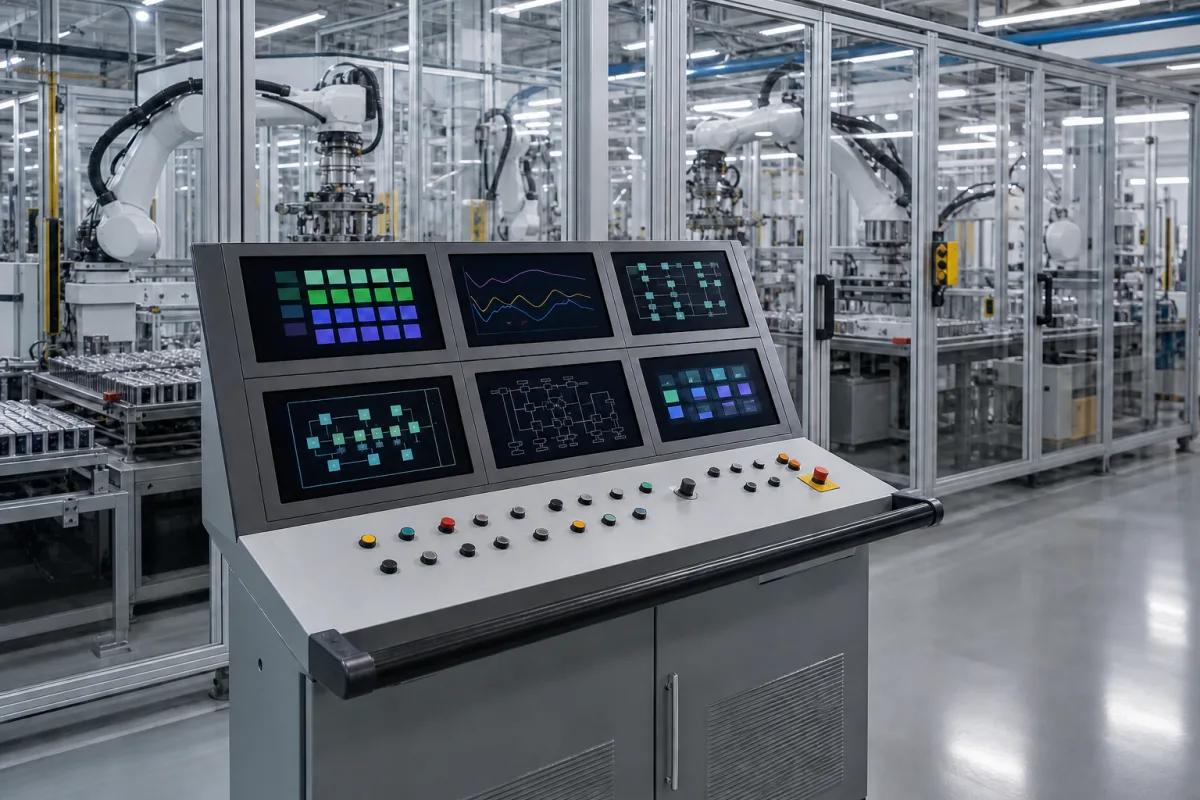
Control and Monitoring Console

Based on aggregated insights from structured factory profiles within the CNFX directory, the standard Control and Monitoring Console used in the Electrical Equipment Manufacturing sector typically supports operational capacities ranging from standard industrial configurations to heavy-duty production requirements.

Technical Definition & Core Assembly

A canonical Control and Monitoring Console is characterized by the integration of Human-Machine Interface (HMI) Panel and Industrial PC/Controller. In industrial production environments, manufacturers listed on CNFX commonly emphasize Powder-coated steel construction to support stable, high-cycle operation across diverse manufacturing scenarios.

Centralized interface for managing and overseeing the assembly and testing processes of lithium-ion battery modules.

Product Specifications

Technical details and manufacturing context for Control and Monitoring Console

Definition
A specialized console within the Lithium-Ion Battery Module Assembly and Testing System that provides operators with centralized control over assembly line machinery, real-time monitoring of testing parameters (voltage, current, temperature), data acquisition, and system diagnostics to ensure production quality and safety.
Working Principle
The console integrates with sensors, PLCs, and testing equipment via industrial communication protocols. It receives real-time data, processes it through specialized software, displays it on HMI screens, and allows operators to send control commands to adjust assembly parameters, initiate tests, or halt processes based on predefined thresholds and safety protocols.
Common Materials
Powder-coated steel, Polycarbonate screen, Electronic components (PCBs, connectors)
Technical Parameters
  • Typical console dimensions for industrial rack or desk mounting (mm) Standard Spec
Components / BOM
  • Human-Machine Interface (HMI) Panel
    Provides touchscreen interface for operator input and visual display of system status, alarms, and data trends.
    Material: Polycarbonate/glass composite
  • Industrial PC/Controller
    Processes data from sensors and testing equipment, runs control algorithms, and manages communication with other system components.
    Material: Electronic components (silicon, PCB, metals)
  • Control Buttons/Emergency Stop
    Manual override controls and emergency shutdown for immediate process halt.
    Material: Plastic (buttons), metal (housing)
  • Communication Module
    Facilitates data exchange with PLCs, sensors, and testing instruments via industrial networks.
    Material: Electronic components

Industry Taxonomies & Aliases

Commonly used trade names and technical identifiers for Control and Monitoring Console.

Industrial Ecosystem & Supply Chain Structure

Complementary Systems
Downstream Applications
Specialized Tooling

Application Fit & Sizing Matrix

Operational Limits
pressure: Atmospheric (sealed NEMA 4X/IP65 enclosure)
other spec: Humidity: 20-80% non-condensing, Power: 100-240VAC, 50/60Hz, 500W max
temperature: 15-35°C (operating), 0-50°C (storage)
Media Compatibility
✓ Lithium-ion electrolyte vapors (controlled) ✓ Dry nitrogen atmosphere ✓ Clean room particulate levels (ISO Class 7 equivalent)
Unsuitable: Chlorinated solvent environments (risk of seal degradation and corrosion)
Sizing Data Required
  • Number of simultaneous assembly/test stations to monitor
  • Required data acquisition rate (samples/sec per channel)
  • Integration complexity with existing PLC/MES systems

Reliability & Engineering Risk Analysis

Failure Mode & Root Cause
Electronic Component Degradation
Cause: Thermal cycling and prolonged exposure to high temperatures leading to solder joint fatigue, capacitor drying, and semiconductor breakdown
Interface/Display Failure
Cause: Backlight burnout, touchscreen digitizer degradation from mechanical wear, or LCD panel damage from environmental contaminants
Maintenance Indicators
  • Intermittent screen flickering or complete display blackout during operation
  • Unresponsive touch controls or erratic cursor movement without user input
Engineering Tips
  • Implement active cooling with filtered air circulation and maintain ambient temperature below 35°C to prevent thermal stress on electronic components
  • Establish quarterly calibration routines for all input devices and displays, using manufacturer-specified test patterns and diagnostic tools

Compliance & Manufacturing Standards

Reference Standards
ISO 13849-1: Safety of machinery - Safety-related parts of control systems ANSI/ISA-5.1: Instrumentation Symbols and Identification CE Marking: Compliance with EU Machinery Directive 2006/42/EC
Manufacturing Precision
  • Panel flatness: +/-0.5mm across 1m span
  • Button actuation force: 2.5N +/-0.3N
Quality Inspection
  • Electrical Safety Test (dielectric strength, insulation resistance)
  • Environmental Sealing Test (IP rating verification per IEC 60529)

Factories Producing Control and Monitoring Console

Manufacturer profiles with relevant production capability in China

Manufacturer listings support early research and capability understanding. They are not certification, ranking, or transaction guarantees.

Technical documentation
4/5
Manufacturing capability
4/5
Inspection readiness
5/5
Supplier transparency
3/5

These scores are example evaluation dimensions, not real customer ratings, country-specific buyer feedback, or live inquiry activity.

Supply Chain Compatible Machinery & Devices

Circuit Breaker Trip Unit

Protective control module for electrical circuit breakers

Explore Specs →
Circuit Breaker Arc Chute

Electrical component that extinguishes arcs in circuit breakers

Explore Specs →
Medium Voltage Switchgear Assembly Line

Automated production system for assembling medium voltage electrical switchgear.

Explore Specs →
Motor Terminal Block

Electrical connection interface for motor windings

Explore Specs →

Frequently Asked Questions

What safety features does this control console include for battery manufacturing?

The console features an emergency stop button, powder-coated steel housing for durability, and polycarbonate screen protection to ensure safe operation in electrical manufacturing environments.

How does this console integrate with existing battery assembly lines?

It includes a communication module and standard industrial connectors (PCBs) for seamless integration with PLC systems, sensors, and testing equipment in lithium-ion battery production facilities.

What are the main components of the control and monitoring console?

Key components include an industrial PC/controller, HMI panel for real-time oversight, control buttons for process management, and communication modules for data exchange during battery module assembly and testing.

Can I contact factories directly on CNFX?

CNFX is an open directory, not a transaction platform. Each factory profile provides direct contact information and production details to help you initiate direct inquiries with Chinese suppliers.

Data Basis

CNFX manufacturer profiles, technical classification, publicly available product information, and ongoing plausibility checks.

Preliminary Technical Classification
This page supports structured research, RFQ preparation, and supplier evaluation. It does not replace buyer-led supplier qualification, standards review, or technical approval.

Request Manufacturing Insight for Control and Monitoring Console

Ask for use case, specification boundaries, supplier type, and RFQ preparation information for Control and Monitoring Console.

Your business information is used only to process this request.

Thank you! Your message has been sent. We'll respond within 1–3 business days.

Need to Manufacture Control and Monitoring Console?

Compare manufacturer profiles with relevant product and process capability.

Create Manufacturer Profile Contact Us
Previous Product
Control and Feedback Circuitry
Next Product
Control and Monitoring Station