Industry-Verified Manufacturing Data (2026)

Electric Motor Stator Lamination Stack

Based on aggregated insights from multiple verified factory profiles within the CNFX directory, the standard Electric Motor Stator Lamination Stack used in the Electrical Equipment Manufacturing sector typically supports operational capacities ranging from standard industrial configurations to heavy-duty production requirements.

Technical Definition & Core Assembly

A canonical Electric Motor Stator Lamination Stack is characterized by the integration of Electrical Steel Lamination and Interlamination Insulation. In industrial production environments, manufacturers listed on CNFX commonly emphasize Non-oriented electrical steel (SiFe) construction to support stable, high-cycle operation across diverse manufacturing scenarios.

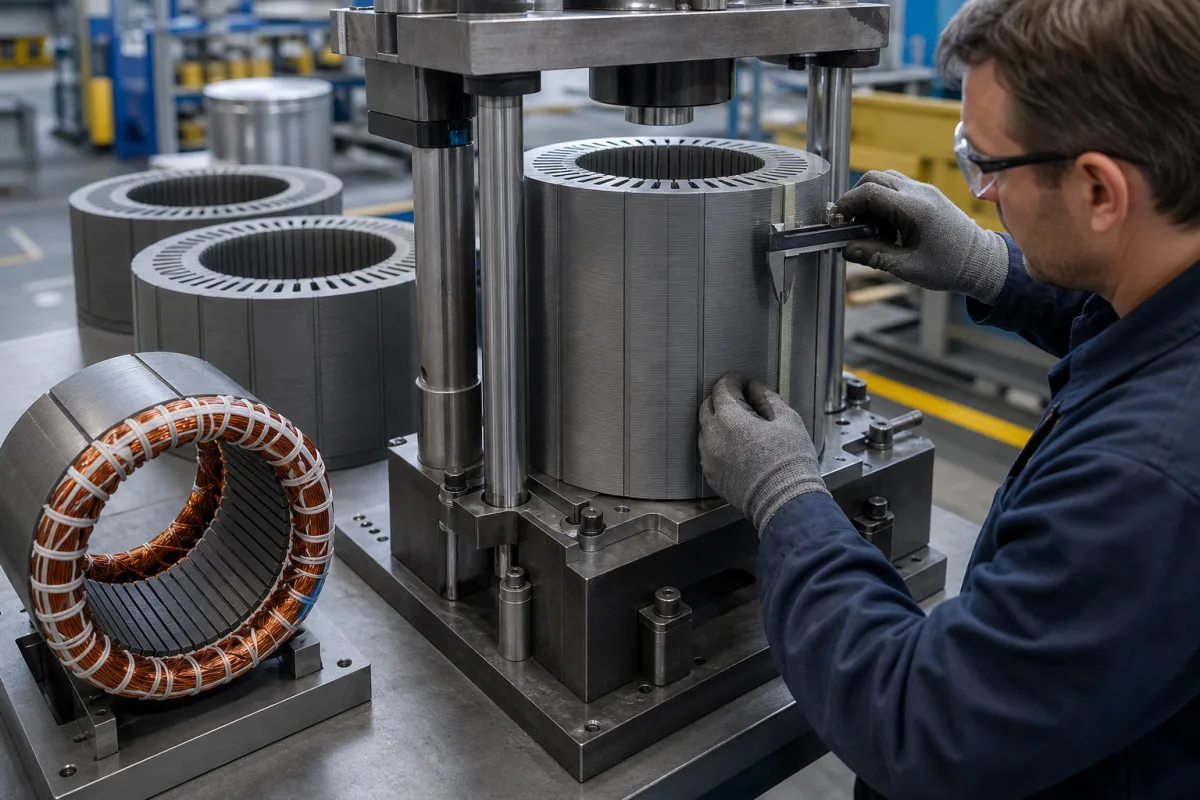
Precisely stacked and bonded electrical steel laminations forming the stationary magnetic core of an electric motor.

Product Specifications

Technical details and manufacturing context for Electric Motor Stator Lamination Stack

Definition
The stator lamination stack is a critical magnetic circuit component in electric motors, generators, and some transformers. It is manufactured by precisely stacking hundreds of thin, insulated electrical steel laminations to minimize eddy current losses. The stack is then bonded under high pressure to form a rigid, low-loss core that provides the stationary magnetic field path. Its precise geometry and material properties directly influence motor efficiency, torque, and thermal performance.
Working Principle
Thin, insulated laminations of electrical steel are stacked to form a solid core. The insulation between layers disrupts potential eddy current paths, reducing energy loss when the core is subjected to the alternating magnetic field from the stator windings.
Common Materials
Non-oriented electrical steel (SiFe), Insulation coating (C-5, C-6)
Technical Parameters
  • Inner diameter (bore) of the finished lamination stack (mm) Customizable
  • Outer diameter of the finished lamination stack (mm) Customizable
Components / BOM
  • Electrical Steel Lamination
    Provides the low-loss magnetic path, cut to precise shape with slots
    Material: Non-oriented silicon steel with insulation coating
  • Interlamination Insulation
    Coating on steel surface to electrically isolate adjacent laminations
    Material: Organic or inorganic coating (e.g., C-5)
  • Bonding Agent/Adhesive
    Bonds laminations together under pressure to form a rigid stack
    Material: Epoxy resin or varnish
Engineering Reasoning
Magnetic flux density: 1.5-1.8 T (Tesla), Core loss: 2.5-4.0 W/kg at 50 Hz, 1.5 T, Stacking factor: 0.95-0.98
Magnetic saturation at 2.1 T (silicon steel), Interlamination insulation breakdown at 500 V/mm, Stack bond failure at 15 MPa shear stress
Design Rationale: Hysteresis and eddy current losses exceeding material Curie temperature (740°C for Fe-3%Si), leading to insulation degradation and magnetic property loss
Risk Mitigation (FMEA)
Trigger High-frequency harmonic currents from PWM inverter (switching frequencies >5 kHz)
Mode: Excessive eddy current heating in laminations (>120°C), causing insulation degradation and interlamination shorting
Strategy: Implement grain-oriented electrical steel with <0.27 mm thickness and phosphate insulation coating
Trigger Mechanical vibration at motor natural frequency (typically 100-500 Hz)
Mode: Progressive stack delamination and increased magnetic reluctance, reducing motor efficiency by >15%
Strategy: Apply epoxy bonding with 10-15 MPa shear strength and implement vibration damping mounts

Industry Taxonomies & Aliases

Commonly used trade names and technical identifiers for Electric Motor Stator Lamination Stack.

Industrial Ecosystem & Supply Chain DNA

Complementary Systems
Downstream Applications
Specialized Tooling

Application Fit & Sizing Matrix

Operational Limits
pressure: Atmospheric to 10 bar (depends on housing design)
other spec: Max magnetic flux density: 1.8 Tesla, Stacking factor: 0.95-0.98, Core loss: 2-10 W/kg at 1.5T/50Hz
temperature: -40°C to 200°C (Class H insulation typical)
Media Compatibility
✓ Dry air/nitrogen environments ✓ Transformer oil immersion ✓ Encapsulated epoxy systems
Unsuitable: Chlorinated or acidic chemical exposure (corrodes electrical steel)
Sizing Data Required
  • Motor power rating (kW)
  • Operating frequency (Hz)
  • Stator bore diameter (mm)

Reliability & Engineering Risk Analysis

Failure Mode & Root Cause
Insulation breakdown
Cause: Thermal degradation from overheating due to poor ventilation, excessive load, or voltage imbalance, leading to short circuits between laminations or windings.
Lamination separation or buckling
Cause: Mechanical stress from core vibration, improper clamping pressure during assembly, or thermal cycling causing expansion/contraction, resulting in increased eddy current losses and potential core damage.
Maintenance Indicators
  • Audible high-frequency humming or buzzing from the motor casing, indicating loose laminations or core vibration.
  • Visible overheating signs such as discoloration (browning or bluing) on the stator core surface or burning smell from insulation degradation.
Engineering Tips
  • Ensure proper ventilation and cooling: Maintain clean air passages, monitor operating temperature within specifications, and use thermal protection devices to prevent insulation breakdown from overheating.
  • Implement vibration analysis and core tightness checks: Regularly measure vibration levels to detect lamination looseness early, and verify clamping pressure during maintenance to prevent separation and reduce eddy current losses.

Compliance & Manufacturing Standards

Reference Standards
ISO 9001:2015 - Quality Management Systems IEC 60034-1:2022 - Rotating Electrical Machines DIN EN 10027-2:2015 - Designation Systems for Steels
Manufacturing Precision
  • Bore Diameter: +/-0.01mm
  • Stack Height: +/-0.05mm
Quality Inspection
  • Eddy Current Testing for Material Defects
  • Dimensional Verification with CMM

Factories Producing Electric Motor Stator Lamination Stack

Verified manufacturers with capability to produce this product in China

✓ 98% Supplier Capability Match Found

S Sourcing Manager from Singapore Mar 02, 2026
★★★★★
"The Electric Motor Stator Lamination Stack we sourced perfectly fits our Electrical Equipment Manufacturing production line requirements."
Technical Specifications Verified
P Procurement Specialist from Germany Feb 27, 2026
★★★★☆
"Found 30+ suppliers for Electric Motor Stator Lamination Stack on CNFX, but this spec remains the most cost-effective. (Delivery took slightly longer than expected, but technical support was excellent.)"
Technical Specifications Verified
T Technical Director from Brazil Feb 24, 2026
★★★★★
"The technical documentation for this Electric Motor Stator Lamination Stack is very thorough, especially regarding Stack Length (mm)."
Technical Specifications Verified
Verification Protocol

“Feedback is collected from verified sourcing managers during RFQ (Request for Quote) and factory evaluation processes on CNFX. These reports represent historical performance data and technical audit summaries from our B2B manufacturing network.”

6 sourcing managers are analyzing this specification now. Last inquiry for Electric Motor Stator Lamination Stack from USA (1h ago).

Supply Chain Commonly Integrated Components

Control Cabinet

Electrical enclosure housing control systems for automated industrial equipment

Explore Specs →
Rotor Assembly

The rotating component of an actuator motor that converts electrical energy into mechanical motion

Explore Specs →
Stator Assembly

The stationary component of an electric motor that generates a rotating magnetic field when energized.

Explore Specs →
Wire Tensioner

A device that applies and maintains precise tension on electrical wire during the winding process of transformers.

Explore Specs →

Frequently Asked Questions

What are the benefits of using non-oriented electrical steel for stator laminations?

Non-oriented electrical steel (SiFe) provides uniform magnetic properties in all directions, reducing core losses and improving motor efficiency. Combined with C-5 or C-6 insulation coatings, it minimizes eddy current losses in the stator core.

How does stacking factor affect electric motor performance?

Stacking factor measures how densely laminations are packed. A higher stacking factor (typically 95-98%) increases magnetic flux density, improving torque and efficiency while reducing core losses and thermal buildup in the motor.

What specifications should I consider when ordering stator lamination stacks?

Key specifications include core loss at 1.5T/50Hz (W/kg), lamination thickness (typically 0.35-0.65mm), slot count, stack length, stacking factor (%), and stacking pressure (MPa). These determine motor efficiency, power density, and thermal performance.

Can I contact factories directly on CNFX?

CNFX is an open directory, not a transaction platform. Each factory profile provides direct contact information and production details to help you initiate direct inquiries with Chinese suppliers.

Get Quote for Electric Motor Stator Lamination Stack

Request technical pricing, lead times, or customized specifications for Electric Motor Stator Lamination Stack directly from verified manufacturing units.

Your business information is encrypted and only shared with verified Electric Motor Stator Lamination Stack suppliers.

Thank you! Your message has been sent. We'll respond within 1–3 business days.

Need to Manufacture Electric Motor Stator Lamination Stack?

Connect with verified factories specializing in this product category

Add Your Factory Contact Us
Previous Product
Electric Motor Rotor Lamination Stacking and Welding Machine
Next Product
Electric Motor Stator Winding Machine