Editorial Technical Reference

Filtering Circuit (Choke & Capacitors)

This page explains how Filtering Circuit (Choke & Capacitors) is classified within Electrical Equipment Manufacturing. Technical values and manufacturer relationships are research references; confirm the current specification and supplier evidence for each order.

Technical Definition & Core Assembly

A passive electronic circuit that smooths the pulsating DC output from a rectifier by reducing AC ripple voltage.
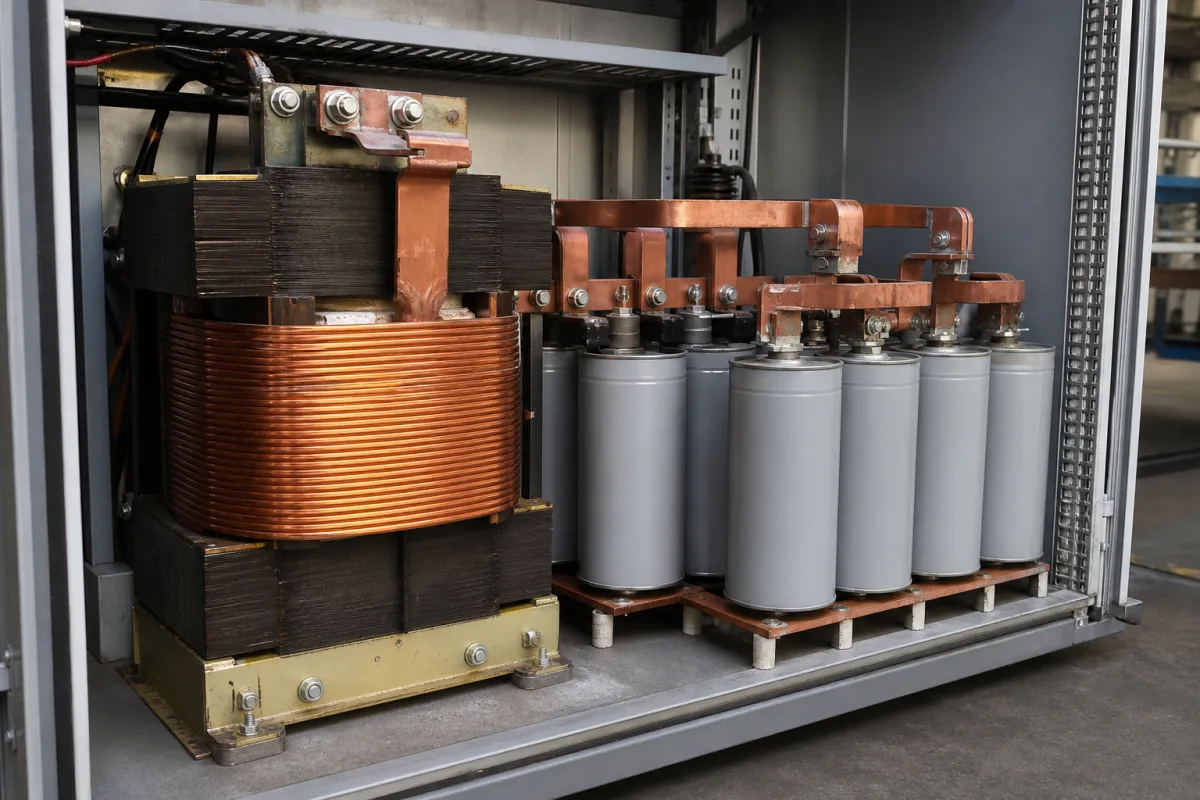
Filtering Circuit (Choke & Capacitors) in a manufacturing environment
Representative product image. Confirm appearance and specifications with the manufacturer.

Product Specifications

Technical details and manufacturing context for Filtering Circuit (Choke & Capacitors)

Definition
The filtering circuit is a passive electronic component used in rectifier power supplies to reduce the alternating current (AC) ripple voltage present in the rectified direct current (DC) output. It consists of inductors (chokes) and capacitors arranged in configurations such as L-section (inductor-input) or C-section (capacitor-input) filters. The choke opposes changes in current, smoothing current flow, while the capacitor stores electrical charge and opposes changes in voltage, smoothing voltage. Together, they attenuate the AC ripple component, allowing a stable, near-constant DC voltage to pass to sensitive electronic loads. This component is critical in applications where a clean DC supply is required, such as in industrial equipment, telecommunications, and precision instrumentation. The filtering circuit is characterized by parameters including rated voltage, capacitance, inductance, ripple current, operating temperature, insulation resistance, dielectric strength, capacitance tolerance, inductance tolerance, humidity range, ingress protection, and weight. These parameters are specified as reference ranges and must be verified for the specific model and application. The circuit is manufactured using materials such as ferrite cores for the choke, aluminum electrolytic foil for the capacitor, copper wire, and insulating materials. It complies with relevant IEC standards, including IEC 60252 for capacitors, IEC 60289 for inductors, IEC 60068-2 for environmental testing, IEC 60062 for marking codes, and IEC 60529 for ingress protection. However, compliance with these standards should be confirmed with the legal manufacturer or supplier for the actual product. The filtering circuit is a component within a larger power supply system and is not a standalone product. Its performance depends on the correct selection of choke and capacitor values based on the load requirements and ripple frequency. When integrating this component, engineers must consider the input and output voltage levels, ripple current, and ambient temperature to ensure reliable operation. Regular inspection for signs of overheating, capacitor bulging, or insulation degradation is recommended to maintain performance and safety.
Working Principle
The filtering circuit operates on the principle of impedance. The choke (inductor) presents high impedance to AC ripple frequencies, blocking or reducing their passage, while offering low impedance to DC, allowing it to pass. The capacitor, connected in parallel with the load, provides a low-impedance path for AC ripple, effectively short-circuiting it to ground, while storing charge to maintain a steady DC voltage. In an L-section filter, the inductor is in series with the load, and the capacitor is in parallel. In a C-section filter, the capacitor alone is connected in parallel with the load. The combination of these components creates a low-pass filter that attenuates high-frequency ripple while passing the DC component. The effectiveness of filtering depends on the values of inductance and capacitance, as well as the load current. Higher inductance and capacitance generally improve ripple reduction but may increase size and cost. The circuit's design must balance these factors to meet the required output voltage stability and ripple specifications.
Common Materials
Ferrite Core (for choke), Aluminum Electrolytic Foil (for capacitor), Copper Wire, Insulating Materials
Technical Parameters
ParameterTypical rangeNotes & selection driver
Rated Voltage250–400 V ACMaximum continuous AC voltage for capacitorsIEC 60252
Capacitance10–100 µFDetermines ripple filtering effectivenessIEC 60252
Inductance1–10 mHChoke inductance for ripple suppressionIEC 60289
Ripple Current1–5 AMaximum allowable AC ripple currentIEC 60252
Operating Temperature-40–85 °CExtended range may require deratingIEC 60068-2
Insulation Resistance≥100 At 500 V DC, 25°CIEC 60252
Dielectric Strength1500–2500 V ACTest voltage for 1 minuteIEC 60252
Capacitance Tolerance±5–±10 %Tighter tolerance for precision applicationsIEC 60062
Inductance Tolerance±10–±20 %Depends on core material and constructionIEC 60062
Humidity Range5–95 % RHNon-condensingIEC 60068-2-78
Ingress ProtectionIP20–IP54Higher IP for harsh environmentsIEC 60529
Weight0.5–5 kgDepends on choke size and capacitor bank

Ranges are indicative industry figures for RFQ preparation, not a supplier commitment. Confirm every value and standard with the legal manufacturer before ordering.

Components / BOM
  • Choke (Inductor) Part
    Provides series impedance to AC ripple current, smoothing the current waveform.
    Material: Ferrite core with copper winding
  • Filter Capacitor Part
    Provides a low-impedance shunt path for AC ripple to ground, smoothing the voltage waveform.
    Material: Aluminum electrolytic or film dielectric

Industry Taxonomies & Aliases

Commonly used trade names and technical identifiers for Filtering Circuit (Choke & Capacitors).

Applied To / Applications

This component is essential for the following industrial systems and equipment:

Industrial Ecosystem & Supply Chain Structure

Complementary Systems
Downstream Applications
Specialized Tooling

Application Fit & Sizing Matrix

Operational Limits
pressure: Atmospheric (non-pressurized)
other spec: Voltage rating: 50V to 1000V DC, Current rating: 1A to 100A, Frequency range: 50Hz to 100kHz
temperature: -40°C to +85°C
Media Compatibility
✓ DC power supplies ✓ Motor drives ✓ LED lighting systems
Unsuitable: High-frequency RF circuits (>1MHz) or environments with strong electromagnetic interference
Sizing Data Required
  • Input ripple voltage (mV pk-pk)
  • Load current (A)
  • Desired output ripple reduction (%)

Reliability & Engineering Risk Analysis

Failure Mode & Root Cause
Capacitor dielectric breakdown
Cause: Overvoltage stress, thermal degradation, or manufacturing defects leading to insulation failure and short circuits
Choke winding insulation failure
Cause: Thermal cycling, moisture ingress, or vibration-induced abrasion causing insulation breakdown and winding shorts
Maintenance Indicators
  • Audible humming or buzzing from capacitors indicating internal arcing or dielectric breakdown
  • Visible bulging, leaking, or discoloration of capacitor casings signaling internal pressure buildup or thermal overload
Engineering Tips
  • Implement regular infrared thermography scans to detect abnormal heating in capacitors and choke windings before catastrophic failure
  • Maintain strict voltage regulation and harmonic filtering to prevent overvoltage stress on capacitor dielectrics and reduce choke thermal cycling

Indicative industry ranges for design and RFQ preparation. Confirm the exact figures and applicable standard with the manufacturer before specifying.

Compliance & Manufacturing Standards

Applicable Standards
IEC 60938-1 (Inductive components for electromagnetic interference suppression) IEC 60384-1 (Fixed capacitors for use in electronic equipment) EN 55032 (Electromagnetic compatibility of multimedia equipment)

Quoted from the published standard.

Manufacturing Precision
  • Inductance tolerance: +/-10%
  • Capacitance tolerance: +/-20%
Quality Inspection
  • High-potential (hipot) test for dielectric strength
  • Temperature cycling test (-40°C to +85°C)

Manufacturers of Filtering Circuit (Choke & Capacitors)

Manufacturer profiles associated with Filtering Circuit (Choke & Capacitors).

Sourcing Filtering Circuit (Choke & Capacitors) from China?
Tell us your specification and target quantity — we will match it against manufacturer records and come back with the factories that fit.
Request manufacturers We manufacture this

Manufacturer listings support early research and capability understanding. They are not certification, ranking, or transaction guarantees.

Share this page
Technical documentation
Request current drawings, revision history, and a signed specification sheet.
Manufacturing capability
Verify equipment lists, process limits, capacity, and representative production evidence.
Inspection readiness
Confirm test methods, calibrated equipment, sampling plans, and traceable reports.
Supplier transparency
Check the legal entity, factory address, ownership, certifications, and direct contacts.

CNFX does not score or rank suppliers. Buyers must verify all claims and documents with the legal manufacturer before ordering.

Supply Chain Compatible Machinery & Devices

Motor Terminal Block

A motor terminal block is a standardized electrical component that provides secure, insulated connection points for motor winding leads.

Explore Specs →
PLC Control System

A digital industrial computer control system that monitors inputs, makes decisions based on a custom program, and controls outputs to automate industrial processes.

Explore Specs →
Control Panel

A centralized interface for monitoring and controlling industrial equipment and processes

Explore Specs →
PLC Control Panel

A centralized interface unit housing the programmable logic controller and associated control components for industrial automation systems.

Explore Specs →

Frequently Asked Questions

What is the purpose of a filtering circuit in a power supply?

The filtering circuit smooths the pulsating DC output from a rectifier by reducing the AC ripple voltage, providing a stable DC voltage for sensitive electronic loads.

What are the typical configurations of a filtering circuit?

Common configurations include L-section (inductor-input) and C-section (capacitor-input) filters, which use a combination of inductors and capacitors to attenuate AC ripple.

What parameters should be verified before selecting a filtering circuit?

Key parameters include rated voltage, capacitance, inductance, ripple current, operating temperature, insulation resistance, dielectric strength, and tolerances. These must be confirmed with the manufacturer for the specific application.

What standards apply to filtering circuits?

Relevant standards include IEC 60252 for capacitors, IEC 60289 for inductors, IEC 60068-2 for environmental testing, IEC 60062 for marking codes, and IEC 60529 for ingress protection. Compliance should be verified with the supplier.

Data Basis

Editorial classification, named public sources where available, and source-reviewed manufacturer records.

Preliminary Technical Classification
This page supports structured research, RFQ preparation, and supplier evaluation. It does not replace buyer-led supplier qualification, standards review, or technical approval.
Buyer enquiry

Request manufacturing insight for Filtering Circuit (Choke & Capacitors)

Ask for use case, specification boundaries, supplier type, and RFQ preparation information for this product.

Where it goes
Straight to the CNFX editorial desk, and to the manufacturer if this product is linked to a claimed profile. Nothing is broadcast to a supplier list.
Your details stay here
We do not sell or rent enquiry data, and we do not add you to a mailing list. Used only to answer this request.
No commission, no middleman
CNFX is a directory. We take no cut of any order and never negotiate on a supplier's behalf.
What we don't claim
A listing is not an endorsement. Qualify every supplier and verify every figure yourself before ordering.

Your business information is used only to process this request.

Thank you! Your message has been sent. We'll respond within 1–3 business days.
Sorry, we couldn't send your message. Please try again, or email us at [email protected].

Need to Manufacture Filtering Circuit (Choke & Capacitors)?

Compare manufacturer profiles with relevant product and process capability.

Previous Product
Wire Tensioning System
Last Product
Get QuotesChat