Industry-Verified Manufacturing Data (2026)

Industrial Wire Harness Strain Relief Bushing

Based on aggregated insights from multiple verified factory profiles within the CNFX directory, the standard Industrial Wire Harness Strain Relief Bushing used in the Electrical Equipment Manufacturing sector typically supports operational capacities ranging from standard industrial configurations to heavy-duty production requirements.

Technical Definition & Core Assembly

A canonical Industrial Wire Harness Strain Relief Bushing is characterized by the integration of Bushing Body and Sealing Gland. In industrial production environments, manufacturers listed on CNFX commonly emphasize Nylon 6/6 construction to support stable, high-cycle operation across diverse manufacturing scenarios.

Mechanical component that secures and protects wire harnesses at entry/exit points.

Product Specifications

Technical details and manufacturing context for Industrial Wire Harness Strain Relief Bushing

Definition
An industrial wire harness strain relief bushing is a critical component used to anchor and protect wire harnesses, cables, or conduits where they pass through panels, enclosures, or bulkheads. Its primary function is to absorb mechanical stress, vibration, and tension, preventing damage to the wires and ensuring a secure, sealed connection. This component is essential for maintaining electrical integrity, preventing wire pull-out, and protecting against environmental contaminants like dust and moisture. It is a standard part in the assembly of control panels, machinery, and electrical enclosures across various industries.
Working Principle
The bushing is installed in a pre-drilled hole. The wire harness is fed through its central aperture. When the locking mechanism (e.g., a nut or clamp) is tightened, it compresses the bushing's body, causing it to grip the harness firmly and form a seal against the panel surface, thereby immobilizing the harness and distributing any external forces.
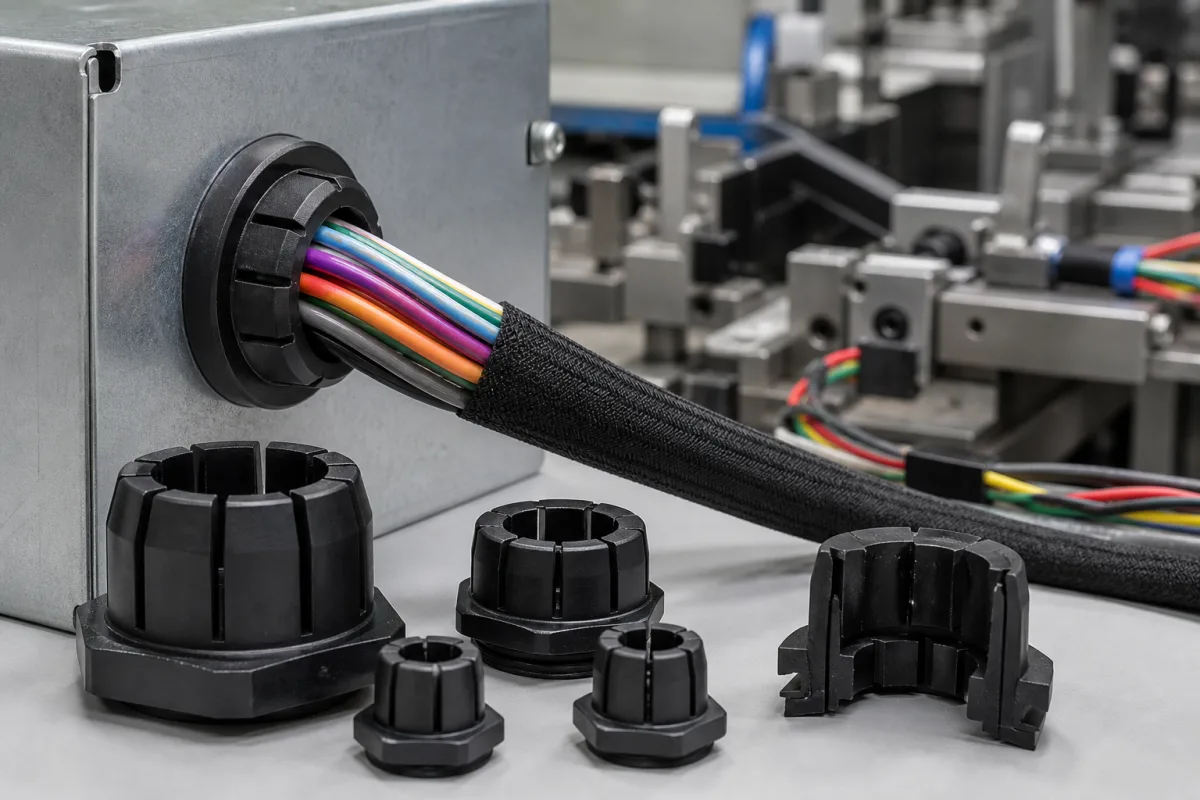
Common Materials
Nylon 6/6, Neoprene Rubber, Stainless Steel
Technical Parameters
  • Acceptable outer diameter range of the wire harness or cable (mm) Customizable
  • Compatible thickness of the mounting panel (mm) Customizable
Components / BOM
  • Bushing Body
    Main structural element that houses the cable and provides the sealing surface
    Material: Nylon 6/6
  • Sealing Gland
    Compressible ring that forms a seal around the cable and against the panel
    Material: Neoprene Rubber
  • Locking Nut
    Threaded component that tightens to compress the seal and secure the bushing in the panel
    Material: Nylon 6/6 or Stainless Steel
Engineering Reasoning
0-150 N axial pull force, -40°C to +125°C temperature
Axial pull force exceeding 150 N causes permanent deformation of locking tabs, temperature exceeding 125°C initiates polymer chain scission in nylon 6/6 material
Design Rationale: Stress concentration at tab root exceeds nylon 6/6 yield strength (80 MPa) causing plastic deformation; thermal degradation via oxidative chain scission at Arrhenius activation energy threshold of 120 kJ/mol
Risk Mitigation (FMEA)
Trigger Vibration-induced fretting at wire-bushing interface
Mode: Insulation abrasion leading to short circuit
Strategy: Integrate silicone grommet with Shore A 40 hardness and 0.5 mm interference fit
Trigger UV radiation exposure exceeding 500 W/m² for 2000 hours
Mode: Polymer embrittlement causing bushing fracture under 50 N side load
Strategy: Apply carbon-black additive at 2.5% concentration for UV stabilization

Industry Taxonomies & Aliases

Commonly used trade names and technical identifiers for Industrial Wire Harness Strain Relief Bushing.

Industrial Ecosystem & Supply Chain DNA

Complementary Systems
Downstream Applications
Specialized Tooling

Application Fit & Sizing Matrix

Operational Limits
pressure: Up to 50 psi (sealing pressure)
other spec: Cable diameter range: 3mm to 25mm, IP68/IP69K rating when properly installed
temperature: -40°C to +125°C
Media Compatibility
✓ Automotive engine compartments ✓ Industrial control panels ✓ Marine electrical systems
Unsuitable: High-pressure hydraulic fluid environments (>50 psi dynamic pressure)
Sizing Data Required
  • Cable/Conduit outer diameter
  • Panel/enclosure wall thickness
  • Required ingress protection rating (IP code)

Reliability & Engineering Risk Analysis

Failure Mode & Root Cause
Material degradation and cracking
Cause: Exposure to environmental stressors such as UV radiation, ozone, extreme temperatures, or chemical contaminants, leading to loss of elasticity, hardening, and eventual fracture.
Mechanical displacement or pull-out
Cause: Inadequate clamping force, improper installation (e.g., misalignment or over-tightening), or excessive vibration/cyclic loading, causing the bushing to shift, deform, or detach from its housing.
Maintenance Indicators
  • Visible cracks, splits, or significant discoloration (e.g., whitening or brittleness) on the bushing surface
  • Audible rattling or scraping noises from the harness area during equipment operation, indicating loose or displaced components
Engineering Tips
  • Select bushings with material compatibility for the operating environment (e.g., EPDM for ozone resistance, silicone for high-temperature applications) and verify IP ratings for ingress protection
  • Ensure proper installation torque and alignment during assembly, and implement routine inspections for signs of wear, especially after maintenance events that may disturb the harness routing

Compliance & Manufacturing Standards

Reference Standards
ISO 6722-1:2011 (Road vehicles - 60 V and 600 V single-core cables) ANSI/SAE J1128 (Low Tension Primary Cable) DIN 72551-6 (Cable harnesses for road vehicles)
Manufacturing Precision
  • Bore diameter: +/-0.05 mm
  • Thread pitch: +/-0.02 mm per thread
Quality Inspection
  • Pull-out force test (minimum 50 N retention)
  • Environmental sealing test (IP67/IP68 rating verification)

Factories Producing Industrial Wire Harness Strain Relief Bushing

Verified manufacturers with capability to produce this product in China

✓ 94% Supplier Capability Match Found

S Sourcing Manager from United Arab Emirates Feb 05, 2026
★★★★★
"Reliable performance in harsh Electrical Equipment Manufacturing environments. No issues with the Industrial Wire Harness Strain Relief Bushing so far."
Technical Specifications Verified
P Procurement Specialist from Australia Feb 02, 2026
★★★★☆
"Testing the Industrial Wire Harness Strain Relief Bushing now; the Mounting Hole Diameter (mm) results are within 1% of the laboratory datasheet. (Delivery took slightly longer than expected, but technical support was excellent.)"
Technical Specifications Verified
T Technical Director from Singapore Jan 30, 2026
★★★★★
"Impressive build quality. Especially the Mounting Hole Diameter (mm) is very stable during long-term operation."
Technical Specifications Verified
Verification Protocol

“Feedback is collected from verified sourcing managers during RFQ (Request for Quote) and factory evaluation processes on CNFX. These reports represent historical performance data and technical audit summaries from our B2B manufacturing network.”

19 sourcing managers are analyzing this specification now. Last inquiry for Industrial Wire Harness Strain Relief Bushing from India (1h ago).

Supply Chain Commonly Integrated Components

Control Cabinet

Electrical enclosure housing control systems for automated industrial equipment

Explore Specs →
Rotor Assembly

The rotating component of an actuator motor that converts electrical energy into mechanical motion

Explore Specs →
Stator Assembly

The stationary component of an electric motor that generates a rotating magnetic field when energized.

Explore Specs →
Wire Tensioner

A device that applies and maintains precise tension on electrical wire during the winding process of transformers.

Explore Specs →

Frequently Asked Questions

What materials are used in industrial wire harness strain relief bushings?

Our industrial strain relief bushings are manufactured from high-quality materials including Nylon 6/6 for the bushing body, Neoprene Rubber for the sealing gland, and Stainless Steel for the locking nut, ensuring durability and reliable performance in demanding environments.

What specifications should I consider when selecting a strain relief bushing?

Key specifications include Ingress Protection (IP) rating for environmental sealing, minimum bending radius to prevent cable damage, mounting hole diameter for proper fit, operating temperature range for thermal stability, and pull-out force rating for secure cable retention.

How does the strain relief bushing protect wire harnesses?

The strain relief bushing mechanically secures wire harnesses at entry/exit points, preventing cable pull-out, reducing stress on connections, and protecting against environmental factors like moisture, dust, and vibration through its sealing components and robust construction.

Can I contact factories directly on CNFX?

CNFX is an open directory, not a transaction platform. Each factory profile provides direct contact information and production details to help you initiate direct inquiries with Chinese suppliers.

Get Quote for Industrial Wire Harness Strain Relief Bushing

Request technical pricing, lead times, or customized specifications for Industrial Wire Harness Strain Relief Bushing directly from verified manufacturing units.

Your business information is encrypted and only shared with verified Industrial Wire Harness Strain Relief Bushing suppliers.

Thank you! Your message has been sent. We'll respond within 1–3 business days.

Need to Manufacture Industrial Wire Harness Strain Relief Bushing?

Connect with verified factories specializing in this product category

Add Your Factory Contact Us
Previous Product
Industrial Wire Harness Sealing Grommet
Next Product
Input Interface Circuitry