Industry-Verified Manufacturing Data (2026)

Output Protection

Based on aggregated insights from multiple verified factory profiles within the CNFX directory, the standard Output Protection used in the Electrical Equipment Manufacturing sector typically supports operational capacities ranging from standard industrial configurations to heavy-duty production requirements.

Technical Definition & Core Assembly

A canonical Output Protection is characterized by the integration of Current Sense Resistor and Protection IC / Comparator. In industrial production environments, manufacturers listed on CNFX commonly emphasize Semiconductor ICs (e.g., protection controllers, comparators) construction to support stable, high-cycle operation across diverse manufacturing scenarios.

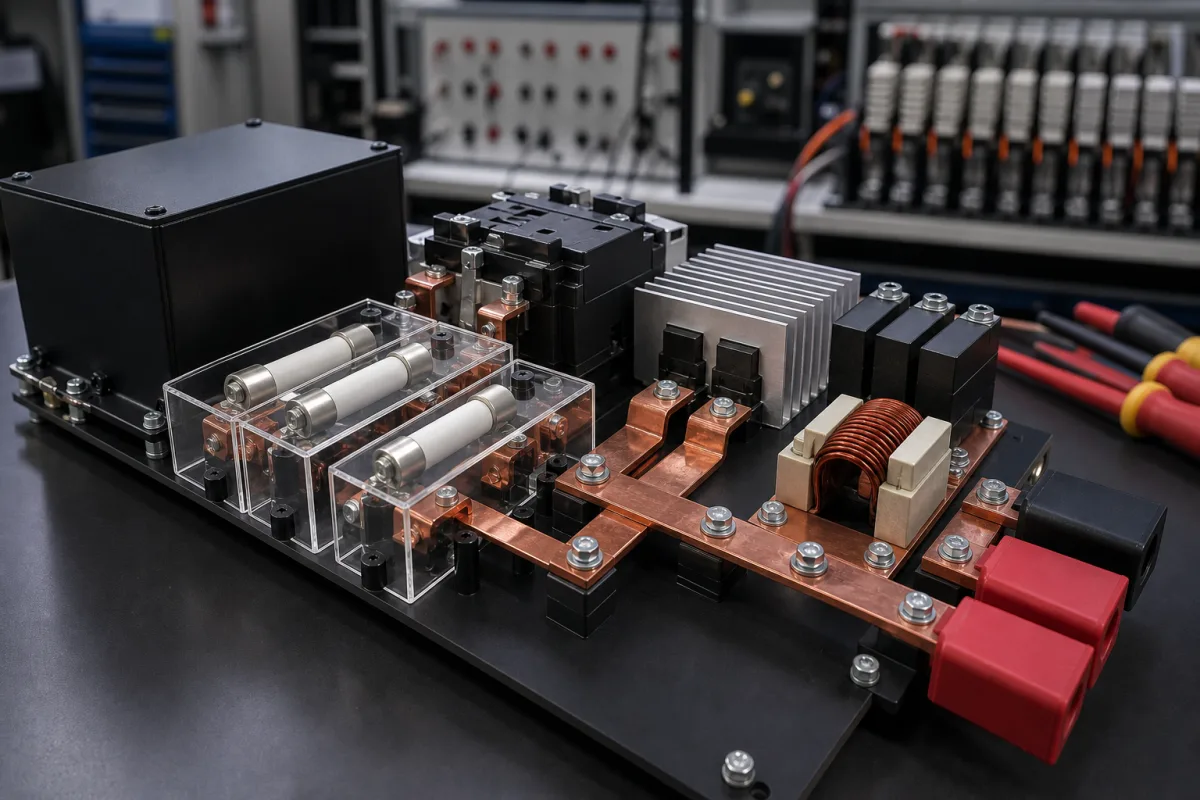
A circuit or mechanism within a power supply module that safeguards connected devices by monitoring and controlling the output voltage and current.
Product Specifications

Technical details and manufacturing context for Output Protection

Definition
Output protection is a critical subsystem within power supply modules designed to prevent damage to both the power supply itself and the connected load. It continuously monitors output parameters and activates protective measures when abnormal conditions are detected, such as overvoltage, overcurrent, short circuits, or reverse polarity. This ensures system reliability and safety by isolating faults before they cause permanent damage.
Working Principle
The protection circuit typically uses sensors (like shunt resistors for current, voltage dividers for voltage) to monitor the output. This data is fed to a control IC or comparator. If parameters exceed predefined safe thresholds, the circuit triggers a response—such as shutting down the output via a MOSFET, activating a crowbar circuit (for overvoltage), or limiting current—to interrupt or regulate the faulty output until the condition is cleared.
Common Materials
Semiconductor ICs (e.g., protection controllers, comparators), Passive components (resistors, capacitors), MOSFETs or relays
Technical Parameters
  • Threshold values for overvoltage protection (OVP) and overcurrent protection (OCP), typically adjustable or fixed based on design. (V, A) Customizable
Components / BOM
  • Current Sense Resistor
    Measures output current by converting it to a proportional voltage drop for monitoring.
    Material: Metal alloy or ceramic
  • Protection IC / Comparator
    Processes sensor inputs and triggers protection mechanisms when thresholds are exceeded.
    Material: Silicon semiconductor
  • Output MOSFET
    Acts as a switch to disconnect the output when a fault is detected.
    Material: Silicon or gallium nitride semiconductor
Engineering Reasoning
0-60 VDC, 0-30 A
Output voltage exceeds 65 VDC or current exceeds 35 A for >100 ms
Design Rationale: Semiconductor junction thermal runaway at >150°C due to I²R heating in MOSFETs when overcurrent protection threshold is exceeded
Risk Mitigation (FMEA)
Trigger Input voltage transient exceeding 400 Vpk for >10 μs
Mode: Feedback loop comparator saturation causing uncontrolled output voltage rise
Strategy: TVS diode clamping at 385 V with 1.5 kJ energy rating on primary side
Trigger Load impedance dropping below 0.2 Ω
Mode: Current sense resistor thermal failure at >250°C
Strategy: Foldback current limiting with 5 ms response time and secondary OCP using Hall-effect sensor

Industry Taxonomies & Aliases

Commonly used trade names and technical identifiers for Output Protection.

Applied To / Applications

This component is essential for the following industrial systems and equipment:

Industrial Ecosystem & Supply Chain DNA

Complementary Systems
Downstream Applications
Specialized Tooling

Application Fit & Sizing Matrix

Operational Limits
pressure: N/A (electronic component)
other spec: Output Voltage Range: 0-60V, Output Current Range: 0-20A
temperature: -40°C to +85°C
Media Compatibility
✓ DC power distribution systems ✓ Industrial control panels ✓ Telecommunications equipment
Unsuitable: High-vibration environments without additional mechanical protection
Sizing Data Required
  • Maximum output current requirement (A)
  • Output voltage range (V)
  • Load transient response time (ms)

Reliability & Engineering Risk Analysis

Failure Mode & Root Cause
Overcurrent Damage
Cause: Excessive electrical load exceeding device rating, often from short circuits, motor inrush currents, or improper sizing, leading to thermal degradation of internal components like fuses, breakers, or semiconductors.
Contamination-Induced Failure
Cause: Accumulation of dust, moisture, or conductive debris on contacts or circuitry, causing insulation breakdown, arcing, or corrosion that compromises protective functionality and increases resistance.
Maintenance Indicators
  • Audible buzzing, humming, or crackling from the device indicating arcing or loose connections
  • Visual signs like discoloration, scorch marks, or melted housing on the output protection unit
Engineering Tips
  • Implement regular infrared thermography scans to detect abnormal heat patterns in connections and components before failure occurs
  • Establish a preventive cleaning schedule using non-conductive compressed air or vacuums to remove contaminants, and apply appropriate conformal coatings in harsh environments

Compliance & Manufacturing Standards

Reference Standards
ISO 13849-1: Safety of machinery - Safety-related parts of control systems ANSI/UL 508: Standard for Industrial Control Equipment CE Marking: Compliance with EU Machinery Directive 2006/42/EC
Manufacturing Precision
  • Enclosure IP Rating: IP65 (dust-tight and protected against water jets)
  • Mounting Hole Alignment: +/-0.5mm
Quality Inspection
  • Dielectric Withstand Test: 1500V AC for 1 minute
  • Environmental Sealing Test: IP65 verification with water spray and dust chamber

Factories Producing Output Protection

Verified manufacturers with capability to produce this product in China

✓ 98% Supplier Capability Match Found

T Technical Director from Singapore Feb 23, 2026
★★★★★
"Reliable performance in harsh Electrical Equipment Manufacturing environments. No issues with the Output Protection so far."
Technical Specifications Verified
P Project Engineer from Germany Feb 20, 2026
★★★★☆
"Testing the Output Protection now; the technical reliability results are within 1% of the laboratory datasheet. (Delivery took slightly longer than expected, but technical support was excellent.)"
Technical Specifications Verified
S Sourcing Manager from Brazil Feb 17, 2026
★★★★★
"Impressive build quality. Especially the technical reliability is very stable during long-term operation."
Technical Specifications Verified
Verification Protocol

“Feedback is collected from verified sourcing managers during RFQ (Request for Quote) and factory evaluation processes on CNFX. These reports represent historical performance data and technical audit summaries from our B2B manufacturing network.”

15 sourcing managers are analyzing this specification now. Last inquiry for Output Protection from Vietnam (1h ago).

Supply Chain Compatible Machinery & Devices

Transformer Winding Machine

Industrial machine for winding copper wire onto transformer cores

Explore Specs →
Circuit Breaker Trip Unit

Protective control module for electrical circuit breakers

Explore Specs →
Circuit Breaker Arc Chute

Electrical component that extinguishes arcs in circuit breakers

Explore Specs →
Medium Voltage Switchgear Assembly Line

Automated production system for assembling medium voltage electrical switchgear.

Explore Specs →

Frequently Asked Questions

How does output protection work in power supply modules?

Output protection continuously monitors voltage and current using sense resistors and protection ICs. When thresholds are exceeded, it triggers MOSFETs or relays to disconnect or limit output, preventing damage to connected devices.

What components are essential for building an output protection circuit?

Key components include a protection IC or comparator for monitoring, current sense resistors for measurement, output MOSFETs or relays for switching, and passive components like resistors and capacitors for stability and filtering.

Why is output protection important in electrical equipment manufacturing?

Output protection prevents costly damage to sensitive devices from voltage spikes, current surges, or short circuits. It enhances product reliability, safety compliance, and reduces warranty claims in industrial applications.

Can I contact factories directly on CNFX?

CNFX is an open directory, not a transaction platform. Each factory profile provides direct contact information and production details to help you initiate direct inquiries with Chinese suppliers.

Get Quote for Output Protection

Request technical pricing, lead times, or customized specifications for Output Protection directly from verified manufacturing units.

Your business information is encrypted and only shared with verified Output Protection suppliers.

Thank you! Your message has been sent. We'll respond within 1–3 business days.

Need to Manufacture Output Protection?

Connect with verified factories specializing in this product category

Add Your Factory Contact Us
Previous Product
Output Measurement and Protection Circuit
Next Product
Output Relay Module