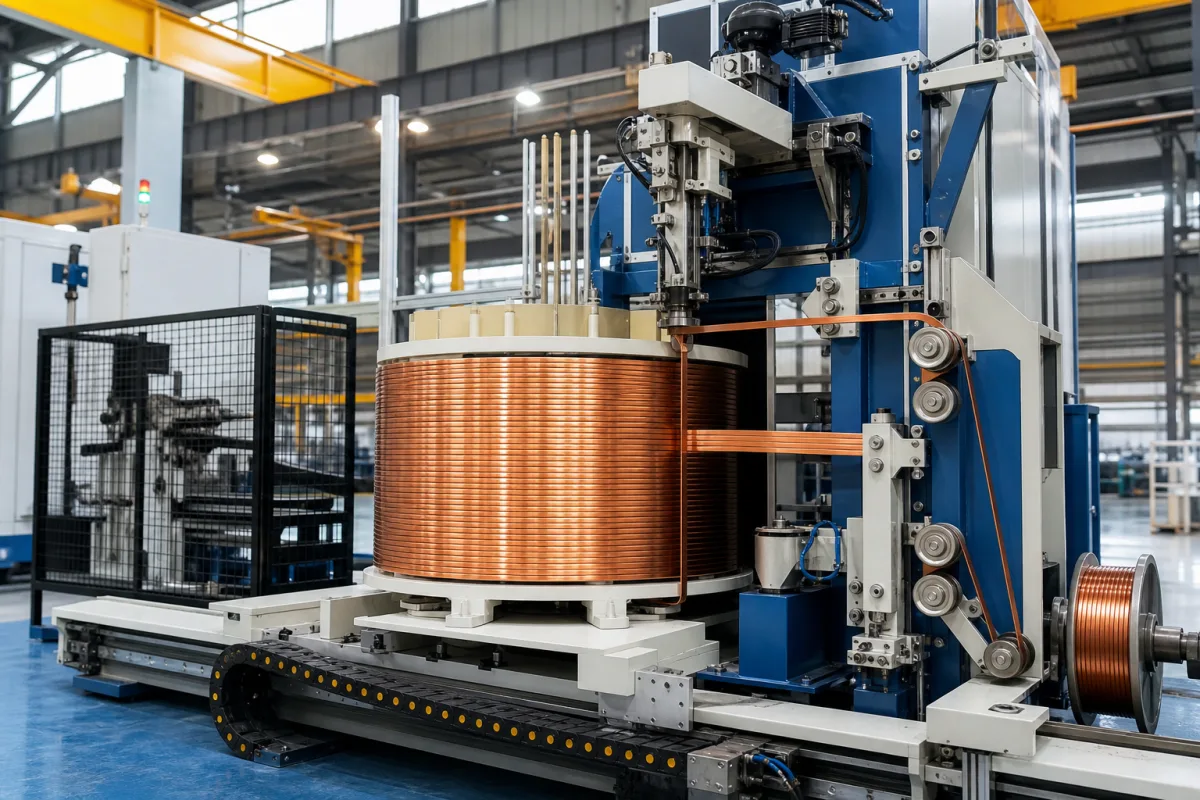
Coil manufacturing · Wire or foil, tension, traverse and coil type
A winding machine turns the spindle, lays the conductor across the coil and holds tension so the wire is neither stretched nor slack. The coil type decides the machine: layer winders for wire, foil winders for low-voltage high-current coils, toroidal winders for ring cores.
Machines for winding transformer, reactor and inductor coils: linear and layer winders, horizontal and vertical heavy-coil winders, foil winders and toroidal winders. Motor stator winders, textile yarn winders and magnet wire itself are outside this page.
CNFX editorial research · Sources checked October 12, 2026 · 6 sources
Transformer Magazine describes foil winding on the low-voltage side of units up to a few MVA and below about 3 kV, with small distribution and rectifier transformers among its listed applications, because a tall thin foil gives the needed cross-section and simplifies winding. The trade-off is eddy currents induced by the stray field across the wide foil surface, which can add up to 70% of the winding's DC losses. [1]
Supplier ranges show the main machine types: MOTI lists foil and horizontal winding machines, Grewin and Guangri list toroidal winding and taping machines, Sanshine lists linear and toroidal winders. [3][5][6]
Give the supplier your coil drawings: conductor type and size (round, rectangular or foil), number of turns and layers, coil and core dimensions and weight, insulation between layers, and production volume.
02
Keep tension within the wire maker's limits
MWS Wire publishes recommended winding tensions for round copper and aluminium magnet wire; its maximums are based on the yield strength of fully annealed copper, and tensions above them may increase resistance. For example, it gives 18 AWG copper a range of 10–13 lb (4.3–5.8 kg) and 28 AWG copper 15–20 oz (425–565 g). It calls these recommendations and advises your own validation tests to make sure the wire is not stretched. [2]
Ask the machine supplier what tension range and accuracy its tensioner holds across the wire sizes you use, and how it is set and verified. Sunshine, for example, describes CNC control of winding, tension, traversing and de-spooling in its TCWM series. [4]
03
Check traverse, counting and handling
Coil quality also depends on how turns are laid and counted and how the machine handles coil weight. Sunshine, for example, lists four spindle speeds with corresponding coil loads on its TCWM series. [4]
Ask for turn-count accuracy, traverse pitch range, maximum coil weight and diameter, spindle speed under load, programmable recipes, and how layer insulation is inserted. For toroids, ask about core size range and taping.
04
Foil, horizontal and toroidal winders on the supplier list
MOTI lists foil winding machines and horizontal winding machines alongside busbar machines; Jinan Sunshine lists TCWM transformer coil winders; Grewin lists toroidal winding machines for power and current transformers; Guangri lists toroidal winding and insulation-taping machines; Sanshine lists linear and toroidal winders with transformer testers. These are suppliers' own descriptions. [3][5]
05
Spindle, tensioner, traverse and pay-off
Only the foil edge control row is specific to foil winders; the tensioner row ties back to the MWS tension limits above.
MOTI lists foil and horizontal winding machines and Jinan Sunshine its TCWM coil winders; Grewin and Guangri list toroidal winding and taping machines, and Sanshine linear and toroidal winders.
JINAN MOTI INDUSTRIAL CO., LTD
Manufacturing site to be confirmed for the order
Lists foil winding and horizontal winding machines for transformer making, alongside busbar machines.
Explore company information and manufacturing capabilities, then discuss the scope of your project with a relevant supplier.
Share this page
Compiled and source-reviewed by the CNFX editorial team.
Each manufacturer above links to the page on that company's own website where the product is listed, with the date we checked it. How we source and review
· Page last updated 13 October 2026
Buyer questions
What winding tension should I use for magnet wire?
Follow the wire maker's table; MWS gives 18 AWG copper 10–13 lb (4.3–5.8 kg), with maximums based on annealed copper yield strength, and advises your own tests. [2]
When are foil windings used in transformers?
Transformer Magazine describes foil winding on the low-voltage side of units up to a few MVA and below 3 kV, at the cost of extra eddy losses. [1]
What happens if winding tension is too high?
MWS notes tensions above its maximums may cause higher resistance values because the wire stretches. [2]
Sources and what still needs a direct check
Sources checked 2026-10-12. Transformer Magazine is a trade publication; its article on foil winding losses explains where foil is used. MWS Wire is a magnet wire maker publishing recommended winding tensions. Supplier pages describe their own offers.