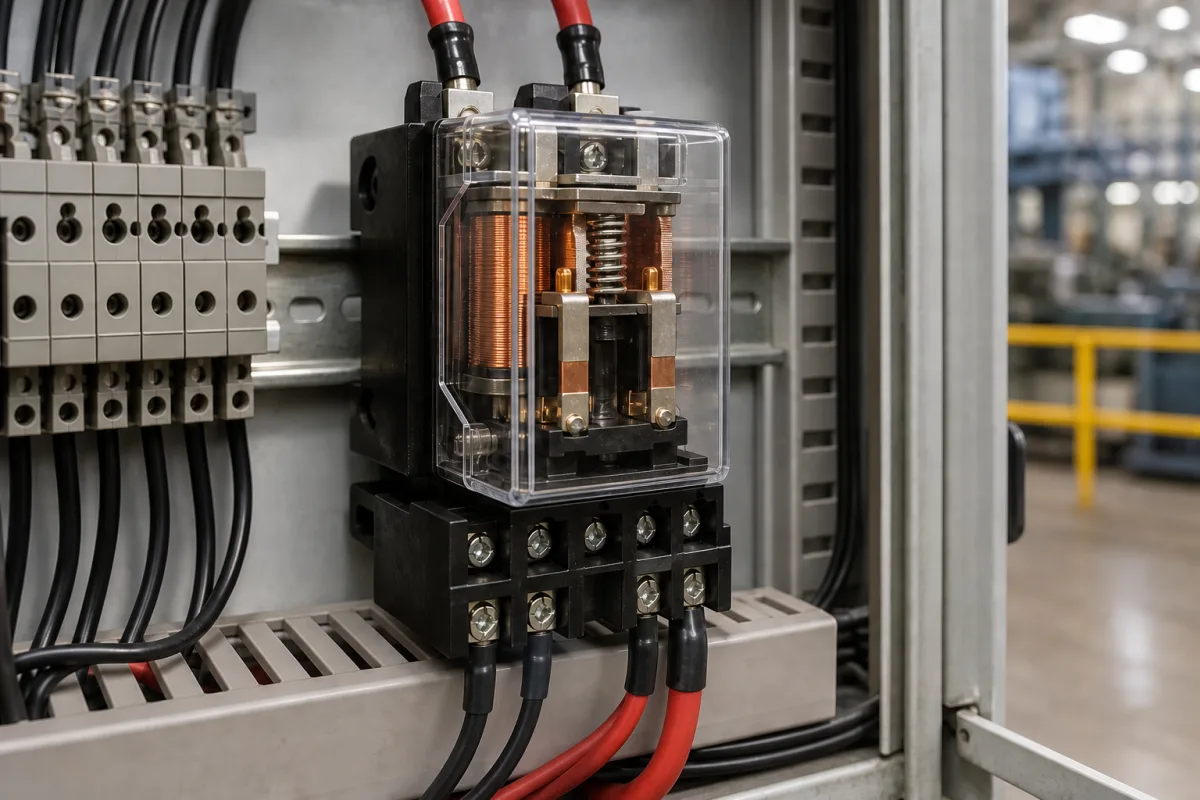
Electromechanical switching · Contact rating by load type, inrush, coil voltage, endurance and insulation
A power relay uses a coil and armature to open or close contacts that carry a load current. Ask three things first: the load type and its inrush current, the coil voltage and drive, and the electrical endurance at your load and switching rate.
Electromechanical power relays for PCB, plug-in socket and panel use in appliances, controls and power equipment. Signal relays, solid-state relays, contactors, automotive relays and high-voltage DC relays are outside this page.
CNFX editorial research · Sources checked October 12, 2026 · 4 sources
ARATAS (formerly Omron Components) explains that contact ratings vary with the voltage applied and the load type and are indicated for resistive loads. Motors and incandescent lamps draw inrush current; a lamp load draws approximately 10 times its steady-state current at switch-on. The UL/CSA TV rating tests inrush withstand with a tungsten lamp load over 25,000 operations, for example TV-5 at 78 A inrush and 5 A steady, and TV-8 at 117 A and 8 A. [1]
DC loads are harder on contacts: without the zero crossing of AC, the arc lasts longer and contacts wear faster; connecting contacts in series increases the total gap to help control the arc. At very small loads, contact resistance can build up through film formation, and twin contacts are more reliable than single contacts. [1]
Causes of contact welding listed by ARATAS include lamp inrush, short-circuit current, vibration, chattering when voltage drops and too high a switching frequency; abnormal contact wear with motor, solenoid and lamp loads calls for surge-absorbing measures. [1]
Give the supplier the load type (resistive, lamp, motor, capacitive, inductive), voltage AC or DC, steady and inrush current, switching rate and required life, coil voltage and drive, mounting, insulation and approvals required.
02
Read a power relay datasheet: a worked example
Hongfa's HF115F datasheet shows the values a buyer should compare. The 1-pole version is rated 12 A or 16 A at 250 VAC resistive, with 440 VAC / 300 VDC maximum switching voltage and 3,000 VA / 4,000 VA maximum switching power; contact resistance is 100 mΩ max at 1 A 6 VDC; mechanical endurance is 1×10⁷ operations, and electrical endurance for the 1H3B type is 1×10⁵ operations at 16 A 250 VAC resistive, room temperature, 1 s on and 9 s off. [3]
Insulation: 1,000 MΩ at 500 VDC; dielectric strength 5,000 VAC for 1 min between coil and contacts and 1,000 VAC across open contacts; 10 kV surge between coil and contacts; operate time 15 ms max and release time 8 ms max; ambient −40 °C to 85 °C. [3]
Editorial calculation: the 24 VDC coil is listed at 1,440 Ω, so it draws 24 ÷ 1,440 ≈ 16.7 mA and 24² ÷ 1,440 = 0.4 W, matching the approximately 400 mW coil power. Its pick-up voltage of 16.8 V max is 70% of nominal and its drop-out of 2.4 V min is 10%. [3] The 1×10⁵-operation electrical rating at one operation per 10 s represents about 278 hours of testing; at 100 operations a day it would last about 2.7 years, but only under the stated resistive load. Electrical durability is counted at the rated load, so test under your actual load. [1]
The same datasheet says products with rated coil voltage of 48 V or more need measures such as a parallel diode to prevent coil overvoltage.
03
Ask which IEC 61810-1 procedure the relay was type-tested to
IEC 61810-1:2015 "applies to electromechanical elementary relays (non-specified time all-or-nothing relays) for incorporation into low voltage equipment (circuits up to 1 000 V alternate current or 1 500 V direct current)". It defines basic functional and safety requirements, verified by type tests, for uses from industrial equipment and household appliances to medical equipment, telecommunications and railways. The fourth edition, published on 25 February 2015, replaced the 2008 third edition and introduced two test procedures: procedure A, as in edition 3, and procedure B, "reflecting the assessment according to North American requirements". [4]
Hongfa lists the HF115F at 12 A or 16 A at 250 VAC resistive with 1×10⁵ electrical operations for one type [3], and ARATAS notes that ratings are stated for resistive loads and that lamp loads draw about 10 times steady-state current at switch-on [1]. Ask the supplier which edition and procedure of IEC 61810-1 the relay was type-tested to, which contact load category the electrical endurance figure refers to, and the certificate number.
For products sold in North America, edition 4's procedure B and Clause D.1 application tests are the parts that reflect North American requirements [4]. ARATAS describes the UL/CSA TV rating as an inrush test with a tungsten lamp load over 25,000 operations [1]; if the load is a lamp or motor, ask for that rating as well as the IEC resistive rating.
Editorial calculation: the 1 000 V AC and 1 500 V DC scope limits are well above a 250 VAC relay rating; at 16 A and 250 V a resistive load is 4,000 VA, matching the HF115F maximum switching power figure. [4][3]
Item
IEC 61810-1:2008 (edition 3)
IEC 61810-1:2015 (edition 4)
Scope
Electromechanical elementary relays for incorporation into equipment
Same, for low voltage equipment up to 1 000 V AC or 1 500 V DC
Main changes
Contact load categories (as IEC 61810-2 and 61810-7); electrical endurance clarified; insulation coordination; annexes for test set-up and special loads
Procedure A and procedure B (North American); device application tests (Clause D.1); single mounting condition; insulation after endurance clarified
Published / withdrawn
27 February 2008 / 25 February 2015
25 February 2015 / current (with AMD1:2019; corrigenda 2017, 2018; interpretation sheet 2023)
Values are from the Standard Norge catalogue pages for IEC 61810-1:2015 and IEC 61810-1:2008; the full standard was not reviewed.
04
Compare what suppliers offer
Suppliers linked to this page list power relays alongside other relay types; each card links to the page reviewed.
Hongfa lists power relays from 5 A to 40 A among its other relay families; Forward, Meishuo, Qianji, HWRELAY and Shenler list power relays with general-purpose, PCB, industrial or automotive relays and sockets; Naidian lists power relays with time and solid-state relays; Mycoil lists general power relays with EMI filters and transformers; RHTECP lists power relays in an electronic components catalogue.
05
Trace the relay components
This is a functional reference built from the sources cited; it is not one maker's parts list.
Part
Role
Fix in the order
Coil
Drives the armature; must not exceed its rating. [1]
Voltage, resistance, power.
Armature and spring
Moves the contacts; foreign matter between armature and core causes buzzing. [1]
Construction.
Contacts
Form A make, Form B break, Form C transfer; single or twin. [2]
Form, material, rating.
Terminals
Plug-in, PCB, screw, surface-mount or quick-connect. [2]
Termination and socket.
Enclosure
Flux-resistant, plastic-sealed or hermetically sealed. [2]
Sealing for your process.
06
Fill the specification fields with values for your load
A power relay quotation needs values for your load and circuit. The table explains each field, gives published values where a reviewed source states them, and says what to obtain from the supplier.
Explore company information and manufacturing capabilities, then discuss the scope of your project with a relevant supplier.
Share this page
Compiled and source-reviewed by the CNFX editorial team.
Published product pages show what a company offers, not tested performance. Confirm the legal seller, factory and scope for your order. How we source and review
· Page last updated 13 October 2026
Buyer questions
Can a 16 A relay switch a 16 A lamp or motor load?
Not necessarily: ARATAS describes ratings as stated for resistive loads, and lamp loads draw about 10 times steady current at switch-on. Check inrush or TV ratings and test at the real load. [1]
Why do relays wear faster on DC?
DC has no zero crossing to quench the arc, so the arc lasts longer and contacts wear more quickly. [1]
What is the difference between mechanical and electrical life?
Mechanical life counts operations with no load on the contacts; electrical life counts operations at the rated load. In the HF115F example they are 1×10⁷ and 1×10⁵ operations. [1][3]
Which standard covers electromechanical power relays?
IEC 61810-1 covers electromechanical elementary relays for low voltage equipment up to 1 000 V AC or 1 500 V DC. Its 2015 edition added test procedure B, reflecting North American requirements, alongside procedure A. [4]
Sources and what still needs a direct check
Sources checked 2026-10-12. ARATAS (formerly Omron Components) is a relay maker; its application guidance is its own. Hongfa is a relay maker listed on this page; its datasheet is used as a worked example, not a recommendation.