SCR power controllers · Zero-cross or phase-angle firing, soft start and current limit, load current sizing, I²t fusing, cooling
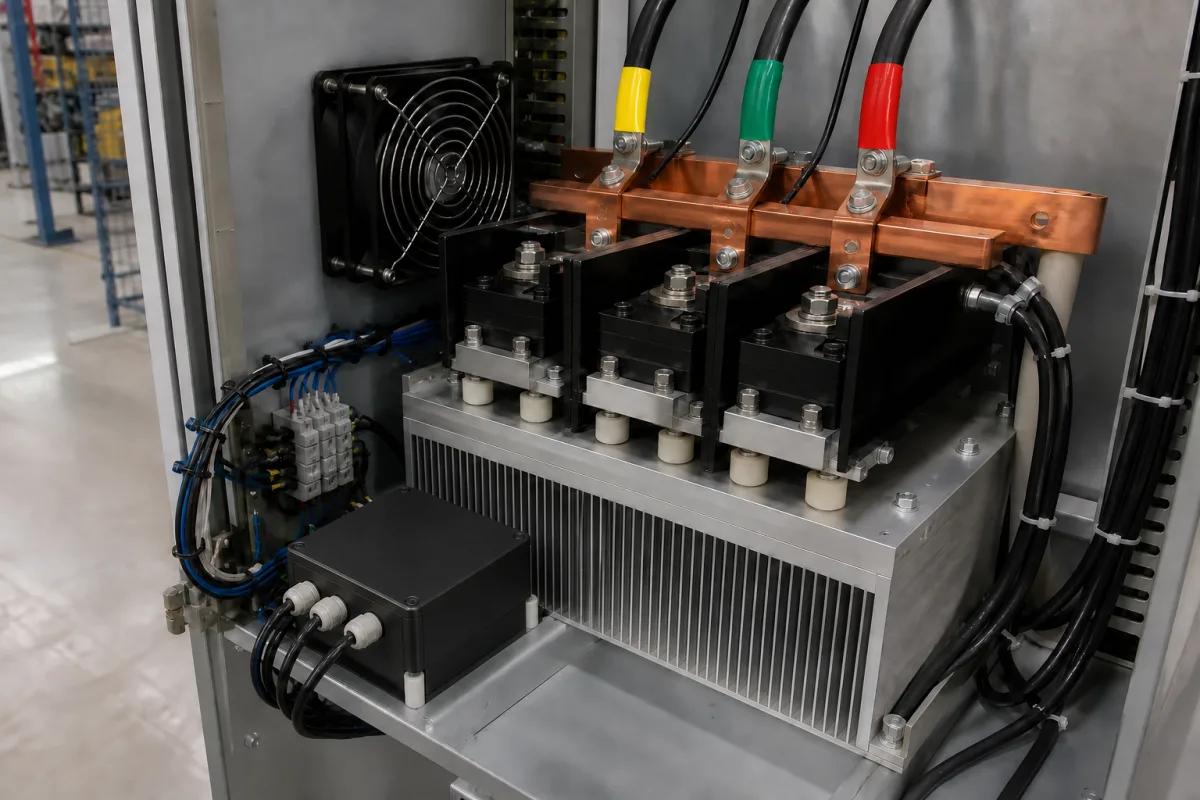
An SCR (thyristor) power controller switches mains power to electric heaters in proportion to a control signal, using back-to-back SCRs on a heat sink with fuses and trigger circuitry, like the fan-cooled thyristor stack pictured with its busbars. Ask three things first: whether the load needs zero-cross (burst) firing or phase-angle firing, what current the load draws at your line voltage and whether soft start or current limit is needed, and how the controller is fused, cooled and protected.
Single- and three-phase SCR power controllers and thyristor power regulators for resistive and heating loads, with zero-cross or phase-angle firing. Solid-state relays used only for on/off switching, DC drives, variable frequency drives and temperature controllers are outside this page.
CNFX editorial research · Sources checked October 11, 2026 · 4 sources
Omega's data for its SCR19-H and SCR39-H power controllers, for resistive loads such as ovens, furnaces and heat sealers, explains that zero-crossover firing switches bursts of full sine waves of line voltage, eliminating the radio-frequency interference associated with mechanical relays, while phase-angle firing turns each SCR on for a controlled portion of each half-cycle so the effective voltage follows the 4–20 mA control signal and is regulated as line voltage changes. The units are not designed to drive transformers or other inductive loads. [1]
Chromalox's MiniMax manual describes its zero-cross DOT firing, which switches the fewest cycles for precise control: at 50% output, one cycle on and one cycle off, with single- or three-cycle resolution selectable. Its phase-angle MiniMax 1P proportions every cycle for very fine resolution, can drive inductive or resistive loads, and is required for fast-responding loads whose resistance changes with temperature; it offers soft start, which ramps power from zero after a power interruption (the manual lists a reset speed of 25% demand per second (typ.)), and optional current limit adjustable from 10 to 100% of rated output to protect against start-up surges. [2]
Omega offers soft start times of 9, 15, 30, 60 or 120 seconds on its phase-angle models, which it lists for high-inrush heaters, and says zero-cross and phase-angle control both extend heater life by reducing thermal shock. [1]
Give the supplier the heater type and resistance behaviour (constant or changing with temperature), total load power, line voltage and phases, connection (delta, star, single phase), control signal, firing mode, soft start and current limit needs, alarms (shorted SCR, over-temperature), ambient temperature, cooling and enclosure, and the EMC and harmonic requirements of your site.
02
Size load current, fusing and cooling
Omega gives the load current as total load watts ÷ line voltage for single-phase loads and total watts ÷ (1.73 × line voltage) for three-phase loads; its SCR19-H and SCR39-H come in 125, 200 and 250 A ratings for 120 to 600 V AC, 50–60 Hz, with 2,500 V AC control signal isolation, 0 to 50 °C ambient, fan cooling and one semiconductor I²t fuse per controlled line. [1]
Chromalox's MiniMax data gives 30, 50 and 75 A ratings from 120 to 575 V, 0 to 50 °C ambient, SCRs with a surge rating of 15 times nominal RMS rating for 8.3 milliseconds (typ.) and 2,500 V isolation, a heat-sink sensor with a warning alarm before a second alarm inhibits firing, and dv/dt and MOV transient protection. It stresses that the I²t fuses protect the SCRs from load-side faults and are not intended to protect the wiring, and that loose power connections create hot spots. [2]
Editorial calculation: a 48 kW three-phase heater bank at 480 V draws 48,000 ÷ (1.73 × 480) ≈ 58 A per line, and a 24 kW single-phase load at 240 V draws 100 A. Choose the controller rating, fuses and cable for these currents plus any allowance the maker sets for ambient temperature and heater hot-to-cold resistance ratio.
03
Heating regulation units and controllers sold with PID instruments
Listings include SCR power controllers for industrial voltage and heating regulation, and SCR controllers for resistance heating offered with temperature controllers. Ask each supplier for firing modes, current ratings at your ambient, fuse type, cooling, alarms and EMC conformity.
04
Match the firing mode to the heating element material
Control Concepts publishes a load-type page for variable-resistance heaters, naming molybdenum, graphite and silicon carbide elements, and lists the SCR controllers it recommends for them. Every model on that list offers phase-angle firing, either as its only mode or as a selectable mode beside zero cross. Its 3629C three-phase phase-angle controller covers 208–575 Vac and 50–1000 A and adds current limiting, shorted SCR detection and over-current trip, the same features it lists for the single-phase 1029D at 50–2000 A. [3]
The same page describes the FUSION range as auto-ranging from 24 to 600 Vac at 45–65 Hz; the single-phase AC FUSION covers 50 to 1200 A and linearly controls the AC voltage, current or true power applied to the load. Control Concepts states that its three-phase FUSION and Compact FUSION can be ordered with 2- or 3-leg control, with 2-leg control limited to zero cross firing. [3]
Editorial note: a molybdenum, graphite or silicon carbide load that needs phase-angle firing on a three-phase supply therefore needs 3-leg control. State the element material, the firing mode and the control variable (voltage, current or true power) in the enquiry.
05
Weigh harmonics, MTBF and current limiting when fixing the firing mode
Watlow's technical article on SCR firing says that not all SCRs can be fired by both zero cross and phase angle, and that Nichrome-wire heaters support both. In its phase-angle example at 30% duty, the controller does not conduct for the first 70% of the sine wave and conducts for the last 30%, which Watlow states delivers 144 volts to the load on a 480 volt source. [4]
Watlow gives the lack of current limiting as the primary reason zero cross is not the correct method for variable-resistance heaters. [4]
Editorial calculation: Watlow's 144 V equals 30% × 480 V. Ask the supplier for the output voltage or power against control signal for the firing mode quoted, and if phase angle is chosen for current limiting or soft start, include harmonic filtering and panel layout in the quotation scope.
Multiple panel units can cause crosstalk; conducted harmonics need chokes, coils or filters [4]
06
SCR pairs, heat sink, trigger board, fuses and alarms
The trigger board row carries the firing-mode choice made above; the fuse row carries Chromalox's warning that I²t fuses guard the SCRs, not the cable. [2]
Voltage, amps, firing mode and soft-start range for the heater
Work out the current row with Omega's formula from the sizing section before choosing a rating; both makers list 0–50 °C ambient, so ask how the rating derates above that.
Greegoo lists SCR power controllers for voltage and heating regulation; Maxwell sells SCR controllers for resistance heating together with PID temperature controllers and sensors.
Greegoo Electric
Manufacturing site to be confirmed for the order
Lists SCR power controllers for industrial voltage and heating regulation.
Explore company information and manufacturing capabilities, then discuss the scope of your project with a relevant supplier.
Share this page
Compiled and source-reviewed by the CNFX editorial team.
Each manufacturer above links to the page on that company's own website where the product is listed, with the date we checked it. How we source and review
· Page last updated 13 October 2026
Buyer questions
What is the difference between zero-cross and phase-angle firing?
Omega explains that zero-cross switches bursts of full sine waves, while phase-angle switches part of every half-cycle; Chromalox says phase angle suits loads whose resistance changes with temperature. [1][2]
How do I calculate the current of a three-phase heater?
Omega gives amps = total watts ÷ (1.73 × line voltage); 48 kW at 480 V is about 58 A (editorial calculation). [1]
Do the SCR fuses protect the cables?
No. Chromalox states its I²t fuses protect the SCRs from load-side faults and are not intended to protect wiring. [2]
Which firing mode suits silicon carbide, molybdenum or graphite heaters?
Control Concepts lists only controllers with phase-angle firing (some also offer zero cross) for these variable-resistance loads, and limits its 2-leg three-phase controllers to zero cross firing. [3]
What are the trade-offs of phase-angle SCR firing?
Watlow lists current limiting, a voltage soft-start option and suitability for high hot-to-cold resistance loads, against higher cost, lower MTBF, harmonic distortion and EMI that can need chokes, coils or filters. [4]
Sources and what still needs a direct check
Sources checked 2026-10-11. Omega and Chromalox are makers of SCR power controllers; their data and manual describe their own products.