Industry-Verified Manufacturing Data (2026)

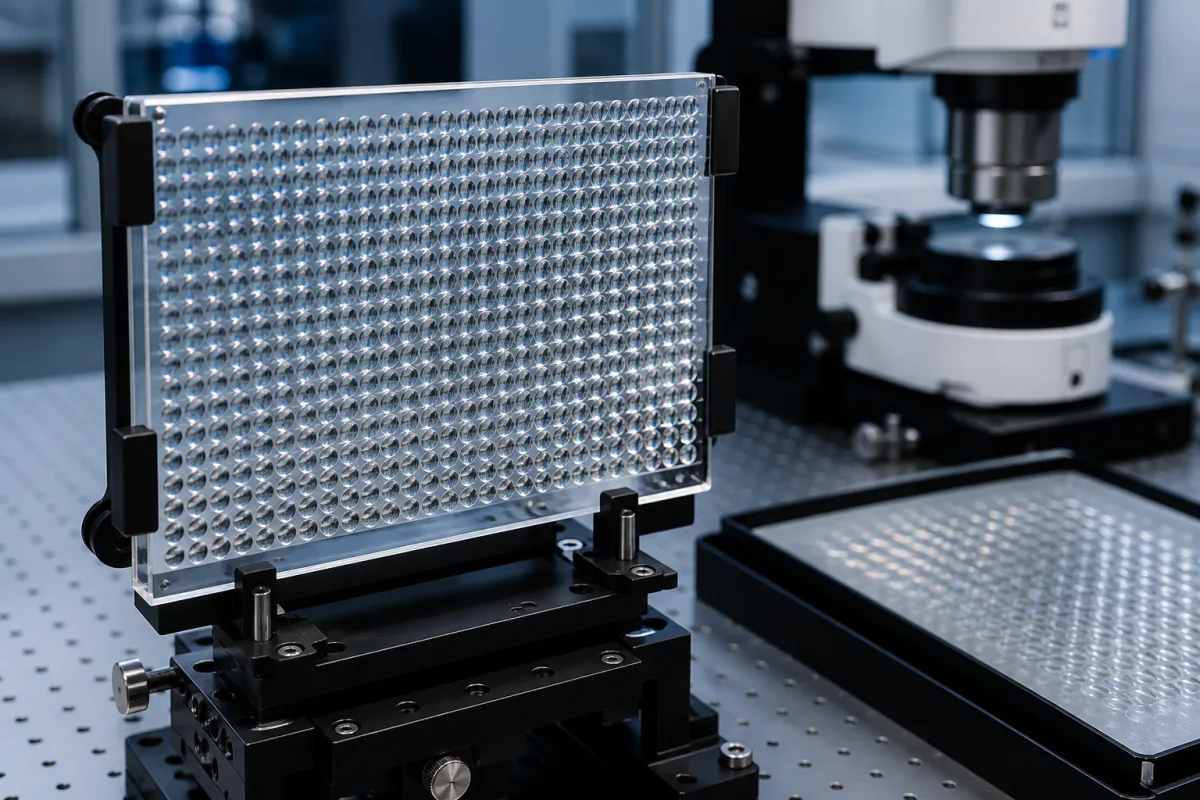
Precision Optical Lens Array

Based on aggregated insights from multiple verified factory profiles within the CNFX directory, the standard Precision Optical Lens Array used in the Electrical Equipment Manufacturing sector typically supports operational capacities ranging from standard industrial configurations to heavy-duty production requirements.

Technical Definition & Core Assembly

A canonical Precision Optical Lens Array is characterized by the integration of Lens Element and Mounting Frame. In industrial production environments, manufacturers listed on CNFX commonly emphasize Optical-grade polycarbonate construction to support stable, high-cycle operation across diverse manufacturing scenarios.

Multi-element optical component for controlled light distribution in professional lighting systems.
Product Specifications

Technical details and manufacturing context for Precision Optical Lens Array

Definition
A precision-engineered optical assembly consisting of multiple lens elements arranged in a specific pattern to manipulate light output from LED or other light sources. This component is critical in professional lighting equipment manufacturing, enabling precise beam shaping, light diffusion, and intensity control. It serves as a key sub-assembly in B2B supply chains for architectural, stage, and industrial lighting systems, where optical performance directly impacts product quality and compliance with lighting standards. Manufacturers integrate these arrays into luminaires to achieve specific photometric distributions required for various applications.
Working Principle
Utilizes refraction through precisely shaped glass or polymer lens elements to redirect, focus, or diffuse light rays from the source, creating controlled illumination patterns through optical design principles.
Common Materials
Optical-grade polycarbonate, Borosilicate glass, Optical silicone
Technical Parameters
  • Array pitch distance between lens centers (mm) Per Request
  • Beam angle at 50% intensity (degrees) Per Request
Components / BOM
  • Lens Element
    Primary light refraction surface
    Material: Optical-grade polycarbonate or glass
  • Mounting Frame
    Structural support and alignment of lens elements
    Material: Aluminum alloy or engineering plastic
  • Anti-reflective Coating Optional
    Reduces surface reflections and increases light transmission
    Material: Magnesium fluoride or multi-layer dielectric
  • Sealing Gasket Optional
    Environmental protection against dust and moisture
    Material: Silicone rubber
Engineering Reasoning
400-700 nm wavelength, 20-80°C ambient temperature, 0-85% relative humidity
Lens surface temperature exceeds 120°C, causing polymer substrate glass transition at Tg=115°C
Design Rationale: Thermal expansion coefficient mismatch (α_lens=8.2×10^-6/K, α_mount=23×10^-6/K) induces mechanical stress exceeding yield strength σ_y=45 MPa
Risk Mitigation (FMEA)
Trigger UV radiation exposure at 365 nm wavelength exceeding 50 mW/cm² intensity
Mode: Polymer lens substrate photodegradation, transmittance reduction to <85% at 550 nm
Strategy: UV-blocking coating with extinction coefficient k=0.01 at 365 nm, integrated optical filter with cutoff at 400 nm
Trigger Mechanical shock exceeding 50g acceleration for 11 ms duration
Mode: Lens array misalignment exceeding 5 μm positional tolerance, beam divergence increase to >2°
Strategy: Kinematic mounting with 6-DOF constraint, viscoelastic damping material with loss factor η=0.3 at 100 Hz

Industry Taxonomies & Aliases

Commonly used trade names and technical identifiers for Precision Optical Lens Array.

Industrial Ecosystem & Supply Chain DNA

Complementary Systems
Downstream Applications
Specialized Tooling

Application Fit & Sizing Matrix

Operational Limits
pressure: Atmospheric to 2 bar
other spec: Wavelength range: 380-780 nm, Humidity: 0-95% RH non-condensing
temperature: -40°C to +85°C
Media Compatibility
✓ Clean air environments ✓ LED light sources ✓ UV-stable polymer housings
Unsuitable: Abrasive particulate-laden atmospheres
Sizing Data Required
  • Required beam angle distribution
  • Target illumination uniformity
  • Source-to-lens distance

Reliability & Engineering Risk Analysis

Failure Mode & Root Cause
Surface contamination and adhesion of particulates
Cause: Inadequate cleanroom protocols during handling or assembly, leading to dust, oils, or residues that scatter light and degrade optical performance.
Delamination or micro-cracking of anti-reflective coatings
Cause: Thermal cycling stress or exposure to high humidity, causing differential expansion between coating layers and the substrate, compromising optical clarity.
Maintenance Indicators
  • Visible haze, streaks, or discoloration on lens surfaces under inspection lighting
  • Audible clicking or grinding during automated alignment, indicating particulate interference or mechanical stress
Engineering Tips
  • Implement strict cleanroom handling procedures (e.g., Class 1000 or better environment, use of lint-free gloves, and regular HEPA filter maintenance) to minimize particulate contamination.
  • Control environmental conditions (maintain stable temperature ±1°C and humidity below 40% RH) to reduce thermal and moisture-induced stress on coatings and substrates.

Compliance & Manufacturing Standards

Reference Standards
ISO 10110-7:2017 (Optics and photonics - Preparation of drawings for optical elements and systems - Surface imperfection tolerances) ANSI/OPC 1-2020 (Optical Performance Criteria for Precision Optical Components) DIN 3140-7:2016 (Optics and optical instruments - Preparation of drawings for optical elements and systems - Part 7: Surface form tolerances)
Manufacturing Precision
  • Surface figure error: λ/10 RMS (λ=632.8nm)
  • Centration tolerance: ±0.02mm
Quality Inspection
  • Interferometric surface testing
  • MTF (Modulation Transfer Function) measurement

Factories Producing Precision Optical Lens Array

Verified manufacturers with capability to produce this product in China

✓ 93% Supplier Capability Match Found

P Project Engineer from Germany Feb 07, 2026
★★★★★
"Testing the Precision Optical Lens Array now; the Focal Length (mm) results are within 1% of the laboratory datasheet."
Technical Specifications Verified
S Sourcing Manager from Brazil Feb 04, 2026
★★★★★
"Impressive build quality. Especially the Focal Length (mm) is very stable during long-term operation."
Technical Specifications Verified
P Procurement Specialist from Canada Feb 01, 2026
★★★★★
"As a professional in the Electrical Equipment Manufacturing sector, I confirm this Precision Optical Lens Array meets all ISO standards."
Technical Specifications Verified
Verification Protocol

“Feedback is collected from verified sourcing managers during RFQ (Request for Quote) and factory evaluation processes on CNFX. These reports represent historical performance data and technical audit summaries from our B2B manufacturing network.”

15 sourcing managers are analyzing this specification now. Last inquiry for Precision Optical Lens Array from India (52m ago).

Supply Chain Commonly Integrated Components

Stator Assembly

The stationary component of an electric motor that generates a rotating magnetic field when energized.

Explore Specs →
Wire Tensioner

A device that applies and maintains precise tension on electrical wire during the winding process of transformers.

Explore Specs →
Wire Guide System

A precision mechanical system that guides and positions wire during the winding process on a transformer winding machine.

Explore Specs →
Counter System

A monitoring and control subsystem that tracks and records the number of winding turns during transformer coil production.

Explore Specs →

Frequently Asked Questions

What are the key applications for this precision optical lens array?

This lens array is designed for professional lighting systems requiring controlled light distribution, including architectural lighting, stage/studio lighting, industrial lighting, and specialized illumination applications where precise beam shaping is critical.

How does the anti-reflective coating improve performance?

The anti-reflective coating minimizes light loss through reflection, increasing overall transmittance and reducing glare. This ensures maximum light output efficiency and prevents unwanted light scattering in professional lighting applications.

What temperature range can this lens array withstand?

The lens array operates reliably within the specified temperature range, with materials selected for thermal stability. The optical-grade polycarbonate, borosilicate glass, and optical silicone maintain performance across typical professional lighting operating conditions.

Can I contact factories directly on CNFX?

CNFX is an open directory, not a transaction platform. Each factory profile provides direct contact information and production details to help you initiate direct inquiries with Chinese suppliers.

Get Quote for Precision Optical Lens Array

Request technical pricing, lead times, or customized specifications for Precision Optical Lens Array directly from verified manufacturing units.

Your business information is encrypted and only shared with verified Precision Optical Lens Array suppliers.

Thank you! Your message has been sent. We'll respond within 1–3 business days.

Need to Manufacture Precision Optical Lens Array?

Connect with verified factories specializing in this product category

Add Your Factory Contact Us
Previous Product
Precision LED Lens Molding Machine
Next Product
Precision Reflector Assembly