Industry-Verified Manufacturing Data (2026)

Precision Reflector Assembly

Based on aggregated insights from multiple verified factory profiles within the CNFX directory, the standard Precision Reflector Assembly used in the Electrical Equipment Manufacturing sector typically supports operational capacities ranging from standard industrial configurations to heavy-duty production requirements.

Technical Definition & Core Assembly

A canonical Precision Reflector Assembly is characterized by the integration of Reflective Surface and Structural Frame. In industrial production environments, manufacturers listed on CNFX commonly emphasize Anodized Aluminum construction to support stable, high-cycle operation across diverse manufacturing scenarios.

Optical component that directs and shapes light output in luminaires.

Product Specifications

Technical details and manufacturing context for Precision Reflector Assembly

Definition
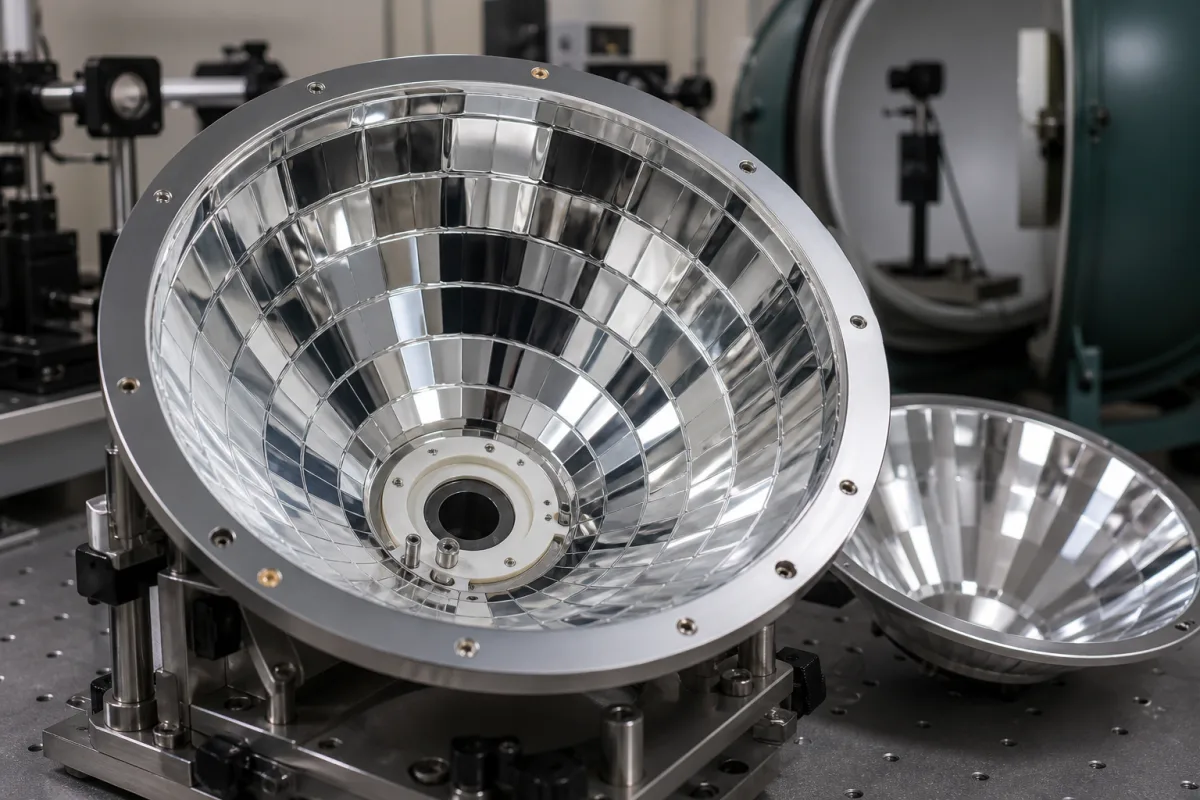
A precision reflector assembly is a critical optical component used in professional and industrial lighting equipment to control light distribution, intensity, and beam patterns. It consists of a reflective surface mounted on a structural frame, engineered to maximize luminous efficiency while minimizing glare and light pollution. These assemblies are essential in B2B supply chains for manufacturers of street lights, stadium floodlights, high-bay industrial fixtures, and architectural lighting systems. They enable lighting designers to achieve specific photometric performance requirements while optimizing energy consumption and maintenance costs.
Working Principle
Light rays from the light source strike the precisely shaped reflective surface, which redirects them according to optical design principles (typically specular or diffuse reflection) to create controlled beam patterns with desired intensity distribution and cutoff angles.
Common Materials
Anodized Aluminum, Polished Stainless Steel, Enhanced Reflector Coatings
Technical Parameters
  • Reflector aperture diameter (mm) Standard Spec
  • Luminous intensity distribution (cd/klm) Standard Spec
Components / BOM
  • Reflective Surface
    Redirects light rays according to optical design
    Material: Anodized aluminum with enhanced coating
  • Structural Frame
    Provides mechanical support and heat dissipation
    Material: Aluminum alloy
  • Mounting Bracket
    Secures assembly to luminaire housing
    Material: Stainless steel
  • Thermal Interface Pad Optional
    Improves heat transfer from light source
    Material: Silicone-based thermal compound
Engineering Reasoning
300-700 nm wavelength, 0-85°C ambient temperature, 0-95% relative humidity (non-condensing)
Reflectance degradation below 85% at 550 nm, surface deformation exceeding 0.1 mm RMS, coating delamination exceeding 1 mm²
Design Rationale: Photodegradation of aluminum/silver reflective coatings due to UV exposure (λ<400 nm) causing oxidation, thermal expansion mismatch between glass substrate (α=8.5×10⁻⁶/K) and metallic coating (α=23×10⁻⁶/K) inducing mechanical stress, moisture ingress through pinhole defects accelerating corrosion via electrochemical reactions
Risk Mitigation (FMEA)
Trigger UV photon flux exceeding 5 W/m² at λ<400 nm over 10,000 hours
Mode: Reflectance loss from 95% to <85% at 550 nm wavelength
Strategy: Deposit 50 nm SiO₂ barrier layer (n=1.46) over aluminum coating using PVD, implement λ<420 nm cutoff filter with OD>3 attenuation
Trigger Thermal cycling between -20°C and +100°C at 5°C/min rate for 500 cycles
Mode: Coating delamination initiating at edge defects propagating >1 mm²
Strategy: Apply graded TiN adhesion layer (0.5 μm) with compressive stress of -1.2 GPa, implement edge sealing with 0.3 mm epoxy bead (CTE=45×10⁻⁶/K)

Industry Taxonomies & Aliases

Commonly used trade names and technical identifiers for Precision Reflector Assembly.

Industrial Ecosystem & Supply Chain DNA

Complementary Systems
Downstream Applications
Specialized Tooling

Application Fit & Sizing Matrix

Operational Limits
pressure: Atmospheric only (non-pressurized)
other spec: Max optical power density: 5 W/cm²
temperature: -40°C to +150°C
Media Compatibility
✓ Indoor air environments ✓ Clean room atmospheres ✓ Dry inert gas enclosures
Unsuitable: High humidity/condensing environments
Sizing Data Required
  • Required beam angle (degrees)
  • Target luminous flux output (lumens)
  • Mounting interface dimensions (mm)

Reliability & Engineering Risk Analysis

Failure Mode & Root Cause
Optical surface degradation
Cause: Accumulation of contaminants (dust, oils, particulates) or micro-scratches from improper cleaning methods, leading to reduced reflectivity and beam distortion.
Mechanical misalignment
Cause: Thermal expansion/contraction stresses, vibration-induced loosening of mounting hardware, or impact damage altering the precise angular orientation of the reflector.
Maintenance Indicators
  • Visible haze, streaks, or particulate buildup on the reflective surface under inspection lighting.
  • Audible rattling or clicking from the assembly during operation, indicating loose components or compromised structural integrity.
Engineering Tips
  • Implement a strict cleaning protocol using lint-free wipes and approved optical-grade solvents only, avoiding abrasive contact to preserve surface finish.
  • Use vibration-damping mounts and schedule periodic laser alignment checks to maintain optical precision and compensate for thermal drift.

Compliance & Manufacturing Standards

Reference Standards
ISO 10110-5:2015 (Optics and photonics - Preparation of drawings for optical elements and systems - Part 5: Surface form tolerances) ANSI/ASME Y14.5-2018 (Dimensioning and Tolerancing) DIN 3140-7:2016 (Optics and optical instruments - Preparation of drawings for optical elements and systems - Part 7: Surface form and location tolerances)
Manufacturing Precision
  • Surface Roughness: Ra ≤ 0.025 μm
  • Angular Alignment: ±0.05°
Quality Inspection
  • Interferometric Surface Flatness Test
  • Coordinate Measuring Machine (CMM) Dimensional Verification

Factories Producing Precision Reflector Assembly

Verified manufacturers with capability to produce this product in China

✓ 98% Supplier Capability Match Found

P Procurement Specialist from Singapore Jan 11, 2026
★★★★★
"Great transparency on the Precision Reflector Assembly components. Essential for our Electrical Equipment Manufacturing supply chain."
Technical Specifications Verified
T Technical Director from Germany Jan 08, 2026
★★★★★
"The Precision Reflector Assembly we sourced perfectly fits our Electrical Equipment Manufacturing production line requirements."
Technical Specifications Verified
P Project Engineer from Brazil Jan 05, 2026
★★★★★
"Found 59+ suppliers for Precision Reflector Assembly on CNFX, but this spec remains the most cost-effective."
Technical Specifications Verified
Verification Protocol

“Feedback is collected from verified sourcing managers during RFQ (Request for Quote) and factory evaluation processes on CNFX. These reports represent historical performance data and technical audit summaries from our B2B manufacturing network.”

17 sourcing managers are analyzing this specification now. Last inquiry for Precision Reflector Assembly from Thailand (1h ago).

Supply Chain Commonly Integrated Components

Rotor Assembly

The rotating component of an actuator motor that converts electrical energy into mechanical motion

Explore Specs →
Stator Assembly

The stationary component of an electric motor that generates a rotating magnetic field when energized.

Explore Specs →
Wire Tensioner

A device that applies and maintains precise tension on electrical wire during the winding process of transformers.

Explore Specs →
Wire Guide System

A precision mechanical system that guides and positions wire during the winding process on a transformer winding machine.

Explore Specs →

Frequently Asked Questions

What materials are used in the Precision Reflector Assembly?

The assembly uses anodized aluminum for durability, polished stainless steel for structural integrity, and enhanced reflector coatings for optimal light reflection and beam shaping.

How does the reflector efficiency impact lighting performance?

Reflector efficiency determines how effectively light is directed and shaped, reducing waste and improving illumination consistency, which is critical for energy savings and precise lighting applications.

What is the purpose of the thermal interface pad in the BOM?

The thermal interface pad manages heat dissipation from the luminaire, protecting the reflector and components from overheating, ensuring longevity and stable performance across the operating temperature range.

Can I contact factories directly on CNFX?

CNFX is an open directory, not a transaction platform. Each factory profile provides direct contact information and production details to help you initiate direct inquiries with Chinese suppliers.

Get Quote for Precision Reflector Assembly

Request technical pricing, lead times, or customized specifications for Precision Reflector Assembly directly from verified manufacturing units.

Your business information is encrypted and only shared with verified Precision Reflector Assembly suppliers.

Thank you! Your message has been sent. We'll respond within 1–3 business days.

Need to Manufacture Precision Reflector Assembly?

Connect with verified factories specializing in this product category

Add Your Factory Contact Us
Previous Product
Precision Optical Lens Array
Next Product
Precision Shear