Industry-Verified Manufacturing Data (2026)

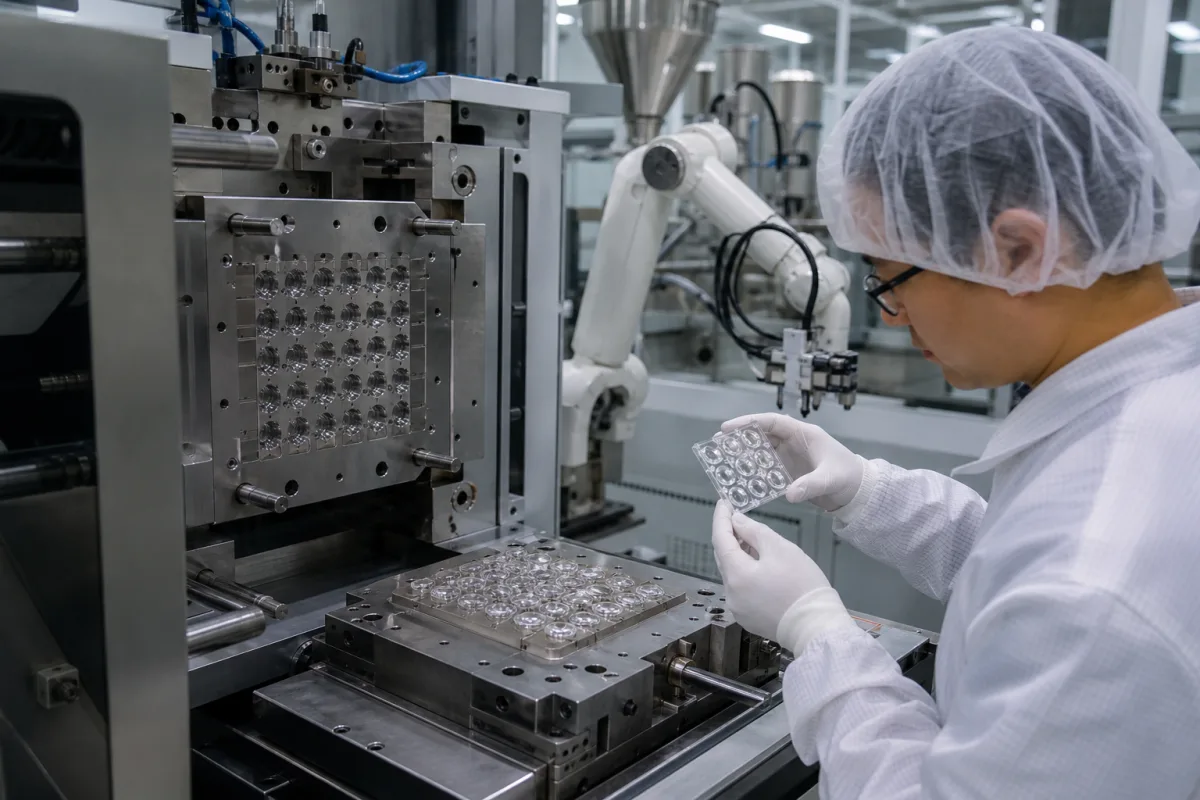
Precision LED Lens Molding Machine

Based on aggregated insights from multiple verified factory profiles within the CNFX directory, the standard Precision LED Lens Molding Machine used in the Electrical Equipment Manufacturing sector typically supports operational capacities ranging from standard industrial configurations to heavy-duty production requirements.

Technical Definition & Core Assembly

A canonical Precision LED Lens Molding Machine is characterized by the integration of Injection Unit and Clamping Unit. In industrial production environments, manufacturers listed on CNFX commonly emphasize Stainless Steel construction to support stable, high-cycle operation across diverse manufacturing scenarios.

Industrial injection molding machine for producing precision optical lenses for LED lighting
Product Specifications

Technical details and manufacturing context for Precision LED Lens Molding Machine

Definition
A specialized injection molding machine designed for manufacturing high-precision optical lenses used in LED lighting fixtures. This machine produces lenses with exact optical properties for beam shaping, light distribution, and glare reduction. It features precision temperature control and pressure regulation to ensure consistent optical clarity and dimensional accuracy. The equipment is essential for producing secondary optics that enhance LED lighting performance in commercial, industrial, and automotive applications.
Working Principle
Heats plastic pellets to molten state, injects material into precision mold cavity under controlled pressure, cools to solidify lens shape, then ejects finished product
Common Materials
Stainless Steel, Hardened Tool Steel, Ceramic Heating Elements
Technical Parameters
  • Maximum plastic injection volume per cycle (cm³) Customizable
  • Maximum mold clamping force (kN) Customizable
Components / BOM
  • Injection Unit
    Melts and injects plastic material into mold
    Material: Hardened Steel with Ceramic Heaters
  • Clamping Unit
    Opens, closes, and holds mold under pressure
    Material: High-Strength Steel Alloy
  • Precision Temperature Controller
    Maintains exact mold and barrel temperatures
    Material: Stainless Steel with PID Controllers
  • Hydraulic Power System
    Provides pressure for injection and clamping operations
    Material: Steel with Hydraulic Components
Engineering Reasoning
80-120 MPa injection pressure, 200-280°C melt temperature, 0.5-2.0 mm/s injection speed
Melt temperature exceeding 320°C causes polymer degradation, injection pressure below 60 MPa results in incomplete mold filling, mold temperature differentials >15°C across cavity cause optical distortion
Design Rationale: Polymer thermal degradation at Arrhenius rate constants above 320°C, non-Newtonian fluid flow instability below 60 MPa injection pressure, differential thermal expansion coefficient mismatch (α=80×10⁻⁶ K⁻¹ for steel vs α=120×10⁻⁶ K⁻¹ for polymer) causing birefringence
Risk Mitigation (FMEA)
Trigger Hydraulic servo valve spool sticking due to 5μm particulate contamination
Mode: Injection velocity profile deviation exceeding ±0.1 mm/s tolerance
Strategy: Install 3μm absolute filtration with differential pressure monitoring at 0.3 bar threshold
Trigger Heater band failure creating 50°C thermal gradient across barrel
Mode: Polymer viscosity variation causing 0.005 mm dimensional deviation in lens curvature
Strategy: Redundant PID control loops with 0.5°C thermocouples at 25mm intervals

Industry Taxonomies & Aliases

Commonly used trade names and technical identifiers for Precision LED Lens Molding Machine.

Industrial Ecosystem & Supply Chain DNA

Complementary Systems
Downstream Applications
Specialized Tooling

Application Fit & Sizing Matrix

Operational Limits
pressure: Up to 250 MPa injection pressure
flow rate: 0.5-15 cm³/s (injection rate)
clamp force: 50-500 tons (depending on model)
temperature: 50-300°C (mold temperature control range)
shot capacity: 10-500 g (plasticizing capacity)
slurry concentration: Not applicable (handles solid pellets, not slurries)
Media Compatibility
✓ Optical-grade polycarbonate (PC) ✓ Polymethyl methacrylate (PMMA) ✓ Cyclic olefin copolymer (COC)
Unsuitable: Abrasive-filled materials (e.g., glass-filled resins) due to precision mold wear concerns
Sizing Data Required
  • Required lens dimensions and volume (for shot size calculation)
  • Annual production volume (for cycle time and machine capacity)
  • Optical clarity requirements (for mold temperature control precision)

Reliability & Engineering Risk Analysis

Failure Mode & Root Cause
Thermal degradation of optical surfaces
Cause: Excessive or uneven heating during molding cycles leading to lens surface clouding, micro-cracks, or dimensional inaccuracies due to thermal stress and polymer degradation
Precision alignment drift
Cause: Wear in guide rails, ball screws, or mounting components from high-cycle repetitive motion, causing misalignment between mold halves and resulting in flash, incomplete fills, or optical defects
Maintenance Indicators
  • Visible haze or streaks on molded lenses indicating contamination or thermal issues in the molding chamber
  • Audible knocking or grinding during mold closure/opening cycles suggesting mechanical wear or misalignment
Engineering Tips
  • Implement predictive maintenance using thermal imaging cameras to monitor heater zones and mold surface temperatures, enabling early detection of hot spots or cooling inconsistencies before they affect lens quality
  • Establish a precision laser alignment verification program with monthly checks of mold parallelism and platen squareness, coupled with automated lubrication systems for motion components to minimize wear-induced drift

Compliance & Manufacturing Standards

Reference Standards
ISO 9001:2015 - Quality Management Systems CE Marking - Machinery Directive 2006/42/EC ASTM D638 - Standard Test Method for Tensile Properties of Plastics
Manufacturing Precision
  • Lens Surface Roughness: Ra ≤ 0.1μm
  • Mold Cavity Dimensional Accuracy: ±0.005mm
Quality Inspection
  • Optical Transmission Testing (ASTM D1003)
  • Coordinate Measuring Machine (CMM) Dimensional Verification

Factories Producing Precision LED Lens Molding Machine

Verified manufacturers with capability to produce this product in China

✓ 95% Supplier Capability Match Found

P Project Engineer from Brazil Jan 22, 2026
★★★★★
"As a professional in the Electrical Equipment Manufacturing sector, I confirm this Precision LED Lens Molding Machine meets all ISO standards."
Technical Specifications Verified
S Sourcing Manager from Canada Jan 19, 2026
★★★★★
"Standard OEM quality for Electrical Equipment Manufacturing applications. The Precision LED Lens Molding Machine arrived with full certification."
Technical Specifications Verified
P Procurement Specialist from United States Jan 16, 2026
★★★★★
"Great transparency on the Precision LED Lens Molding Machine components. Essential for our Electrical Equipment Manufacturing supply chain."
Technical Specifications Verified
Verification Protocol

“Feedback is collected from verified sourcing managers during RFQ (Request for Quote) and factory evaluation processes on CNFX. These reports represent historical performance data and technical audit summaries from our B2B manufacturing network.”

18 sourcing managers are analyzing this specification now. Last inquiry for Precision LED Lens Molding Machine from Poland (26m ago).

Supply Chain Commonly Integrated Components

Control Cabinet

Electrical enclosure housing control systems for automated industrial equipment

Explore Specs →
Rotor Assembly

The rotating component of an actuator motor that converts electrical energy into mechanical motion

Explore Specs →
Stator Assembly

The stationary component of an electric motor that generates a rotating magnetic field when energized.

Explore Specs →
Wire Tensioner

A device that applies and maintains precise tension on electrical wire during the winding process of transformers.

Explore Specs →

Frequently Asked Questions

What materials can the Precision LED Lens Molding Machine process?

This machine is designed for molding precision optical-grade plastics commonly used in LED lighting applications, including polycarbonate, PMMA (acrylic), and optical silicone, with compatibility for various transparent and diffusive materials.

How does the precision temperature controller improve LED lens quality?

The integrated precision temperature controller maintains mold temperature within ±0.5°C, ensuring consistent material flow, reducing optical defects like bubbles or streaks, and producing lenses with uniform light transmission properties essential for LED lighting applications.

What maintenance is required for the hydraulic power system?

Regular maintenance includes hydraulic fluid analysis every 500 operating hours, filter replacement every 1,000 hours, and seal inspection every 2,000 hours. The system features easy-access points for routine checks to minimize downtime in lighting equipment manufacturing.

Can I contact factories directly on CNFX?

CNFX is an open directory, not a transaction platform. Each factory profile provides direct contact information and production details to help you initiate direct inquiries with Chinese suppliers.

Get Quote for Precision LED Lens Molding Machine

Request technical pricing, lead times, or customized specifications for Precision LED Lens Molding Machine directly from verified manufacturing units.

Your business information is encrypted and only shared with verified Precision LED Lens Molding Machine suppliers.

Thank you! Your message has been sent. We'll respond within 1–3 business days.

Need to Manufacture Precision LED Lens Molding Machine?

Connect with verified factories specializing in this product category

Add Your Factory Contact Us
Previous Product
Precision LED Encapsulation Machine
Next Product
Precision Optical Lens Array