Industry-Verified Manufacturing Data (2026)

Relay/Switch

Based on aggregated insights from multiple verified factory profiles within the CNFX directory, the standard Relay/Switch used in the Electrical Equipment Manufacturing sector typically supports operational capacities ranging from standard industrial configurations to heavy-duty production requirements.

Technical Definition & Core Assembly

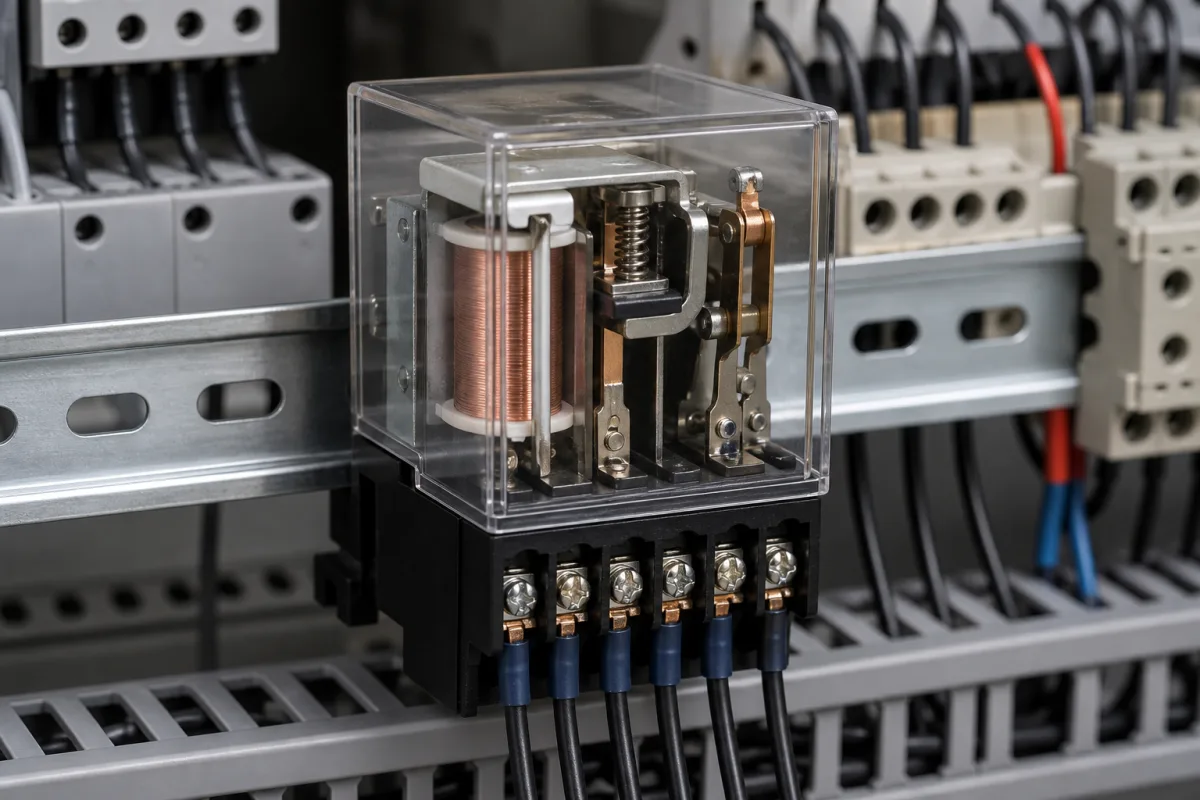
A canonical Relay/Switch is characterized by the integration of Coil and Armature. In industrial production environments, manufacturers listed on CNFX commonly emphasize Copper construction to support stable, high-cycle operation across diverse manufacturing scenarios.

An electromechanical or solid-state device that opens or closes electrical circuits to control the flow of current within a control unit or thermostat.
Product Specifications

Technical details and manufacturing context for Relay/Switch

Definition
A relay/switch is a critical component within control units and thermostats that functions as an electrically operated switch. It receives a low-power control signal from the thermostat's logic circuit and uses it to open or close a separate, higher-power circuit that controls heating, cooling, or fan systems. This isolation allows sensitive electronic controls to safely manage high-voltage or high-current loads.
Working Principle
In an electromechanical relay, a control current energizes an electromagnet, which moves an armature to physically open or close electrical contacts. In a solid-state relay, semiconductor components (like optocouplers and thyristors) perform the switching electronically without moving parts. Both types provide electrical isolation between the low-voltage control circuit and the high-voltage load circuit.
Common Materials
Copper, Plastic/Polymer, Steel/Iron, Silver Alloy (for contacts)
Technical Parameters
  • Contact Rating (Load Current & Voltage), Coil Voltage, Switching Speed, Contact Form (SPST, SPDT, etc.) (A, V) Per Request
Components / BOM
  • Coil
    Electromagnet that generates a magnetic field when energized by the control signal, causing the armature to move.
    Material: Copper wire, Steel core
  • Armature
    Movable iron or steel part attracted by the electromagnet's field, physically moving to open or close the contacts.
    Material: Steel/Iron
  • Contacts
    Conductive points that make or break the electrical connection in the load circuit. Often made of materials resistant to arcing and wear.
    Material: Silver alloy, Silver Cadmium Oxide, Silver Tin Oxide
  • Spring
    Returns the armature to its default position when the coil is de-energized.
    Material: Steel
  • Housing/Base
    Protects internal components, provides mounting points, and ensures electrical insulation.
    Material: Plastic (e.g., PBT, Nylon), Ceramic
Engineering Reasoning
0-30 VDC, 0-250 VAC, 0-10 A continuous current, -40°C to +85°C ambient temperature
Contact resistance exceeding 100 mΩ, dielectric breakdown at 1500 VAC, mechanical wear exceeding 10^7 cycles, coil burnout at 125% rated voltage for 60 seconds
Design Rationale: Arcing-induced contact erosion (Paschen's Law at 350 V breakdown), thermal expansion mismatch causing contact welding (coefficient difference >5×10^-6/K), dielectric aging under partial discharge (>500 pC discharge magnitude)
Risk Mitigation (FMEA)
Trigger Inductive load switching without snubber circuit
Mode: Contact welding due to arc energy exceeding 2 mJ per operation
Strategy: RC snubber network with 100 Ω resistor and 0.1 μF capacitor in parallel with contacts
Trigger Coil voltage exceeding 110% of rated value for >30 seconds
Mode: Insulation breakdown at 150°C hotspot temperature
Strategy: Voltage clamping circuit using 24 V Zener diode with 5 W rating

Industry Taxonomies & Aliases

Commonly used trade names and technical identifiers for Relay/Switch.

Applied To / Applications

This component is essential for the following industrial systems and equipment:

Industrial Ecosystem & Supply Chain DNA

Complementary Systems
Downstream Applications
Specialized Tooling

Application Fit & Sizing Matrix

Operational Limits
pressure: Atmospheric (not pressure-rated; for dry/low-pressure environments)
other spec: Contact Rating: 1A to 30A typical, Switching Frequency: up to 1000 operations/hour (mechanical), Insulation Resistance: >100 MΩ
temperature: -40°C to +85°C (operating range, varies by model)
Media Compatibility
✓ Dry air/non-corrosive gases ✓ Low-voltage DC/AC control circuits ✓ Non-conductive/non-flammable fluids in sealed systems
Unsuitable: High-moisture, corrosive, or explosive atmospheres (e.g., chlorine gas, salt spray, dust-laden air)
Sizing Data Required
  • Load Current (Amps) and Voltage (V)
  • Switching Type (Normally Open/Closed, latching)
  • Environmental Conditions (ambient temp, humidity, enclosure rating)

Reliability & Engineering Risk Analysis

Failure Mode & Root Cause
Contact welding
Cause: Excessive inrush current or frequent switching under load causing arcing and material transfer between contacts
Contact oxidation/corrosion
Cause: Environmental contaminants (moisture, sulfur, dust) or lack of protective atmosphere leading to increased contact resistance
Maintenance Indicators
  • Audible chattering or buzzing during operation indicating contact bounce or poor connection
  • Visible arcing/sparks through transparent housing or discoloration/overheating marks on enclosure
Engineering Tips
  • Install proper arc suppression circuits (snubbers) and ensure switching occurs at zero-crossing points for AC loads to reduce contact erosion
  • Maintain clean, dry operating environment with appropriate IP-rated enclosures and implement regular contact resistance testing during preventive maintenance

Compliance & Manufacturing Standards

Reference Standards
IEC 61810-1:2015 (Electromechanical relays - General requirements) UL 508 (Industrial Control Equipment) EN 60947-5-1:2017 (Low-voltage switchgear and controlgear - Control circuit devices and switching elements)
Manufacturing Precision
  • Contact Resistance: +/- 10% of rated value
  • Operating Time: +/- 20% of specified time
Quality Inspection
  • Contact Resistance Measurement
  • Dielectric Strength Test

Factories Producing Relay/Switch

Verified manufacturers with capability to produce this product in China

✓ 97% Supplier Capability Match Found

S Sourcing Manager from Canada Feb 09, 2026
★★★★★
"Testing the Relay/Switch now; the technical reliability results are within 1% of the laboratory datasheet."
Technical Specifications Verified
P Procurement Specialist from United States Feb 06, 2026
★★★★☆
"Impressive build quality. Especially the technical reliability is very stable during long-term operation. (Delivery took slightly longer than expected, but technical support was excellent.)"
Technical Specifications Verified
T Technical Director from United Arab Emirates Feb 03, 2026
★★★★★
"As a professional in the Electrical Equipment Manufacturing sector, I confirm this Relay/Switch meets all ISO standards."
Technical Specifications Verified
Verification Protocol

“Feedback is collected from verified sourcing managers during RFQ (Request for Quote) and factory evaluation processes on CNFX. These reports represent historical performance data and technical audit summaries from our B2B manufacturing network.”

13 sourcing managers are analyzing this specification now. Last inquiry for Relay/Switch from Poland (1h ago).

Supply Chain Compatible Machinery & Devices

Circuit Breaker Arc Chute

Electrical component that extinguishes arcs in circuit breakers

Explore Specs →
Medium Voltage Switchgear Assembly Line

Automated production system for assembling medium voltage electrical switchgear.

Explore Specs →
Motor Terminal Block

Electrical connection interface for motor windings

Explore Specs →
PLC Control System

A digital industrial computer control system that monitors inputs, makes decisions based on a custom program, and controls outputs to automate industrial processes.

Explore Specs →

Frequently Asked Questions

What are the main differences between electromechanical and solid-state relays?

Electromechanical relays use physical moving parts (armature, contacts) to open/close circuits, while solid-state relays use semiconductor components without moving parts, offering faster switching and longer lifespan in certain applications.

Why are silver alloy contacts used in relays/switches?

Silver alloy contacts provide superior electrical conductivity, reduce contact resistance, minimize arcing, and offer excellent durability for high-current applications in electrical equipment manufacturing.

What maintenance do industrial relays/switches typically require?

Regular inspection for contact wear, cleaning of oxidation on contacts, testing coil resistance, and ensuring proper spring tension are key maintenance tasks to ensure reliable operation in control units and thermostats.

Can I contact factories directly on CNFX?

CNFX is an open directory, not a transaction platform. Each factory profile provides direct contact information and production details to help you initiate direct inquiries with Chinese suppliers.

Get Quote for Relay/Switch

Request technical pricing, lead times, or customized specifications for Relay/Switch directly from verified manufacturing units.

Your business information is encrypted and only shared with verified Relay/Switch suppliers.

Thank you! Your message has been sent. We'll respond within 1–3 business days.

Need to Manufacture Relay/Switch?

Connect with verified factories specializing in this product category

Add Your Factory Contact Us
Previous Product
Relay/Contactor Driver Circuit
Next Product
Relays