Industry-Verified Manufacturing Data (2026)

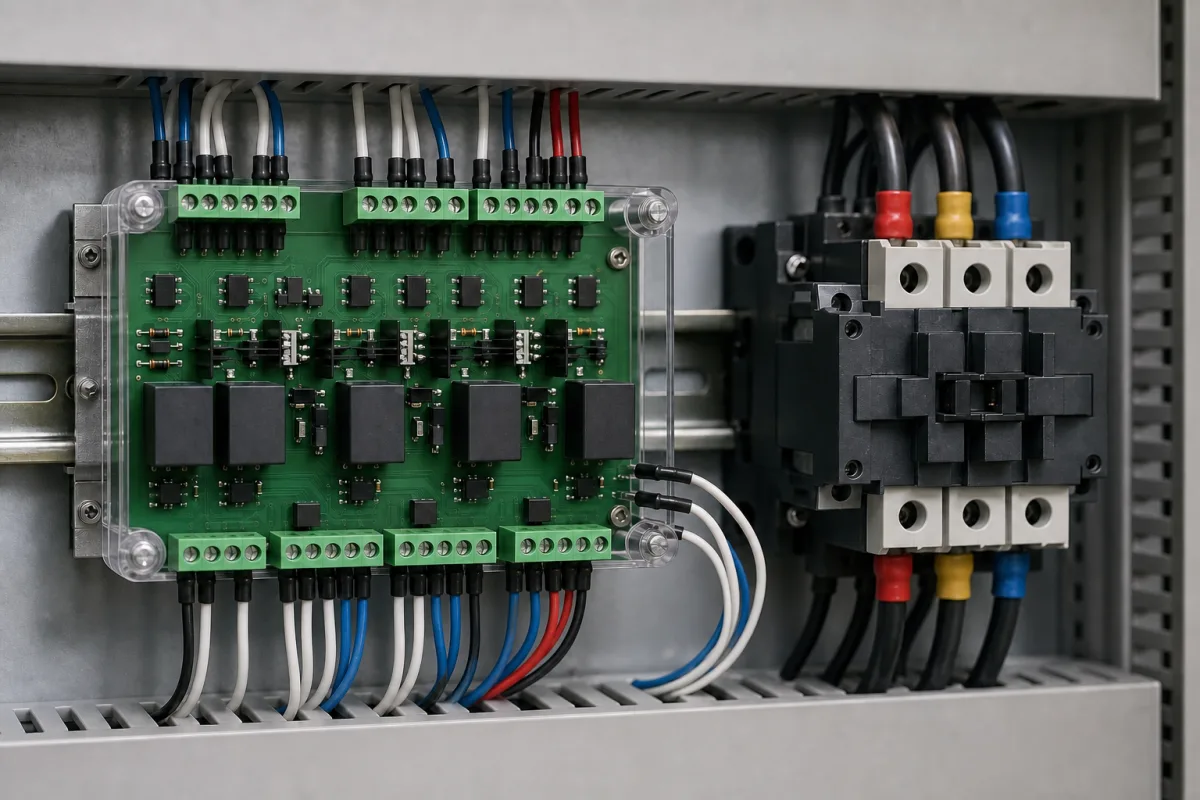
Relay/Contactor Driver Circuit

Based on aggregated insights from multiple verified factory profiles within the CNFX directory, the standard Relay/Contactor Driver Circuit used in the Electrical Equipment Manufacturing sector typically supports operational capacities ranging from standard industrial configurations to heavy-duty production requirements.

Technical Definition & Core Assembly

A canonical Relay/Contactor Driver Circuit is characterized by the integration of Power Transistor/MOSFET and Flyback Diode. In industrial production environments, manufacturers listed on CNFX commonly emphasize Printed Circuit Board (PCB) construction to support stable, high-cycle operation across diverse manufacturing scenarios.

Electronic circuit that controls the switching of relays or contactors by providing appropriate voltage and current signals.
Product Specifications

Technical details and manufacturing context for Relay/Contactor Driver Circuit

Definition
A specialized electronic circuit within an Intelligent Controller that interfaces between low-power control signals and high-power relays or contactors. It amplifies control signals from microcontrollers or PLCs to drive electromagnetic coils, enabling safe and reliable switching of electrical loads in industrial automation systems.
Working Principle
Receives low-voltage control signals from the controller's processor, amplifies them using transistors or MOSFETs, and provides sufficient current to energize the relay or contactor coil. Includes protection features like flyback diodes, current limiting, and isolation to prevent damage to the control circuitry.
Common Materials
Printed Circuit Board (PCB), Semiconductors (Transistors/MOSFETs), Copper traces, Protective components (diodes, resistors)
Technical Parameters
  • Maximum output current capacity for driving relay/contactor coils (A) Customizable
Components / BOM
  • Power Transistor/MOSFET
    Amplifies control signals to drive relay/contactor coils
    Material: semiconductor
  • Flyback Diode
    Protects circuit from voltage spikes when coil de-energizes
    Material: semiconductor
  • Current Limiting Resistor
    Limits current to the relay/contactor coil
    Material: carbon film/metal film
  • Optocoupler/Isolator
    Provides electrical isolation between control and power circuits
    Material: semiconductor
Engineering Reasoning
5-24 VDC control voltage, 10-500 mA coil current, -40°C to +85°C ambient temperature
Control voltage <4.5 VDC causes insufficient magnetic field, >28 VDC causes insulation breakdown; Coil current >550 mA causes thermal runaway; Ambient temperature >90°C causes semiconductor junction failure
Design Rationale: Electromagnetic saturation at low voltage prevents relay closure; Dielectric breakdown at high voltage; Joule heating (P=I²R) exceeding thermal dissipation capacity; Semiconductor thermal runaway at 175°C junction temperature
Risk Mitigation (FMEA)
Trigger Inductive kickback voltage spike reaching 200-400 V from relay coil de-energization
Mode: MOSFET gate oxide breakdown at 20 V threshold, causing permanent short circuit
Strategy: Flyback diode with 1N4007 (1000 V PIV) across coil, snubber circuit with 100 Ω + 0.1 μF RC network
Trigger Sustained coil current exceeding 500 mA due to stuck relay armature
Mode: Driver transistor thermal shutdown at 150°C junction temperature, circuit lockout
Strategy: Current limiting with 1 Ω sense resistor and comparator cutoff at 550 mA, thermal derating to 80% of rated current

Industry Taxonomies & Aliases

Commonly used trade names and technical identifiers for Relay/Contactor Driver Circuit.

Applied To / Applications

This component is essential for the following industrial systems and equipment:

Industrial Ecosystem & Supply Chain DNA

Complementary Systems
Downstream Applications
Specialized Tooling

Application Fit & Sizing Matrix

Operational Limits
current: Up to 10A continuous output current, 20A inrush/peak handling
voltage: 3V to 48V DC input range, 5V to 240V AC/DC output switching capability
isolation: 2500Vrms minimum isolation between control and load circuits
temperature: -40°C to +85°C (operating), -55°C to +125°C (storage)
Media Compatibility
✓ Industrial control panels (NEMA 1/12 enclosures) ✓ Motor control centers with proper EMI shielding ✓ Automated machinery with clean power supplies
Unsuitable: High-vibration environments without mechanical securing (e.g., heavy machinery mounts without shock absorption)
Sizing Data Required
  • Load current rating (continuous and inrush)
  • Control voltage compatibility (input signal level)
  • Switching frequency requirements (Hz)

Reliability & Engineering Risk Analysis

Failure Mode & Root Cause
Contact Welding
Cause: Excessive inrush current or frequent switching under load causing arcing and material transfer between contacts, leading to permanent sticking.
Coil Failure
Cause: Overvoltage, voltage spikes, or thermal degradation from prolonged energization leading to insulation breakdown or open circuit in the coil winding.
Maintenance Indicators
  • Audible buzzing or chattering from the relay/contactor during operation
  • Visible arcing, discoloration, or burning on contacts or terminals during switching
Engineering Tips
  • Install snubber circuits or surge suppressors across the coil and contacts to protect against voltage transients and reduce arcing
  • Implement regular contact inspection and cleaning, and ensure proper contact pressure and alignment to prevent uneven wear and overheating

Compliance & Manufacturing Standards

Reference Standards
ISO 9001:2015 Quality Management Systems IEC 60947-5-1 Low-voltage switchgear and controlgear - Part 5-1: Control circuit devices and switching elements - Electromechanical control circuit devices EN 55032:2015 Electromagnetic compatibility of multimedia equipment - Emission requirements
Manufacturing Precision
  • Contact resistance: +/- 10% of nominal value
  • Insulation resistance: >100 MΩ at 500 V DC
Quality Inspection
  • Contact bounce test (oscilloscope measurement)
  • Dielectric strength test (hipot test)

Factories Producing Relay/Contactor Driver Circuit

Verified manufacturers with capability to produce this product in China

✓ 93% Supplier Capability Match Found

T Technical Director from Germany Jan 30, 2026
★★★★★
"As a professional in the Electrical Equipment Manufacturing sector, I confirm this Relay/Contactor Driver Circuit meets all ISO standards."
Technical Specifications Verified
P Project Engineer from Brazil Jan 27, 2026
★★★★☆
"Standard OEM quality for Electrical Equipment Manufacturing applications. The Relay/Contactor Driver Circuit arrived with full certification. (Delivery took slightly longer than expected, but technical support was excellent.)"
Technical Specifications Verified
S Sourcing Manager from Canada Jan 24, 2026
★★★★★
"Great transparency on the Relay/Contactor Driver Circuit components. Essential for our Electrical Equipment Manufacturing supply chain."
Technical Specifications Verified
Verification Protocol

“Feedback is collected from verified sourcing managers during RFQ (Request for Quote) and factory evaluation processes on CNFX. These reports represent historical performance data and technical audit summaries from our B2B manufacturing network.”

8 sourcing managers are analyzing this specification now. Last inquiry for Relay/Contactor Driver Circuit from Poland (37m ago).

Supply Chain Compatible Machinery & Devices

Transformer Winding Machine

Industrial machine for winding copper wire onto transformer cores

Explore Specs →
Circuit Breaker Trip Unit

Protective control module for electrical circuit breakers

Explore Specs →
Circuit Breaker Arc Chute

Electrical component that extinguishes arcs in circuit breakers

Explore Specs →
Medium Voltage Switchgear Assembly Line

Automated production system for assembling medium voltage electrical switchgear.

Explore Specs →

Frequently Asked Questions

What is the purpose of the flyback diode in a relay driver circuit?

The flyback diode protects the circuit by suppressing voltage spikes generated when the relay coil de-energizes, preventing damage to sensitive semiconductor components.

How does optocoupler isolation improve relay driver safety?

Optocouplers provide electrical isolation between control signals and power circuits, preventing ground loops, reducing noise interference, and protecting low-voltage control systems from high-voltage faults.

What factors determine the transistor/MOSFET selection for relay driving?

Selection depends on relay coil current requirements, switching frequency, voltage ratings, thermal considerations, and whether the application needs bipolar transistors for linear control or MOSFETs for fast switching efficiency.

Can I contact factories directly on CNFX?

CNFX is an open directory, not a transaction platform. Each factory profile provides direct contact information and production details to help you initiate direct inquiries with Chinese suppliers.

Get Quote for Relay/Contactor Driver Circuit

Request technical pricing, lead times, or customized specifications for Relay/Contactor Driver Circuit directly from verified manufacturing units.

Your business information is encrypted and only shared with verified Relay/Contactor Driver Circuit suppliers.

Thank you! Your message has been sent. We'll respond within 1–3 business days.

Need to Manufacture Relay/Contactor Driver Circuit?

Connect with verified factories specializing in this product category

Add Your Factory Contact Us
Previous Product
Relay Output Board
Next Product
Relay/Switch