Industry-Verified Manufacturing Data (2026)

Control Unit / Thermostat

Based on aggregated insights from multiple verified factory profiles within the CNFX directory, the standard Control Unit / Thermostat used in the Electrical Equipment Manufacturing sector typically supports operational capacities ranging from standard industrial configurations to heavy-duty production requirements.

Technical Definition & Core Assembly

A canonical Control Unit / Thermostat is characterized by the integration of Temperature Sensor and Control Circuit. In industrial production environments, manufacturers listed on CNFX commonly emphasize Plastic housing construction to support stable, high-cycle operation across diverse manufacturing scenarios.

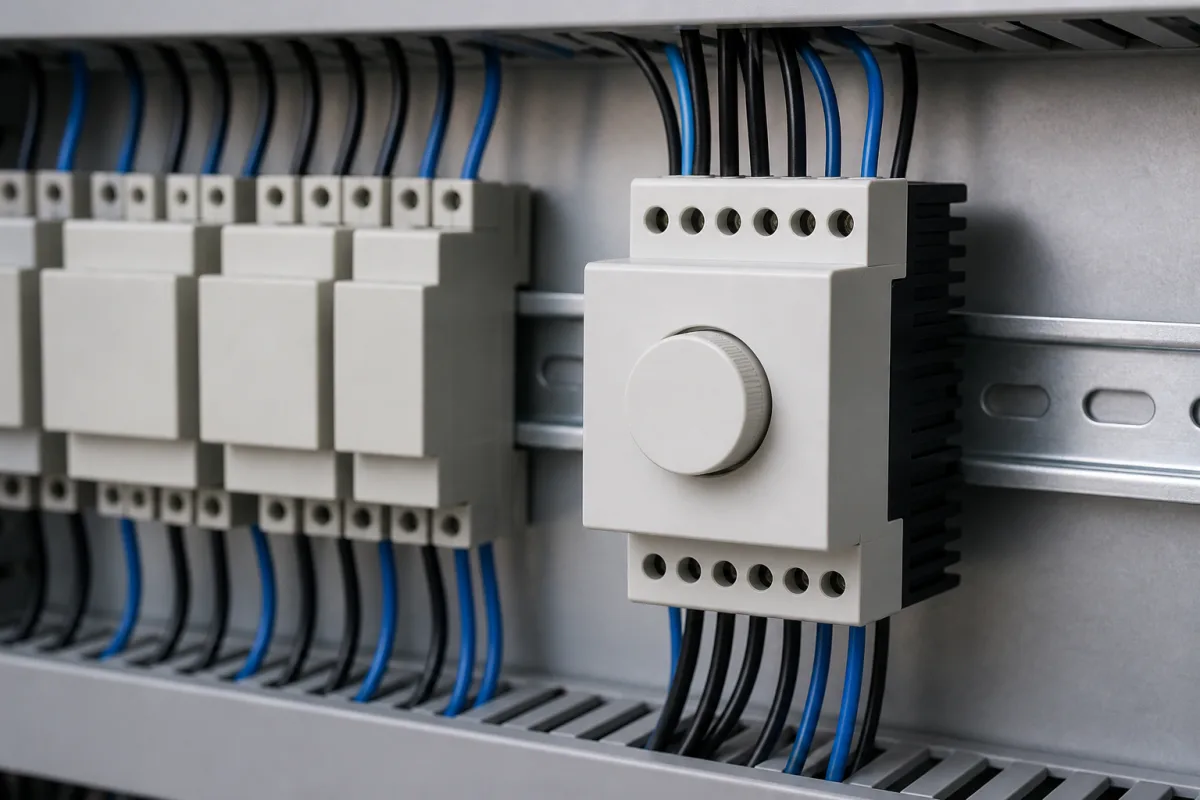
A device that regulates temperature by controlling heating equipment operation based on setpoints and sensor inputs.
Product Specifications

Technical details and manufacturing context for Control Unit / Thermostat

Definition
The control unit/thermostat is a critical component within heating systems that monitors ambient temperature through sensors and activates or deactivates heating elements to maintain desired temperature ranges. It serves as the interface between user settings and system operation, ensuring energy efficiency and comfort.
Working Principle
The thermostat continuously measures temperature using internal or remote sensors. When temperature falls below the setpoint, it closes a circuit to activate heating equipment. When temperature rises above the setpoint, it opens the circuit to deactivate heating. Modern units may use digital logic, PID control algorithms, or programmable schedules for precise regulation.
Common Materials
Plastic housing, Electronic components, Metal contacts
Technical Parameters
  • Temperature measurement and control range (°C) Standard Spec
Components / BOM
  • Temperature Sensor
    Detects ambient temperature and converts it to electrical signals
    Material: Thermistor or thermocouple
  • Control Circuit
    Processes sensor data and executes control logic
    Material: Printed circuit board with microcontrollers
  • Relay/Switch
    Activates or deactivates heating equipment based on control signals
    Material: Metal contacts with electromagnetic coil
  • User Interface
    Allows temperature setting and mode selection
    Material: Plastic buttons with LCD display
Engineering Reasoning
0-60°C ambient temperature, 12-24 VDC power input, 0-100% relative humidity (non-condensing)
Ambient temperature >85°C causes permanent semiconductor junction damage, < -40°C causes mechanical stress fractures in bimetallic elements, voltage input >30 VDC destroys voltage regulation circuitry
Design Rationale: Thermal expansion coefficient mismatch (17 ppm/°C for bimetallic strip vs. 3 ppm/°C for housing) creates mechanical stress fractures at low temperatures; semiconductor junction thermal runaway occurs when ambient temperature exceeds maximum junction temperature (Tjmax = 125°C) minus thermal resistance (θja = 65°C/W) times power dissipation (0.5W)
Risk Mitigation (FMEA)
Trigger Moisture ingress through IP40-rated housing seals during condensation cycles
Mode: Electrochemical migration forming dendritic growth between PCB traces at 5μm spacing
Strategy: Conformal coating application (25μm acrylic thickness) with IP67-rated housing and desiccant capsule integration
Trigger PWM switching frequency (1kHz) resonance with mechanical relay natural frequency (850Hz ±50Hz)
Mode: Contact welding due to sustained arcing at 15V/2A breaking capacity exceeded
Strategy: Solid-state relay replacement with zero-crossing detection and snubber circuit (100Ω/0.1μF RC network)

Industry Taxonomies & Aliases

Commonly used trade names and technical identifiers for Control Unit / Thermostat.

Applied To / Applications

This component is essential for the following industrial systems and equipment:

Industrial Ecosystem & Supply Chain DNA

Complementary Systems
Downstream Applications
Specialized Tooling

Application Fit & Sizing Matrix

Operational Limits
pressure: 0 to 1 bar (ambient pressure rating)
other spec: Humidity: 0-95% RH non-condensing, Power: 24V AC/DC ±15%, Enclosure: IP20/IP54/IP65 options
temperature: -40°C to 85°C (operating), -55°C to 125°C (storage)
Media Compatibility
✓ HVAC systems (air handling units) ✓ Hydronic heating systems (water/glycol) ✓ Industrial process heating (non-corrosive environments)
Unsuitable: High-vibration environments (e.g., heavy machinery, transportation) without additional mounting provisions
Sizing Data Required
  • Heating load capacity (kW/BTU/hr)
  • Control signal type (0-10V, 4-20mA, relay)
  • Installation environment (indoor/outdoor, NEMA/IP rating requirement)

Reliability & Engineering Risk Analysis

Failure Mode & Root Cause
Temperature sensor drift
Cause: Degradation of thermistor or RTD due to thermal cycling, contamination, or aging, leading to inaccurate temperature readings and improper control.
Electrical contact failure
Cause: Oxidation, pitting, or wear of relay contacts from frequent switching cycles, high inrush currents, or environmental contaminants, resulting in intermittent or complete loss of control output.
Maintenance Indicators
  • Audible chattering or buzzing from internal relays during operation
  • Visible corrosion, discoloration, or moisture ingress on the unit housing or terminal connections
Engineering Tips
  • Implement regular calibration checks using a traceable temperature source to detect and correct sensor drift before it impacts process control.
  • Ensure proper environmental sealing and maintain clean, dry installation conditions to prevent contamination and corrosion of electrical components.

Compliance & Manufacturing Standards

Reference Standards
ISO 9001:2015 - Quality Management Systems IEC 60730-1 - Automatic electrical controls for household and similar use CE Marking - Compliance with EU safety, health, and environmental requirements
Manufacturing Precision
  • Temperature accuracy: +/-0.5°C
  • Electrical contact resistance: <10 mΩ
Quality Inspection
  • Functional temperature cycling test
  • Insulation resistance test (minimum 100 MΩ at 500 VDC)

Factories Producing Control Unit / Thermostat

Verified manufacturers with capability to produce this product in China

✓ 97% Supplier Capability Match Found

T Technical Director from Canada Jan 02, 2026
★★★★★
"Impressive build quality. Especially the technical reliability is very stable during long-term operation."
Technical Specifications Verified
P Project Engineer from United States Dec 30, 2025
★★★★☆
"As a professional in the Electrical Equipment Manufacturing sector, I confirm this Control Unit / Thermostat meets all ISO standards. (Delivery took slightly longer than expected, but technical support was excellent.)"
Technical Specifications Verified
S Sourcing Manager from United Arab Emirates Dec 27, 2025
★★★★★
"Standard OEM quality for Electrical Equipment Manufacturing applications. The Control Unit / Thermostat arrived with full certification."
Technical Specifications Verified
Verification Protocol

“Feedback is collected from verified sourcing managers during RFQ (Request for Quote) and factory evaluation processes on CNFX. These reports represent historical performance data and technical audit summaries from our B2B manufacturing network.”

9 sourcing managers are analyzing this specification now. Last inquiry for Control Unit / Thermostat from Mexico (1h ago).

Supply Chain Compatible Machinery & Devices

Circuit Breaker Trip Unit

Protective control module for electrical circuit breakers

Explore Specs →
Circuit Breaker Arc Chute

Electrical component that extinguishes arcs in circuit breakers

Explore Specs →
Medium Voltage Switchgear Assembly Line

Automated production system for assembling medium voltage electrical switchgear.

Explore Specs →
Motor Terminal Block

Electrical connection interface for motor windings

Explore Specs →

Frequently Asked Questions

What is the primary function of this control unit/thermostat?

This control unit regulates temperature by monitoring sensor inputs and automatically operating heating equipment to maintain user-defined setpoints, ensuring precise thermal management in industrial applications.

What materials are used in the construction of this thermostat?

The unit features a durable plastic housing, high-quality electronic components for reliable operation, and metal contacts for secure electrical connections in demanding industrial environments.

What components are included in the bill of materials (BOM)?

The BOM includes a control circuit for processing, a relay/switch for equipment operation, a temperature sensor for accurate monitoring, and a user interface for setpoint adjustment and system control.

Can I contact factories directly on CNFX?

CNFX is an open directory, not a transaction platform. Each factory profile provides direct contact information and production details to help you initiate direct inquiries with Chinese suppliers.

Get Quote for Control Unit / Thermostat

Request technical pricing, lead times, or customized specifications for Control Unit / Thermostat directly from verified manufacturing units.

Your business information is encrypted and only shared with verified Control Unit / Thermostat suppliers.

Thank you! Your message has been sent. We'll respond within 1–3 business days.

Need to Manufacture Control Unit / Thermostat?

Connect with verified factories specializing in this product category

Add Your Factory Contact Us
Previous Product
Control Unit (Microcontroller/DSP)
Next Product
Control Unit/Transmitter