Industry-Verified Manufacturing Data (2026)

Rotary Spindle Head

Based on aggregated insights from multiple verified factory profiles within the CNFX directory, the standard Rotary Spindle Head used in the Electrical Equipment Manufacturing sector typically supports operational capacities ranging from standard industrial configurations to heavy-duty production requirements.

Technical Definition & Core Assembly

A canonical Rotary Spindle Head is characterized by the integration of Main Housing and Precision Bearings. In industrial production environments, manufacturers listed on CNFX commonly emphasize High-strength steel construction to support stable, high-cycle operation across diverse manufacturing scenarios.

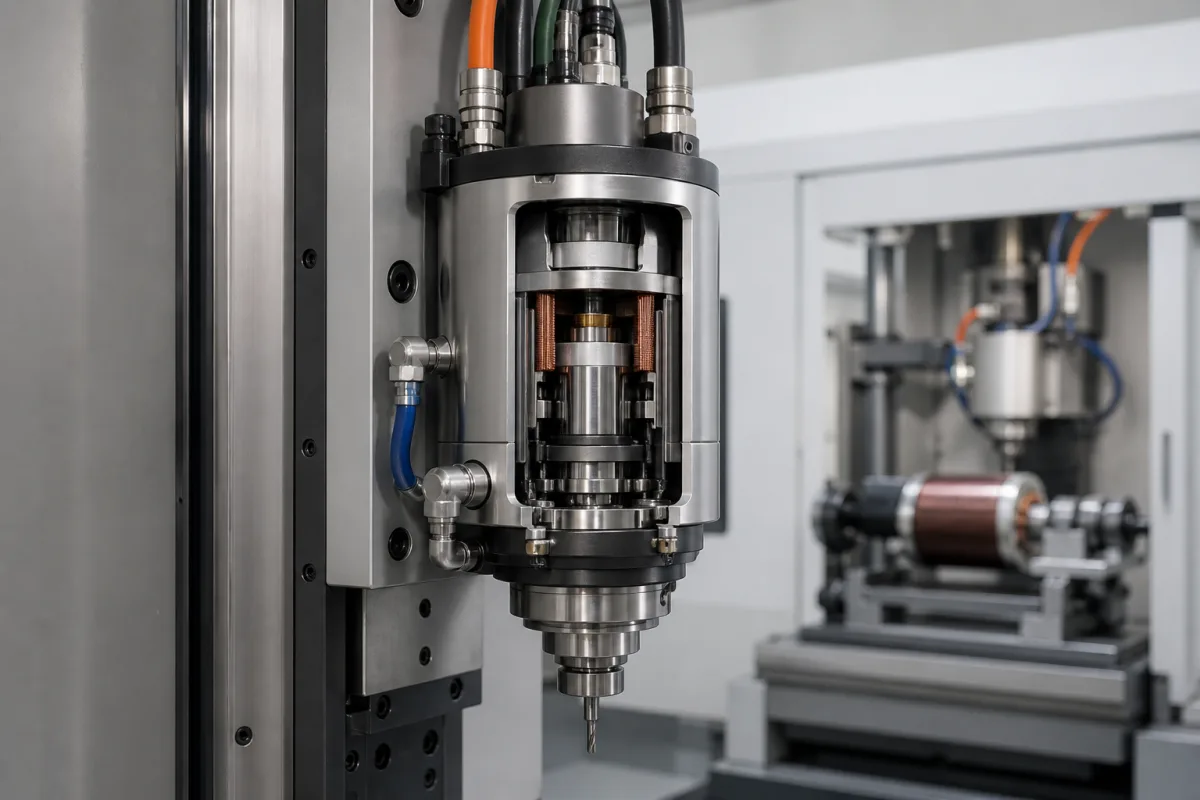
A precision rotating assembly that holds and positions the winding spindle in an electric motor stator winding machine.
Product Specifications

Technical details and manufacturing context for Rotary Spindle Head

Definition
The rotary spindle head is a critical component of electric motor stator winding machines that provides controlled rotational motion to the winding spindle. It precisely positions and rotates the spindle during the winding process to ensure accurate wire placement on the stator core. This component directly affects winding quality, consistency, and production efficiency by maintaining proper tension and alignment throughout the winding operation.
Working Principle
The rotary spindle head receives rotational input from the machine's drive system (typically via servo motors or stepper motors) and transmits this motion to the winding spindle. It incorporates precision bearings and rotational mechanisms to ensure smooth, accurate rotation while maintaining the spindle's position relative to the stator core. The head may include indexing capabilities for multi-slot winding and often integrates with tension control systems to manage wire feed during rotation.
Common Materials
High-strength steel, Precision bearings, Aluminum alloy housing
Technical Parameters
  • Spindle mounting interface dimensions (mm) Customizable
Components / BOM
  • Main Housing
    Provides structural support and houses internal components
    Material: Aluminum alloy
  • Precision Bearings
    Enable smooth, low-friction rotation of the spindle
    Material: Bearing steel
  • Drive Coupling
    Transmits rotational force from motor to spindle
    Material: Steel alloy
  • Mounting Flange
    Interface for attaching to the winding machine frame
    Material: Steel
Engineering Reasoning
0-8000 rpm at 0.1-50 N·m torque, 20-80°C ambient temperature, 0.5-5 μm radial runout tolerance
Exceeds 8500 rpm centrifugal force causing bearing raceway spalling, exceeds 55 N·m torque causing shaft torsional yield at 250 MPa, exceeds 5 μm runout causing dynamic imbalance > G2.5 ISO 1940-1 grade
Design Rationale: Bearing fatigue failure via Hertzian contact stress exceeding 1800 MPa at 10⁷ cycles, shaft deflection exceeding 0.05 mm/m causing misalignment-induced fretting, thermal expansion differential > 15 μm between ceramic bearings and steel housing at 100°C delta-T
Risk Mitigation (FMEA)
Trigger Lubricant viscosity breakdown at 120°C causing boundary lubrication failure
Mode: Bearing seizure with torque spike to 75 N·m
Strategy: Integrate PTFE-coated bearing cages with 200°C thermal stability and install infrared thermocouples with 90°C shutdown threshold
Trigger Resonant vibration at 650 Hz matching 2nd bending mode of 400 mm spindle length
Mode: Fatigue crack initiation at shaft fillet radius under 10⁸ cycle loading at 150 MPa alternating stress
Strategy: Implement finite element analysis-optimized 8 mm fillet radius and dynamic balancing to ISO G1.0 standard with 0.4 g·mm/kg residual unbalance

Industry Taxonomies & Aliases

Commonly used trade names and technical identifiers for Rotary Spindle Head.

Industrial Ecosystem & Supply Chain DNA

Complementary Systems
Downstream Applications
Specialized Tooling

Application Fit & Sizing Matrix

Operational Limits
pressure: Atmospheric to 2 bar (sealed bearing environment)
other spec: Max rotational speed: 10,000 RPM, Vibration tolerance: < 2.5 mm/s RMS, Axial load capacity: 500 N max
temperature: 0°C to 80°C (operating), -20°C to 100°C (storage)
Media Compatibility
✓ Clean dry air (instrument air quality) ✓ Synthetic lubricants (ISO VG 32-68) ✓ Copper and aluminum winding wires (enamel insulated)
Unsuitable: Abrasive slurry or particulate-laden environments (causes bearing degradation and precision loss)
Sizing Data Required
  • Spindle diameter and taper specification (e.g., ISO 30, HSK 63)
  • Required rotational speed and torque profile
  • Mounting interface dimensions and motor power requirements

Reliability & Engineering Risk Analysis

Failure Mode & Root Cause
Bearing fatigue failure
Cause: Cyclic loading from rotational forces, improper lubrication, or contamination leading to spalling and eventual bearing seizure.
Seal degradation and leakage
Cause: Wear from abrasive particles in lubricant, thermal degradation from overheating, or improper installation causing loss of sealing integrity.
Maintenance Indicators
  • Unusual high-frequency vibration or audible grinding noise during operation
  • Visible lubricant leakage around spindle seals or abnormal temperature rise on housing
Engineering Tips
  • Implement condition-based monitoring with vibration analysis and thermography to detect early bearing degradation before catastrophic failure
  • Establish strict contamination control protocols for lubrication systems and maintain proper alignment/tension on drive components to reduce abnormal loads

Compliance & Manufacturing Standards

Reference Standards
ISO 10791-7:2020 (Test conditions for machining centres - Accuracy of rotary tables) ANSI B5.54-2005 (Specification for spindle noses with taper 7:24 for tool shanks) DIN 55027 (Spindle noses for machine tools; types and dimensions)
Manufacturing Precision
  • Radial runout: ≤0.005 mm at 100 mm from spindle face
  • Axial runout: ≤0.003 mm at spindle face
Quality Inspection
  • Dynamic balancing test (ISO 1940-1:2003 G2.5 grade)
  • Thermal growth test (measuring spindle expansion under operational temperatures)

Factories Producing Rotary Spindle Head

Verified manufacturers with capability to produce this product in China

✓ 97% Supplier Capability Match Found

P Procurement Specialist from Canada Jan 27, 2026
★★★★★
"As a professional in the Electrical Equipment Manufacturing sector, I confirm this Rotary Spindle Head meets all ISO standards."
Technical Specifications Verified
T Technical Director from United States Jan 24, 2026
★★★★★
"Standard OEM quality for Electrical Equipment Manufacturing applications. The Rotary Spindle Head arrived with full certification."
Technical Specifications Verified
P Project Engineer from United Arab Emirates Jan 21, 2026
★★★★★
"Great transparency on the Rotary Spindle Head components. Essential for our Electrical Equipment Manufacturing supply chain."
Technical Specifications Verified
Verification Protocol

“Feedback is collected from verified sourcing managers during RFQ (Request for Quote) and factory evaluation processes on CNFX. These reports represent historical performance data and technical audit summaries from our B2B manufacturing network.”

11 sourcing managers are analyzing this specification now. Last inquiry for Rotary Spindle Head from UAE (21m ago).

Supply Chain Compatible Machinery & Devices

Transformer Winding Machine

Industrial machine for winding copper wire onto transformer cores

Explore Specs →
Circuit Breaker Trip Unit

Protective control module for electrical circuit breakers

Explore Specs →
Circuit Breaker Arc Chute

Electrical component that extinguishes arcs in circuit breakers

Explore Specs →
Medium Voltage Switchgear Assembly Line

Automated production system for assembling medium voltage electrical switchgear.

Explore Specs →

Frequently Asked Questions

What materials are used in the rotary spindle head construction?

The rotary spindle head is constructed from high-strength steel for durability, precision bearings for smooth rotation, and an aluminum alloy housing for lightweight stability.

How does the rotary spindle head improve stator winding machine performance?

The precision rotating assembly ensures accurate positioning and holding of the winding spindle, resulting in consistent coil winding, reduced material waste, and improved motor quality in electrical equipment manufacturing.

What maintenance is required for the rotary spindle head?

Regular lubrication of precision bearings, inspection of the drive coupling for wear, and periodic alignment checks of the mounting flange are recommended to maintain optimal performance and longevity.

Can I contact factories directly on CNFX?

CNFX is an open directory, not a transaction platform. Each factory profile provides direct contact information and production details to help you initiate direct inquiries with Chinese suppliers.

Get Quote for Rotary Spindle Head

Request technical pricing, lead times, or customized specifications for Rotary Spindle Head directly from verified manufacturing units.

Your business information is encrypted and only shared with verified Rotary Spindle Head suppliers.

Thank you! Your message has been sent. We'll respond within 1–3 business days.

Need to Manufacture Rotary Spindle Head?

Connect with verified factories specializing in this product category

Add Your Factory Contact Us
Previous Product
Robotic Routing Arm
Next Product
Rotor Assembly