Industry-Verified Manufacturing Data (2026)

Actuator Motor

Based on aggregated insights from multiple verified factory profiles within the CNFX directory, the standard Actuator Motor used in the Motor Vehicle Manufacturing sector typically supports operational capacities ranging from standard industrial configurations to heavy-duty production requirements.

Technical Definition & Core Assembly

A canonical Actuator Motor is characterized by the integration of Stator Assembly and Rotor Assembly. In industrial production environments, manufacturers listed on CNFX commonly emphasize Electrical Steel Laminations construction to support stable, high-cycle operation across diverse manufacturing scenarios.

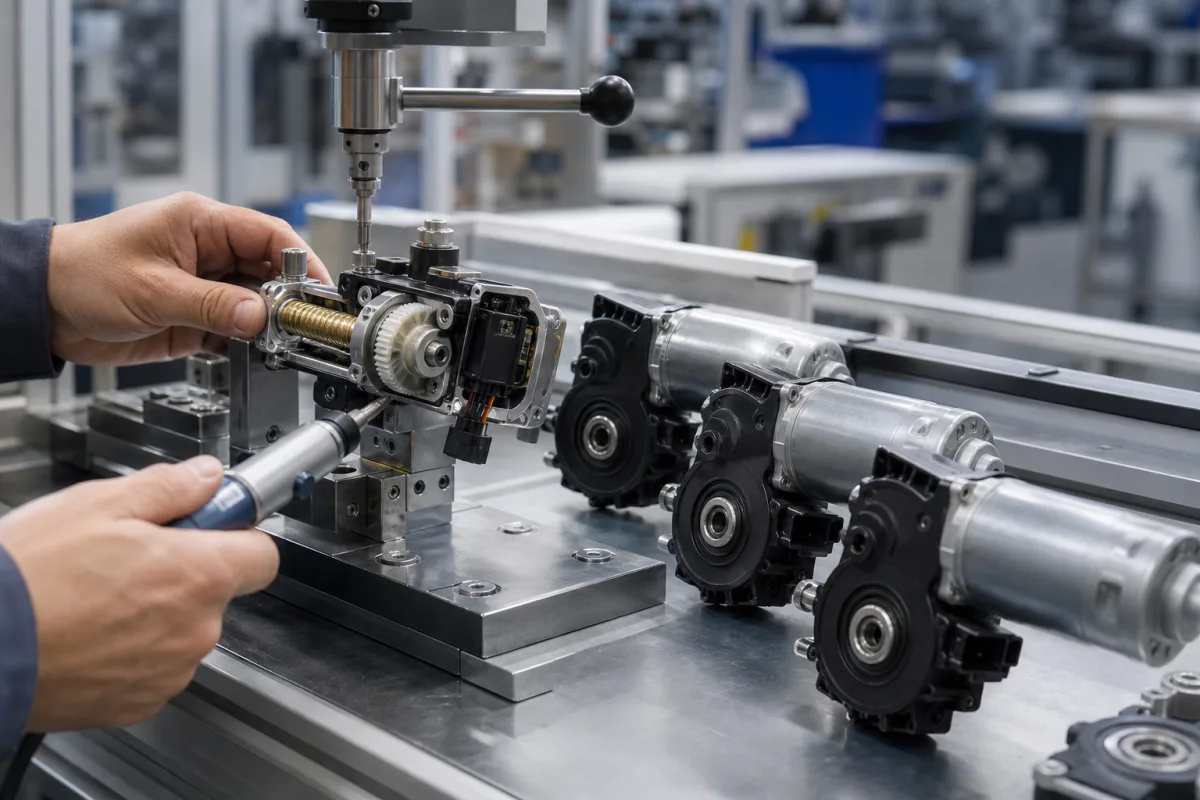
An electric motor that converts electrical energy into precise mechanical motion to drive an actuator mechanism.
Product Specifications

Technical details and manufacturing context for Actuator Motor

Definition
Within an Industrial System, an Actuator Motor serves as the primary power source for actuation components, providing controlled rotational or linear motion to operate valves, dampers, robotic arms, or other mechanical interfaces. It enables automated positioning, force application, and movement control based on system commands.
Working Principle
The Actuator Motor operates by generating electromagnetic torque when electrical current passes through its windings within a magnetic field. This rotational force is transmitted through the motor shaft to a connected mechanical linkage, gearbox, or lead screw, which converts it into the specific linear or rotary motion required by the actuator assembly to perform work within the Industrial System.
Common Materials
Electrical Steel Laminations, Copper Windings
Technical Parameters
  • Rated torque output of the Actuator Motor (Nm) Customizable
Components / BOM
  • Stator Assembly
    Creates a rotating magnetic field when energized
    Material: Laminated electrical steel with copper windings
  • Rotor Assembly
    Rotates within the stator's magnetic field to produce torque
    Material: Laminated steel with conductive bars or permanent magnets
  • Shaft
    Transmits mechanical torque from rotor to external load
    Material: Hardened steel alloy
  • Bearings
    Support the rotor shaft and reduce rotational friction
    Material: Steel with lubricated surfaces
Engineering Reasoning
0.5-15 Nm continuous torque, 100-6000 RPM rotational speed, 24-480 VDC input voltage
Thermal failure at 155°C winding temperature (Class F insulation), mechanical failure at 20 Nm peak torque (150% rated), electrical failure at 600 VDC dielectric breakdown
Design Rationale: Copper winding insulation degradation due to Arrhenius law thermal aging (doubling failure rate per 10°C above rated temperature), permanent magnet demagnetization at 80°C Curie point for NdFeB magnets, bearing fatigue at 10^7 cycles L10 life
Risk Mitigation (FMEA)
Trigger Permanent magnet demagnetization from 120°C rotor temperature exceeding 80°C Curie point
Mode: 30% torque loss, 15% efficiency reduction, cogging torque increase
Strategy: Embedded NTC thermistor thermal protection at 100°C, lamination stack cooling fins, samarium-cobalt magnets for 300°C Curie point
Trigger Hall effect sensor misalignment exceeding 0.5mm from ideal commutation position
Mode: 15% current ripple, 20% torque pulsation, audible 1kHz whine
Strategy: Optical encoder with 0.1° resolution, sensorless FOC algorithm with 2% flux observer error

Industry Taxonomies & Aliases

Commonly used trade names and technical identifiers for Actuator Motor.

Applied To / Applications

This component is essential for the following industrial systems and equipment:

Industrial Ecosystem & Supply Chain DNA

Complementary Systems
Downstream Applications
Specialized Tooling

Application Fit & Sizing Matrix

Operational Limits
pressure: 0 to 10 bar
other spec: Max Torque: 50 Nm, Speed Range: 0-3000 RPM
temperature: -20°C to +80°C
Media Compatibility
✓ Hydraulic Fluids ✓ Compressed Air Systems ✓ Clean Water Applications
Unsuitable: Corrosive Chemical Environments
Sizing Data Required
  • Required Torque (Nm)
  • Operating Speed (RPM)
  • Duty Cycle (%)

Reliability & Engineering Risk Analysis

Failure Mode & Root Cause
Insulation breakdown
Cause: Thermal degradation from overheating due to excessive load, poor ventilation, or voltage imbalance leading to winding insulation failure and short circuits.
Bearing wear/failure
Cause: Lubrication breakdown (grease degradation, contamination, or insufficient lubrication), misalignment, or excessive axial/radial loads causing premature bearing fatigue and seizure.
Maintenance Indicators
  • Unusual audible noise (grinding, screeching, or humming) indicating bearing wear, rotor imbalance, or electrical issues.
  • Excessive motor housing temperature (hot to touch beyond normal operating range) or visible smoke/odor from insulation overheating.
Engineering Tips
  • Implement predictive maintenance: Use vibration analysis and thermal imaging to detect early bearing wear, misalignment, or overheating before catastrophic failure.
  • Ensure proper lubrication schedule with correct grease type/quantity and maintain clean, dry operating conditions to prevent contamination and electrical faults.

Compliance & Manufacturing Standards

Reference Standards
ISO 9001:2015 - Quality management systems CE Marking - EU compliance for safety and performance IEC 60034-1 - Rotating electrical machines
Manufacturing Precision
  • Shaft runout: +/-0.01mm
  • Mounting flange flatness: 0.05mm
Quality Inspection
  • Insulation resistance test (megger test)
  • Vibration analysis and noise level measurement

Factories Producing Actuator Motor

Verified manufacturers with capability to produce this product in China

✓ 92% Supplier Capability Match Found

P Procurement Specialist from United States Feb 08, 2026
★★★★★
"Reliable performance in harsh Motor Vehicle Manufacturing environments. No issues with the Actuator Motor so far."
Technical Specifications Verified
T Technical Director from United Arab Emirates Feb 05, 2026
★★★★★
"Testing the Actuator Motor now; the technical reliability results are within 1% of the laboratory datasheet."
Technical Specifications Verified
P Project Engineer from Australia Feb 02, 2026
★★★★★
"Impressive build quality. Especially the technical reliability is very stable during long-term operation."
Technical Specifications Verified
Verification Protocol

“Feedback is collected from verified sourcing managers during RFQ (Request for Quote) and factory evaluation processes on CNFX. These reports represent historical performance data and technical audit summaries from our B2B manufacturing network.”

15 sourcing managers are analyzing this specification now. Last inquiry for Actuator Motor from USA (50m ago).

Supply Chain Commonly Integrated Components

Overhead Conveyor System

A suspended material handling system that transports automotive components and assemblies through the final assembly process using overhead tracks and carriers.

Explore Specs →
Chassis Assembly Station

A specialized workstation within an automotive assembly line where the vehicle chassis is assembled and integrated with major components.

Explore Specs →
Body Drop Station

Automated station in final assembly where vehicle body is precisely lowered onto chassis frame

Explore Specs →
Interior Assembly Station

A specialized workstation within an automotive final assembly line dedicated to installing interior components into vehicle bodies.

Explore Specs →

Frequently Asked Questions

What are the key components in this actuator motor's BOM?

The bill of materials includes bearings for smooth operation, rotor assembly for motion conversion, shaft for torque transmission, and stator assembly with electrical steel laminations and copper windings for electromagnetic efficiency.

How does this actuator motor benefit motor vehicle manufacturing?

This electric actuator motor provides precise mechanical motion control essential for automotive systems like throttle control, braking actuators, or suspension adjustments, ensuring reliability and performance in vehicle applications.

What materials ensure durability in this actuator motor?

Electrical steel laminations minimize energy loss through eddy currents, while copper windings offer excellent conductivity and thermal resistance, ensuring efficient operation and longevity in demanding automotive environments.

Can I contact factories directly on CNFX?

CNFX is an open directory, not a transaction platform. Each factory profile provides direct contact information and production details to help you initiate direct inquiries with Chinese suppliers.

Get Quote for Actuator Motor

Request technical pricing, lead times, or customized specifications for Actuator Motor directly from verified manufacturing units.

Your business information is encrypted and only shared with verified Actuator Motor suppliers.

Thank you! Your message has been sent. We'll respond within 1–3 business days.

Need to Manufacture Actuator Motor?

Connect with verified factories specializing in this product category

Add Your Factory Contact Us
Previous Product
Actuator (e.g., Solenoid, Pneumatic Piston)
Next Product
Adhesive Application Module