Industry-Verified Manufacturing Data (2026)

Structural Steel Angle Bar

Based on aggregated insights from multiple verified factory profiles within the CNFX directory, the standard Structural Steel Angle Bar used in the Fabricated Metal Product Manufacturing sector typically supports operational capacities ranging from standard industrial configurations to heavy-duty production requirements.

Technical Definition & Core Assembly

A canonical Structural Steel Angle Bar is characterized by the integration of Steel Leg A and Steel Leg B. In industrial production environments, manufacturers listed on CNFX commonly emphasize Carbon Steel construction to support stable, high-cycle operation across diverse manufacturing scenarios.

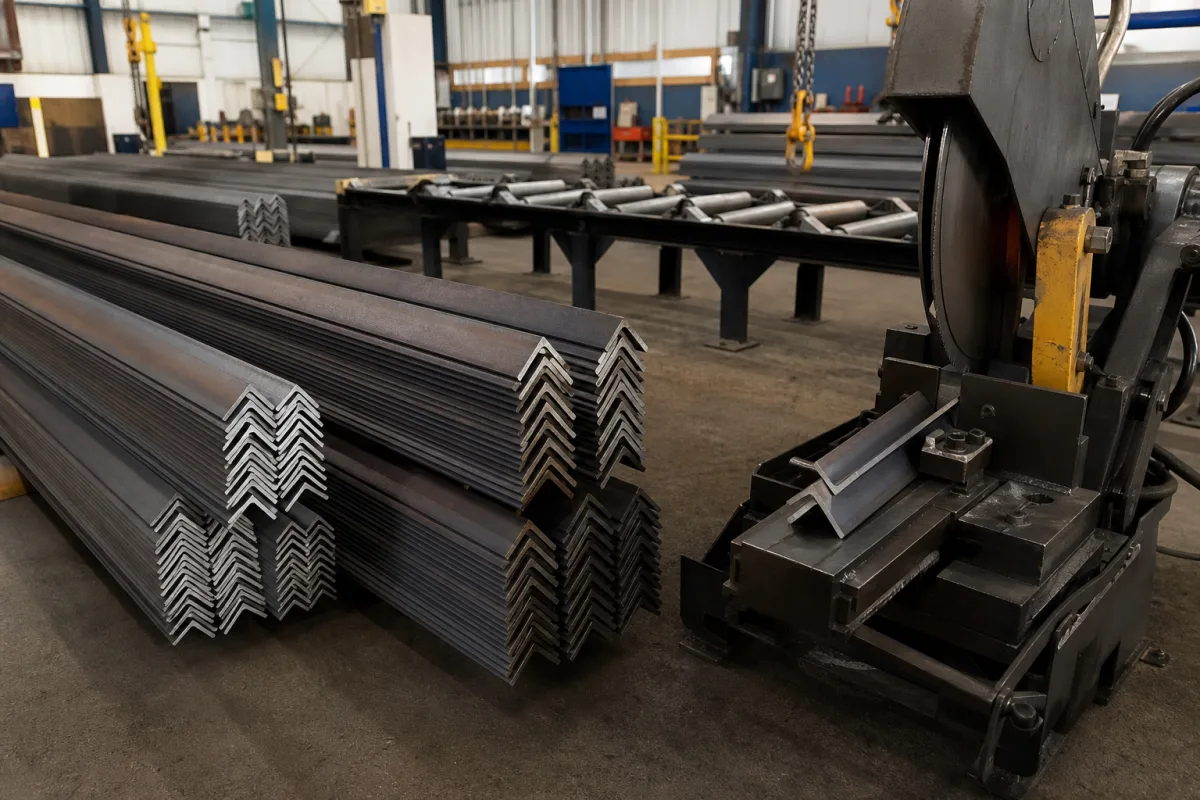
L-shaped structural steel section used as load-bearing framework component.

Product Specifications

Technical details and manufacturing context for Structural Steel Angle Bar

Definition
Structural steel angle bars are L-shaped hot-rolled steel sections with equal or unequal legs, forming 90-degree angles. They serve as fundamental load-bearing elements in construction frameworks, providing structural stability and connection points for beams, columns, and trusses. In industrial manufacturing, these semi-finished products are essential for fabricating support structures, machinery frames, and equipment bases. Their standardized dimensions and mechanical properties enable predictable performance in structural calculations and assembly processes across B2B supply chains.
Working Principle
Utilizes the geometric advantage of L-shaped cross-section to provide bending resistance in two perpendicular directions while maintaining material efficiency through optimized stress distribution along both legs.
Common Materials
Carbon Steel, Low-Alloy Steel
Technical Parameters
  • Uniform thickness of the steel section (mm) Standard Spec
  • Length of each leg in the L-section (mm) Standard Spec
Components / BOM
  • Steel Leg A
    Primary load-bearing surface in one direction
    Material: Carbon Steel
  • Steel Leg B
    Secondary load-bearing surface in perpendicular direction
    Material: Carbon Steel
  • Fillet Radius
    Internal radius connecting both legs for stress distribution
    Material: Same as base material
Engineering Reasoning
Yield strength: 250-355 MPa, Elastic modulus: 200 GPa, Temperature: -40°C to 400°C
Plastic deformation at 250 MPa yield stress, Buckling at slenderness ratio > 200, Fracture at 470 MPa ultimate tensile strength
Design Rationale: Von Mises yield criterion for plastic deformation, Euler buckling formula for slender compression members, Griffith's theory for brittle fracture initiation
Risk Mitigation (FMEA)
Trigger Corrosion rate exceeding 0.1 mm/year in chloride environments
Mode: Section loss reducing moment of inertia by 15%
Strategy: Hot-dip galvanizing with 85 μm zinc coating, Epoxy-polyurethane paint system
Trigger Cyclic loading at 10⁶ cycles with stress amplitude > 150 MPa
Mode: Fatigue crack propagation from fillet radius
Strategy: Radius optimization to 5 mm minimum, Shot peening inducing 400 MPa compressive residual stress

Industry Taxonomies & Aliases

Commonly used trade names and technical identifiers for Structural Steel Angle Bar.

Industrial Ecosystem & Supply Chain DNA

Complementary Systems
Downstream Applications
Specialized Tooling

Application Fit & Sizing Matrix

Operational Limits
pressure: Not applicable (structural load-bearing component)
other spec: Maximum allowable stress: 36-50 ksi (250-345 MPa) depending on steel grade
temperature: -40°C to 400°C (dependent on steel grade and coating)
Media Compatibility
✓ Building structural frameworks ✓ Industrial equipment supports ✓ Bridge and infrastructure components
Unsuitable: Continuous immersion in highly corrosive chemical environments without protective coating
Sizing Data Required
  • Maximum expected load (kN or kips)
  • Span length between supports (m or ft)
  • Required safety factor (typically 1.5-2.0 for structural applications)

Reliability & Engineering Risk Analysis

Failure Mode & Root Cause
Corrosion-induced section loss
Cause: Exposure to moisture, chemicals, or corrosive environments leading to rust formation and material degradation, particularly at joints and edges where protective coatings are compromised.
Fatigue cracking at stress concentrations
Cause: Cyclic loading or vibration causing crack initiation and propagation at sharp corners, weld points, or bolt holes where stress is concentrated, especially in dynamic or seismic applications.
Maintenance Indicators
  • Visible rust scaling or pitting exceeding 10% of surface area, especially at connections
  • Audible creaking or popping noises during load changes, indicating movement or crack propagation
Engineering Tips
  • Apply and maintain protective coatings (e.g., galvanizing, epoxy) with regular inspection and touch-up, particularly at edges and connection points where corrosion initiates.
  • Implement regular non-destructive testing (e.g., ultrasonic or magnetic particle inspection) at stress concentration areas to detect early fatigue cracks before critical failure.

Compliance & Manufacturing Standards

Reference Standards
ASTM A36/A36M - Standard Specification for Carbon Structural Steel EN 10056-1 - Specification for hot rolled equal and unequal leg steel angles ISO 657-1 - Hot-rolled steel sections - Part 1: Equal-leg angles
Manufacturing Precision
  • Length: +/- 6mm for lengths up to 7m
  • Straightness: 0.15% of length maximum deviation
Quality Inspection
  • Tensile Testing - Yield strength, tensile strength, elongation
  • Dimensional Verification - Leg lengths, thickness, straightness per standard tolerances

Factories Producing Structural Steel Angle Bar

Verified manufacturers with capability to produce this product in China

✓ 94% Supplier Capability Match Found

S Sourcing Manager from United Arab Emirates Jan 09, 2026
★★★★★
"Impressive build quality. Especially the Leg Length A (mm) is very stable during long-term operation."
Technical Specifications Verified
P Procurement Specialist from Australia Jan 06, 2026
★★★★☆
"As a professional in the Fabricated Metal Product Manufacturing sector, I confirm this Structural Steel Angle Bar meets all ISO standards. (Delivery took slightly longer than expected, but technical support was excellent.)"
Technical Specifications Verified
T Technical Director from Singapore Jan 03, 2026
★★★★★
"Standard OEM quality for Fabricated Metal Product Manufacturing applications. The Structural Steel Angle Bar arrived with full certification."
Technical Specifications Verified
Verification Protocol

“Feedback is collected from verified sourcing managers during RFQ (Request for Quote) and factory evaluation processes on CNFX. These reports represent historical performance data and technical audit summaries from our B2B manufacturing network.”

14 sourcing managers are analyzing this specification now. Last inquiry for Structural Steel Angle Bar from UAE (1h ago).

Supply Chain Commonly Integrated Components

Lower Blade

The stationary cutting blade in a sheet metal guillotine shear that works in conjunction with the upper blade to shear metal sheets.

Explore Specs →
Aluminum Shell

The outer protective casing component of a pharmaceutical vial aluminum seal

Explore Specs →
Material Handling Crane

Overhead lifting equipment for transporting aluminum profiles between processing stations in an anodizing line

Explore Specs →
Anodizing Tank Module

A modular tank unit designed for the electrochemical anodizing process of aluminum profiles, containing electrolyte solution and electrodes.

Explore Specs →

Frequently Asked Questions

What are the standard leg length ranges for structural steel angle bars?

Standard leg lengths typically range from 20mm to 200mm for Steel Leg A and Steel Leg B, with custom sizes available upon request from manufacturers.

How does yield strength affect the performance of structural steel angle bars?

Higher yield strength (measured in MPa) increases load-bearing capacity and structural integrity, making the angle bars suitable for heavier construction applications and seismic zones.

What surface finishes are available for structural steel angle bars?

Common finishes include mill finish (as-rolled), galvanized (zinc-coated for corrosion resistance), painted, and primed surfaces, depending on environmental exposure and project requirements.

Can I contact factories directly on CNFX?

CNFX is an open directory, not a transaction platform. Each factory profile provides direct contact information and production details to help you initiate direct inquiries with Chinese suppliers.

Get Quote for Structural Steel Angle Bar

Request technical pricing, lead times, or customized specifications for Structural Steel Angle Bar directly from verified manufacturing units.

Your business information is encrypted and only shared with verified Structural Steel Angle Bar suppliers.

Thank you! Your message has been sent. We'll respond within 1–3 business days.

Need to Manufacture Structural Steel Angle Bar?

Connect with verified factories specializing in this product category

Add Your Factory Contact Us
Previous Product
Structural Hollow Section Steel
Next Product
Structural Steel Channel Section