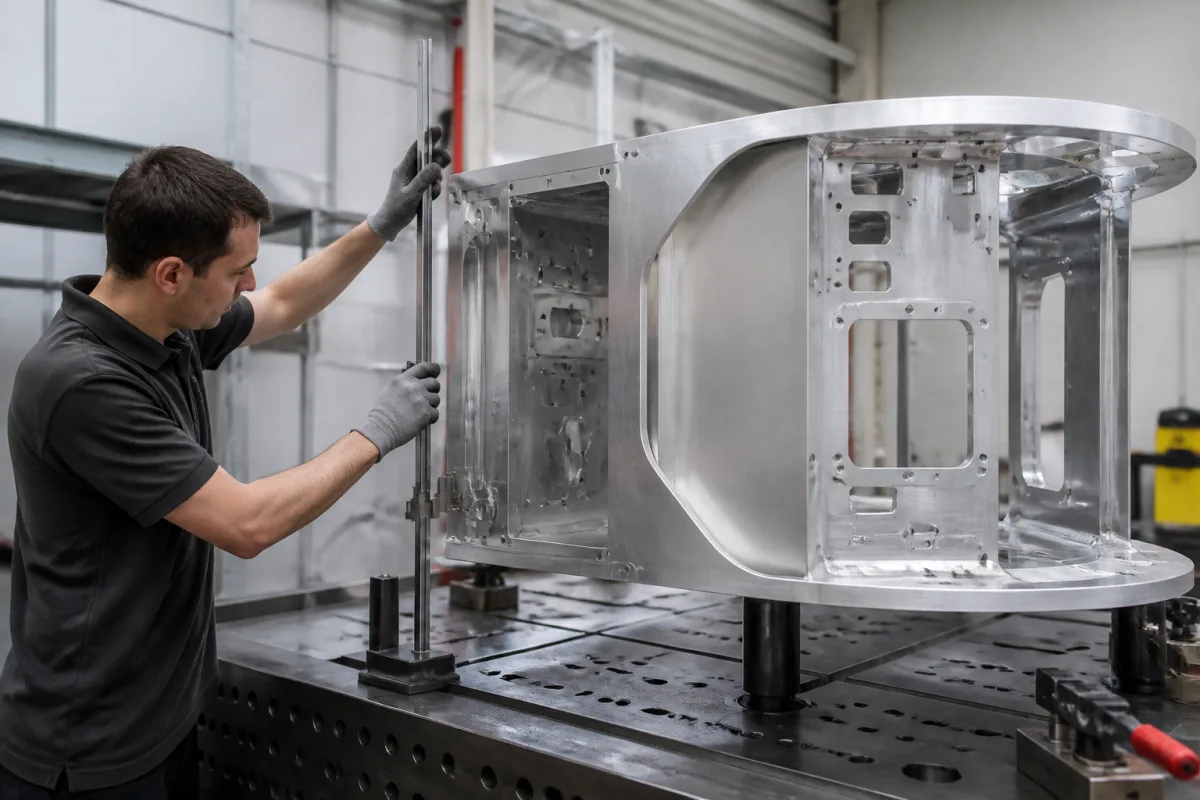
Aluminium shell as a welded structural housing: plate and extrusion frames joined with 4043 or 5356 filler, where the heat-affected zone sets the strength
Welded aluminium structural housings · 6061-T6 and 5xxx plate and extrusion frames, heat-affected-zone strength in groove welds, 4043 or 5356 filler for fillet welds, post-weld heat treatment, anodising and service temperature, and AWS D1.2
This page covers welded aluminium shells: structural housings and frames built from aluminium plate, sheet and extrusions in 5xxx and 6xxx alloys, arc-welded, then machined and checked on a fixture table. Ask three things first: which joints are groove welds and which fillet welds, which filler metal suits the alloy and any later heat treatment, anodising or service temperature, and which welding code the fabrication follows.
Welded aluminium structural housings and frames fabricated from plate, sheet and extrusions in 5xxx and 6xxx alloys, joined with 4043 or 5356 filler and machined after welding. High-pressure die-cast aluminium parts are covered on the Aluminium die casting page. Aluminium pressure vessels and piping, vial seal caps, motor housings and furnace shells are outside this page.
CNFX editorial research · Sources checked October 12, 2026 · 4 sources
Groove welds in 6061-T6: the heat-affected zone, not the filler, sets the strength
Frank Armao, a former chair of the AWS D1 aluminium subcommittee, writes in The Fabricator that in 6061-T6 groove (butt) welds the weak point is the heat-affected zone of the base metal next to the weld, and that both 4043 and 5356 filler give welds stronger than that zone, so either can be used. He notes that all codes require a minimum tensile strength of 24 ksi for welds in 6061-T6 regardless of filler, that in non-heat-treatable 5xxx alloys the heat-affected zone is annealed to O-temper properties, and that designers should use the allowable shear strengths given in the codes rather than estimating filler shear from its tensile strength. [3][1]
Editorial calculation: 24 ksi is about 165 MPa. For a housing whose main joints are butt welds in 6061-T6, ask the supplier to design to the welded strength, not to the base metal's T6 strength. [3]
Give the supplier the drawing with weld symbols and the base alloys and tempers, the loads and which joints carry them, any heat treatment, anodising or painting after welding, the service temperature, the welding code and inspection required, and the machining and flatness tolerances after welding.
02
Fillet welds load the weld metal in shear: choosing 5356 or 4043
Armao writes that fillet welds are almost always loaded in shear and fail in the middle of the weld, so filler strength matters there: he gives minimum shear strengths of 11 ksi for 4043 and 18 ksi for 5356 in one column, and in another describes 5356's shear strength as almost 50% higher than 4043's; he would favour 4043 where groove welds predominate in the joints and consider 5356 where fillet welds predominate. [1][2]
Armao adds that 4043 can flow better, is less crack-sensitive and less prone to crater cracking and weld smut, and gives a neater bead. [2] Editorial calculation: 11 ksi is about 76 MPa and 18 ksi about 124 MPa, a ratio of 1.64; the two columns' "almost 50%" and 64% differ, so take the allowable shear values from the governing code. [1][2]
AWS D1.2 for welded aluminium structures, and checks after machining
AWS D1.2/D1.2M:2026, Structural Welding Code — Aluminum, seventh edition, approved on 16 March 2026 and replacing the 2014 edition, covers the welding requirements for any type of structure made from aluminium structural alloys except pressure vessels and pressure piping, and sets requirements for fabricating and erecting welded aluminium structures; where contract documents stipulate it, all its requirements apply unless the Engineer or contract documents modify them. [4]
Editorial note: for a housing that is machined after welding, ask the supplier how welding sequence and fixturing control distortion, whether machining follows welding, and how flatness, bore positions and hole patterns are measured on the finished part, since these are not set by the filler choice.
04
Send the drawing, alloys and finishing route together
Paste it into your enquiry below or into an email to a maker, then replace every bracket.
Drawing: [weld symbols; groove or fillet; tolerances]
Alloys: [base alloys and tempers; thicknesses]
Filler: [4043 or 5356; reason]
After welding: [heat treatment; anodising; painting]
Service: [loads; temperature]
Code and checks: [AWS D1.2 or other; inspection; dimensional report]
Explore company information and manufacturing capabilities, then discuss the scope of your project with a relevant supplier.
Share this page
Compiled and source-reviewed by the CNFX editorial team.
Each manufacturer above links to the page on that company's own website where the product is listed, with the date we checked it. How we source and review
· Page last updated 13 October 2026
Buyer questions
Is 5356 or 4043 stronger for welding 6061-T6?
5356 is stronger, but in groove welds both exceed the heat-affected zone, which governs; in fillet welds 5356's higher shear strength (18 against 11 ksi) matters. [1][3]
What tensile strength do 6061-T6 welds have to meet?
Frank Armao states that all codes require a minimum tensile strength of 24 ksi for welds in 6061-T6, whichever filler is used. [3]
Which filler should be used if the part will be anodised?
5356, because 4043 welds turn black when anodised while 5356 anodises silver. [2]
Sources and what still needs a direct check
Sources checked 2026-10-12. Frank Armao's Aluminum Workshop columns in The Fabricator explain filler choice and weld strength; AWS D1.2 sets the structural welding code.