Overhead lifting · Hoist duty group and service life, brakes and limit switches, inspection and load testing
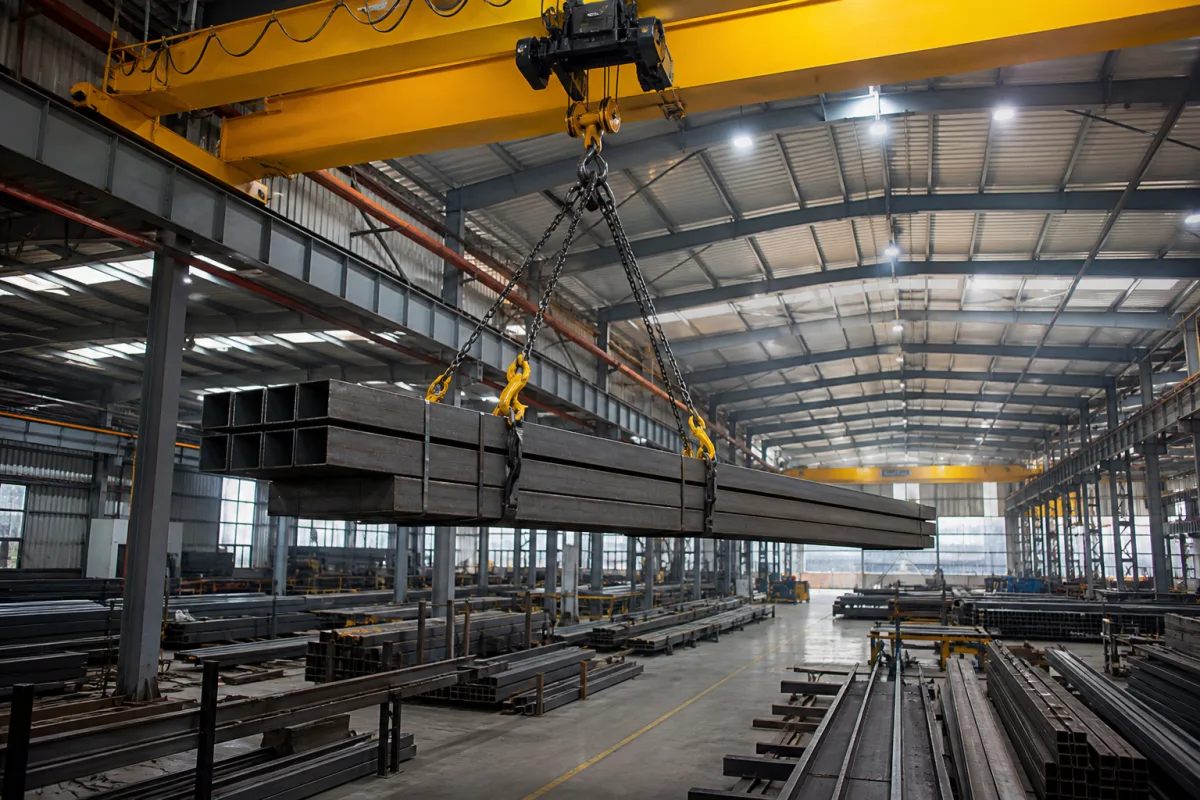
An overhead material handling crane is a bridge girder running on elevated rails, with a trolley and hoist that lift loads and carry them across a bay, such as bundles of steel sections between stock and processing stations. Ask three things first: which duty group the hoist is classified in and how its service life will be tracked, which brakes, limit switches and bumpers it carries, and how it will be inspected and load-tested before use.
Electric overhead travelling (bridge) cranes with wire rope or chain hoists for workshops and stockyards. Jib cranes, truck-mounted and mobile cranes, forklifts and pallet trucks, and hydraulic cylinders sold for crane use are outside this page.
CNFX editorial research · Sources checked October 11, 2026 · 4 sources
Match the hoist duty group and track its service life
Columbus McKinnon's record form for series hoists lists the FEM 9.511 mechanism groups 1Bm, 1Am, 2m, 3m, 4m and 5m alongside ISO 4301-1 groups M3 to M8, with theoretical full-load lifetimes of 400, 800, 1,600, 3,200, 6,300 and 12,500 hours. It describes load spectra from light (maximum load only in exceptional cases) to very heavy (regularly loaded to maximum). [2]
Demag's D-SH hoist manual, applying FEM 9.755, has the owner document the actual duration of service at least once a year as S = kmi × Ti × f, where kmi is the load spectrum factor, Ti the operating hours and f is 1.1 when hours come from an elapsed time indicator or 1.2 when estimated. A general overhaul is due when the theoretical duration of service is reached. Demag notes that average half-load operation increases the actual duration of service eightfold, and quarter-load operation 64-fold. [3]
Demag's worked example (50 m/min, 100 cycles/h, 2 m per cycle, 8 h/day, 250 days) gives Ti = 133.3 h, and with kmi = 0.09 an actual service use of 0.09 × 133.3 × 1.2 = 14.4 h, leaving 785.6 of the 800 h for group 1Am. [3] Editorial calculation: at that rate of use, 800 h would last about 800/14.4 ≈ 56 years of such use, while the same hours at full load (kmi = 1) would use 160 h a year and reach 800 h in 5 years.
Give the supplier the rated capacity, span, lifting height, the loads and their weights over a shift (how often at full load), cycles per hour, hoist and travel speeds, runway and building clearances, power supply, control method (pendant, radio, cab), environment, and the lifting attachment for your loads.
02
Check brakes, limit switches and bumpers
OSHA's overhead and gantry crane rule, 29 CFR 1910.179, requires each independent hoisting unit to have at least one self-setting holding brake applied automatically when power is removed, rated at not less than 125% of full-load hoisting torque when used with non-mechanical control braking, or 100% with mechanical control braking or where two holding brakes are fitted. Units handling hot metal with power control braking need at least two holding brakes. [1]
Where trolley and bridge brakes are required or fitted, the rule sets them to stop within a distance in feet equal to 10% of full-load speed in feet per minute, and bridge bumpers able to stop a crane travelling at least 40% of rated load speed, unless the stated exceptions apply. [1]
The upper hoist limit switch must be tried out under no load at the beginning of each operator's shift, inching the block into the limit, and must never be used as an operating control. The rated load must be plainly marked on each side of the crane and legible from the floor. [1] Editorial calculation: for a bridge travelling at 20 m/min (about 65.6 ft/min), the 10% rule allows a stopping distance of about 6.6 ft, or 2.0 m.
03
Plan inspection and the rated load test
OSHA divides inspections into frequent inspections at daily to monthly intervals and periodic inspections at 1 to 12 month intervals, depending on activity, severity of service and environment. Hooks are inspected visually daily and monthly with a certification record; hooks with cracks, more than 15% excess throat opening or more than 10° twist must be discarded. [1]
New and altered cranes must be tested before first use, including the trip setting of hoist limit switches with an empty hook at increasing speeds. Rated load test loads must not exceed 125% of the rated load unless the manufacturer recommends otherwise, and test reports must be kept on file. [1]
Editorial note: OSHA applies in the United States; ask the supplier which crane design and inspection rules it builds to for your country, and include the test load and test report in the acceptance terms.
04
Compare what suppliers offer
Suppliers linked to this page list overhead cranes; each card links to the page reviewed.
Listings include single and double girder overhead cranes with electric hoists; ask each for the hoist duty group, brake arrangement and test certificate for the crane offered.
05
Plan thorough examinations if the crane works in Great Britain
UK Health and Safety Executive guidance on LOLER requires a competent person to thoroughly examine lifting equipment before first use, after assembly at each location, in service, and after damage, long periods out of use or major changes. Unless a competent person's examination scheme sets other intervals, the defaults are 6 months for all lifting accessories and for equipment used to lift people, and 12 months for all other lifting equipment. [4]
The first examination may be skipped only where the equipment has a Declaration of Conformity less than one year old and was not assembled on site. Routine overload testing is not part of each examination, as some overload tests can damage the equipment. The report must contain all 11 items in LOLER Schedule 1. [4]
Editorial calculation: a goods crane falls in the 12-month group, so 10 years of service means 10 examinations, while its slings and shackles at 6 months need 20 (10 × 12 ÷ 6). Ask the supplier for the Declaration of Conformity date and the data the competent person needs for an examination scheme.
06
Trace the crane components
This is a functional reference built from the sources cited; it is not one maker's specification.
Fill the specification fields with values for your bay
A crane quotation needs values for your building and loads. The table explains each field, gives published values where a reviewed source states them, and says what to obtain from the supplier.
Field
What it means and published values
Ask the supplier for
Rated Lifting Capacity (t)
Maximum load on the nameplate; marked on both sides. [1]
Explore company information and manufacturing capabilities, then discuss the scope of your project with a relevant supplier.
Share this page
Compiled and source-reviewed by the CNFX editorial team.
Published product pages show what a company offers, not tested performance. Confirm the legal seller, factory and scope for your order. How we source and review
· Page last updated 13 October 2026
Buyer questions
What does FEM 2m or ISO M5 mean for a hoist?
It is the mechanism group; Columbus McKinnon lists FEM 2m as ISO M5 with a theoretical full-load lifetime of 1,600 hours. [2]
How strong must a crane hoist brake be?
OSHA 1910.179 requires at least 125% of full-load hoisting torque with non-mechanical control braking, or 100% with mechanical control braking or two holding brakes. [1]
What load is used to test an overhead crane?
OSHA limits rated load test loads to 125% of rated load unless the manufacturer recommends otherwise. [1]
How often must an overhead crane be thoroughly examined in Great Britain?
The UK Health and Safety Executive's LOLER guidance sets 12 months for lifting equipment that does not lift people and 6 months for lifting accessories and equipment used to lift people, unless a competent person's examination scheme sets other intervals. [4]
Sources and what still needs a direct check
Sources checked 2026-10-11. OSHA 29 CFR 1910.179 is a US regulation. Columbus McKinnon and Demag documents describe their own hoists and their application of FEM rules; another hoist's group and life must come from its own data plate and manual.