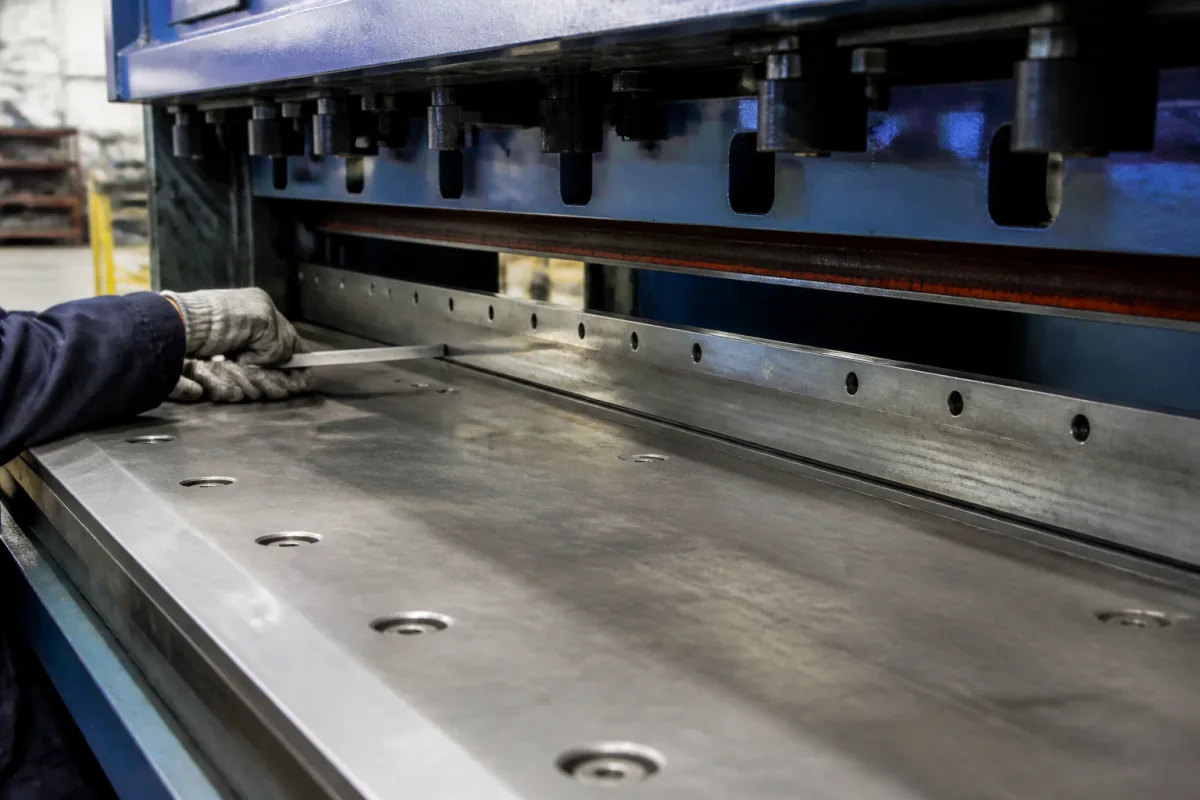
Lower blade (stationary bed blade of a guillotine shear, chosen by steel grade and hardness for the sheet or plate it cuts)
Lower (bed) blades for guillotine and swing-beam shears · blade steel by sheared material: carbon tool steel for mild cold-rolled sheet, alloy tool steels for stainless and hot-rolled plate, hot-work steels for hot shearing, with heat-treated hardness ranges
A lower blade here is the stationary blade bolted along the edge of a guillotine shear's table, against which the moving upper blade cuts. Its steel and heat-treated hardness decide how long its edges last and whether they chip, and the right choice depends on what the shear cuts. Ask three things first: which materials and thicknesses take up the shear's working hours, whether it cuts hot or cold, and what steel grade and tested hardness the blade maker offers for that duty.
Lower (bottom, bed) blades for guillotine and swing-beam sheet and plate shears supplied as replacement parts, chosen by steel grade and hardness for the sheared material. Upper blades, their usable edges, clearance setting against the lower blade, regrinding and refitting are covered on the Upper blade for a guillotine shear page; complete shears on the Guillotine shear page; coil slitting knives, scrap and baler shear knives are outside this page except as material examples.
CNFX editorial research · Sources checked October 12, 2026 · 3 sources
Blade steel by what the shear cuts: mild cold-rolled sheet versus stainless and hot-rolled plate
ADHMT, a hydraulic shear maker, groups shear blade materials by the sheet they cut: carbon tool steels such as T8, T10, 65 and 75, heat-treated to HRC 57-59, for low-carbon cold-rolled sheet and mild steel; low-alloy tool steels such as 6CrW2Si, Cr5Mo1V, 9CrSi and Cr12MoV, at HRC 58-62, for stainless steel and hot-rolled plate. It describes Cr12MoV as a cold work die steel for stainless and medium-thick plate and 6CrW2Si's tungsten and silicon as adding wear resistance for medium-thick and hot-rolled plate. [1]
Durma, another shear maker, puts it the same way: "the steel plate shearing machine blade selection of what material is determined by the plate to be cut". It lists T10, Cr5Mo and 9CrSi blades for "common A3 class, common low carbon cold rolled sheet and scrap", with 9CrSi also for hard thin plate, and 6CrW2Si and Cr12MoV blades for hot-rolled plate, stainless steel and medium-thickness plate. [2]
Give the blade maker the shear make and model, blade length, width, thickness and hole pattern (or the old blade), the materials and thickness range cut, by share of work, whether any hot or scrap cutting is done, the steel grade and hardness wanted or proposed, and the number of blade sets.
02
Hot shearing steels, and trading hardness for toughness
For high-speed and high-temperature hot shearing of hot-rolled billets and medium to thick plate, ADHMT lists alloy tool steels 4Cr5MoSiV1 (H13K), 7Cr7Mo2V2Si (LD), W6Mo5Cr4V2 (6542), H11 and H13. [1] Durma lists the same three Chinese grades for "high speed and high temperature hot shear", describing them as resistant to high temperature and "not easy annealing". [2]
A German blade supplier lists a 343 × 80 × 20 mm guillotine blade for HSM press boxes in AISI D2 (DIN 1.2379) at 54-56 HRC, described as having "slightly increased wear / increased toughness". [3] Editorial note: that is below the HRC 57-62 the shear makers give for sheet blades, so ask each maker which way its hardness choice trades edge wear against chipping for your material. [1][3]
Explore company information and manufacturing capabilities, then discuss the scope of your project with a relevant supplier.
Share this page
Compiled and source-reviewed by the CNFX editorial team.
Each manufacturer above links to the page on that company's own website where the product is listed, with the date we checked it. How we source and review
· Page last updated 13 October 2026
Buyer questions
How is this page different from the upper blade page?
This page covers choosing the lower blade's steel and hardness; usable edges, clearance and regrinding are on the Upper blade for a guillotine shear page. [1][2]
Which blade steel for mild steel sheet?
ADHMT names T8 and T10 carbon tool steels at HRC 57-59; Durma names T10, Cr5Mo and 9CrSi. [1][2]
Which blade steel for stainless?
Both makers name 6CrW2Si and Cr12MoV; ADHMT gives HRC 58-62. [1][2]
Which steel for hot shearing?
4Cr5MoSiV1, 7Cr7Mo2V2Si and W6Mo5Cr4V2, with ADHMT also naming H11 and H13. [1][2]
Sources and what still needs a direct check
Sources checked 2026-10-12. ADHMT and Durma, both shear makers, publish blade material guides; Cutmetall lists a D2 guillotine blade for baler press boxes.