Structured Manufacturing Data (2026)

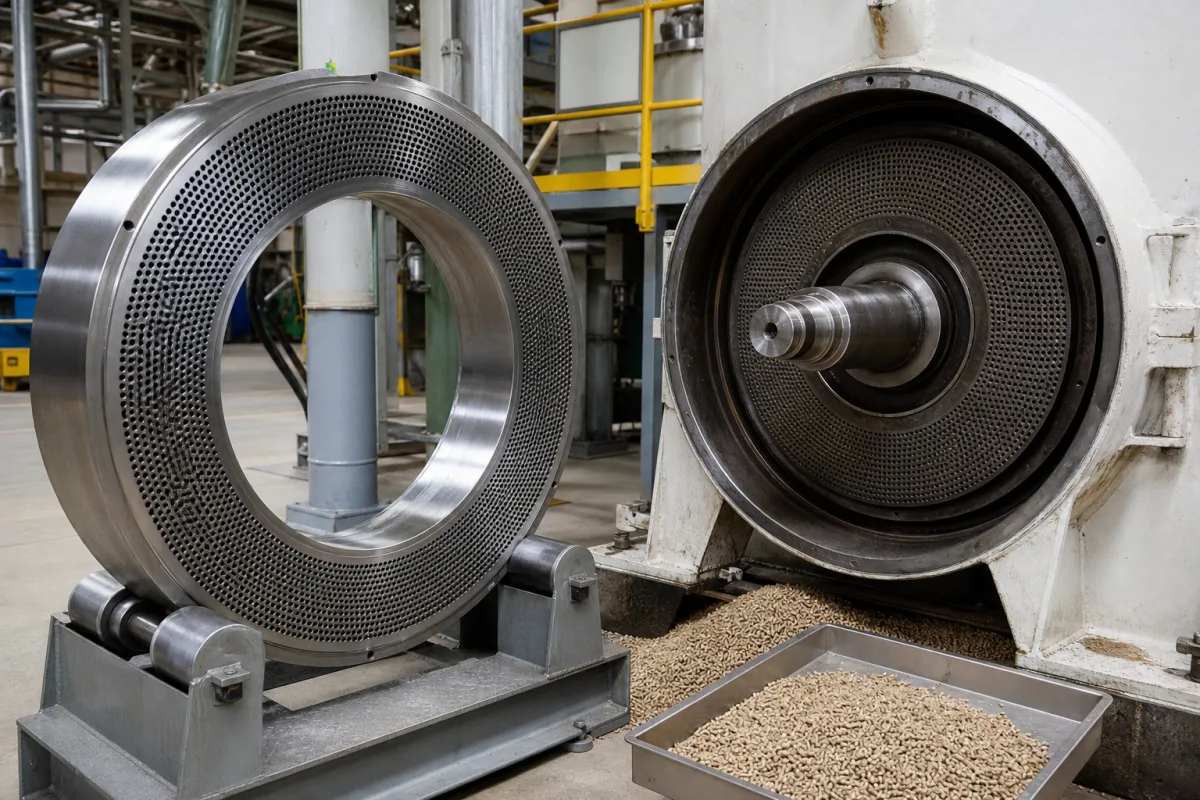
High-Durability Feed Pellet Die Ring

Based on aggregated insights from structured factory profiles within the CNFX directory, the standard High-Durability Feed Pellet Die Ring used in the Food Manufacturing sector typically supports operational capacities ranging from standard industrial configurations to heavy-duty production requirements.

Technical Definition & Core Assembly

A canonical High-Durability Feed Pellet Die Ring is characterized by the integration of Die Ring Body and Wear-Resistant Insert. In industrial production environments, manufacturers listed on CNFX commonly emphasize Chrome Steel Alloy construction to support stable, high-cycle operation across diverse manufacturing scenarios.

Wear-resistant annular die component for animal feed pellet production.

Product Specifications

Technical details and manufacturing context for High-Durability Feed Pellet Die Ring

Definition
A precision-machined annular component that forms the extrusion die in pellet mill systems. This critical wear part determines pellet size, shape consistency, and production efficiency in prepared animal feed manufacturing. It serves as a consumable component in B2B supply chains for feed mill operators and pellet mill OEMs. Proper die ring selection directly impacts feed quality, production throughput, and operational costs.
Working Principle
Feed material is forced through radial holes in the rotating die ring by rollers, extruding uniform pellets that are cut to length by stationary knives.
Common Materials
Chrome Steel Alloy, Carbide-Tipped Composite
Technical Parameters
  • Standard pellet diameter output (mm) Standard Spec
  • Die ring thickness for structural integrity (mm) Standard Spec
Components / BOM
  • Die Ring Body Part
    Main structural component with extrusion holes
    Material: Chrome Steel Alloy
  • Wear-Resistant Insert Optional Part
    Reinforced surface layer for extended service life
    Material: Carbide-Tipped Composite
  • Mounting Flange Part
    Interface for secure attachment to pellet mill shaft
    Material: Structural Steel

Industry Taxonomies & Aliases

Commonly used trade names and technical identifiers for High-Durability Feed Pellet Die Ring.

Industrial Ecosystem & Supply Chain Structure

Complementary Systems
Downstream Applications
Specialized Tooling

Application Fit & Sizing Matrix

Operational Limits
pressure: Up to 300 MPa (43,500 psi) compressive load
flow rate: 5-30 tons/hour feed throughput
temperature: Ambient to 120°C (248°F)
slurry concentration: 12-18% moisture content in feed mix
Media Compatibility
✓ Corn/soybean-based animal feed blends ✓ Poultry/pig complete feed formulations ✓ Aquafeed pellets with fishmeal/oil additives
Unsuitable: Abrasive mineral supplements exceeding 5% silica content
Sizing Data Required
  • Pellet diameter specification (3-12 mm)
  • Required production capacity (tons/hour)
  • Base material hardness (Brinell scale of feed ingredients)

Reliability & Engineering Risk Analysis

Failure Mode & Root Cause
Abrasive wear and ring diameter enlargement
Cause: Continuous friction from hard feed ingredients (e.g., minerals, silica) and high-pressure extrusion causing gradual material loss and increased pellet hole diameter beyond tolerance
Fatigue cracking and ring fracture
Cause: Cyclic thermal and mechanical stresses from repeated heating/cooling during operation and shutdowns, combined with material embrittlement from work hardening
Maintenance Indicators
  • Irregular pellet shapes or inconsistent pellet diameters (visual inspection of output)
  • Unusual metallic grinding noises or increased vibration during operation (audible/ tactile monitoring)
Engineering Tips
  • Implement progressive die ring rotation schedule to distribute wear evenly across the ring circumference and maintain uniform pressure distribution
  • Use controlled pre-heating protocols before high-load operations and gradual cooling after shutdowns to minimize thermal shock-induced microcracks

Compliance & Manufacturing Standards

Reference Standards
ISO 9001:2015 - Quality Management Systems ASTM A681-08(2019) - Standard Specification for Tool Steels Alloy CE Marking - Machinery Directive 2006/42/EC
Manufacturing Precision
  • Bore Diameter: +/-0.02mm
  • Surface Flatness: 0.05mm across 100mm
Quality Inspection
  • Hardness Testing (Rockwell C Scale)
  • Dimensional Verification with CMM

Factories Producing High-Durability Feed Pellet Die Ring

Manufacturer profiles with relevant production capability in China

Manufacturer listings support early research and capability understanding. They are not certification, ranking, or transaction guarantees.

Technical documentation
4/5
Manufacturing capability
4/5
Inspection readiness
5/5
Supplier transparency
3/5

These scores are example evaluation dimensions, not real customer ratings, country-specific buyer feedback, or live inquiry activity.

Supply Chain Commonly Integrated Components

Temperature Control Module

A precision electronic component that regulates and maintains optimal temperature conditions within fermentation vessels.

Explore Specs →
Pressure Regulation Unit

A specialized component within fermentation systems that maintains precise pressure levels during microbial growth processes.

Explore Specs →
Sensor Array Network

A network of multiple sensors distributed throughout a fermentation system to monitor and collect real-time data on critical parameters.

Explore Specs →
Agitation System

A mechanical subsystem within an automated fermentation control system designed to mix and homogenize fermentation media through controlled agitation.

Explore Specs →

Frequently Asked Questions

What materials are used in this high-durability feed pellet die ring?

The die ring is constructed from chrome steel alloy for structural integrity and features carbide-tipped composite inserts in critical wear areas for maximum abrasion resistance during animal feed pellet production.

How does the hole pattern density affect pellet production?

Hole pattern density (holes/cm²) directly influences pellet output rate, size consistency, and extrusion pressure. Higher densities produce more pellets per rotation but require more power, while lower densities create larger pellets with less energy consumption.

What maintenance is required for this die ring?

Regular inspection for wear on the carbide-tipped inserts and cleaning to prevent material buildup between holes. The chrome steel body requires minimal maintenance due to its corrosion resistance, but mounting surfaces should be checked periodically for proper alignment.

Can I contact factories directly on CNFX?

CNFX is an open directory, not a transaction platform. Each factory profile provides direct contact information and production details to help you initiate direct inquiries with Chinese suppliers.

Data Basis

CNFX manufacturer profiles, technical classification, publicly available product information, and ongoing plausibility checks.

Preliminary Technical Classification
This page supports structured research, RFQ preparation, and supplier evaluation. It does not replace buyer-led supplier qualification, standards review, or technical approval.

Request Manufacturing Insight for High-Durability Feed Pellet Die Ring

Ask for use case, specification boundaries, supplier type, and RFQ preparation information for High-Durability Feed Pellet Die Ring.

Your business information is used only to process this request.

Thank you! Your message has been sent. We'll respond within 1–3 business days.

Need to Manufacture High-Durability Feed Pellet Die Ring?

Compare manufacturer profiles with relevant product and process capability.

Create Manufacturer Profile Contact Us
Previous Product
High-Capacity Pellet Mill
Next Product
High-Efficiency Feed Pellet Die