Industry-Verified Manufacturing Data (2026)

High-Capacity Pellet Mill

Based on aggregated insights from multiple verified factory profiles within the CNFX directory, the standard High-Capacity Pellet Mill used in the Food Manufacturing sector typically supports operational capacities ranging from standard industrial configurations to heavy-duty production requirements.

Technical Definition & Core Assembly

A canonical High-Capacity Pellet Mill is characterized by the integration of Extrusion Die and Pressure Rollers. In industrial production environments, manufacturers listed on CNFX commonly emphasize High-Chrome Alloy Steel construction to support stable, high-cycle operation across diverse manufacturing scenarios.

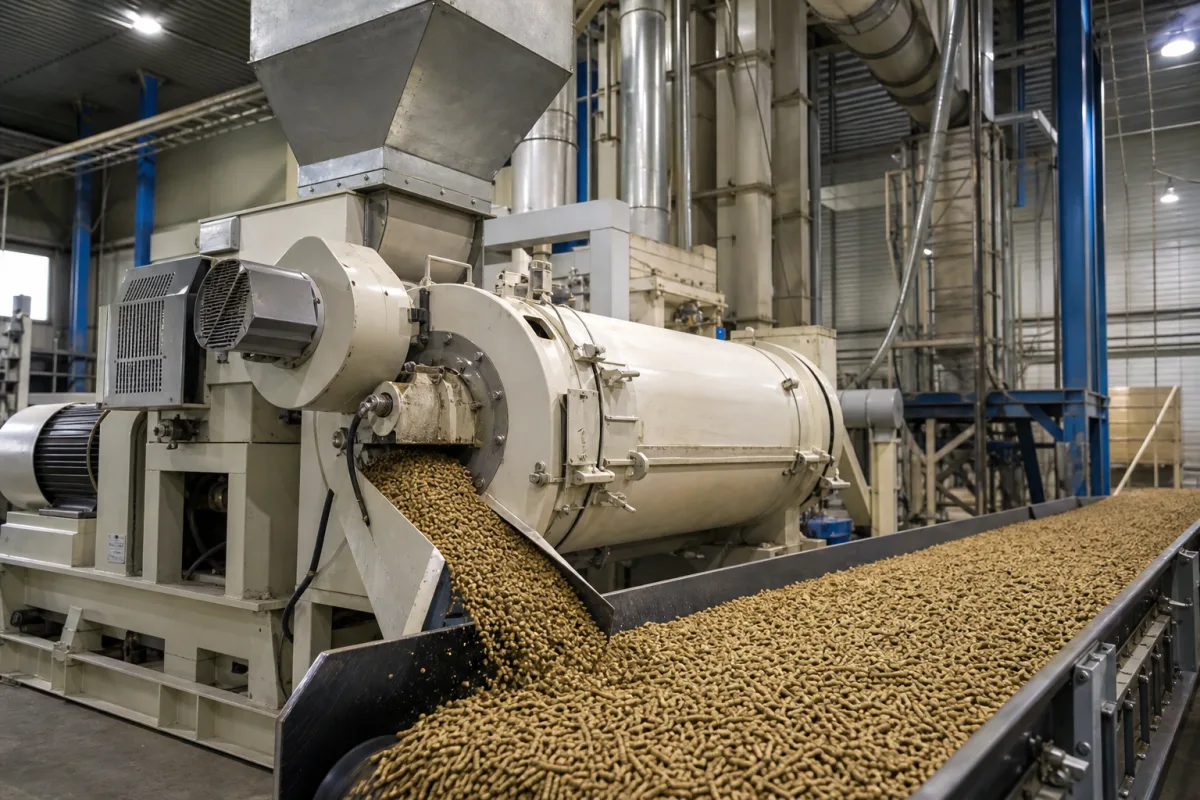
Industrial machine that compresses animal feed mixtures into uniform pellets through extrusion.
Product Specifications

Technical details and manufacturing context for High-Capacity Pellet Mill

Definition
A high-capacity pellet mill is a core industrial machine in prepared animal feed manufacturing that transforms ground feed mixtures into dense, uniform pellets through mechanical compression and extrusion. This equipment plays a critical role in B2B supply chains by enabling feed producers to create nutritionally balanced, dust-free pellets that improve animal feed efficiency and handling characteristics. The pelletization process enhances feed stability during storage and transportation while reducing waste in livestock operations. Industrial-scale pellet mills are essential for meeting the volume requirements of commercial feed mills serving agricultural and aquaculture sectors.
Working Principle
Ground feed mixture is fed into a conditioning chamber where steam is added for moisture and temperature control, then forced through a die by rotating rollers under high pressure, cutting the extruded material into uniform pellets.
Common Materials
High-Chrome Alloy Steel, Stainless Steel 304, Carbon Steel
Technical Parameters
  • Diameter of the extrusion die determining pellet size range (mm) Standard Spec
  • Maximum pellet output rate under optimal conditions (ton/hour) Standard Spec
Components / BOM
  • Extrusion Die
    Forms pellets through compression holes
    Material: High-Chrome Alloy Steel
  • Pressure Rollers
    Compresses feed mixture against die surface
    Material: Hardened Steel
  • Conditioning Chamber
    Mixes steam with feed for optimal moisture
    Material: Stainless Steel 304
  • Main Drive Motor
    Provides rotational power to rollers and die
    Material: Copper Windings, Steel Housing
  • Pellet Cutter Optional
    Cuts extruded material to uniform length
    Material: Carbon Steel
Engineering Reasoning
15-35 MPa extrusion pressure, 60-85°C die temperature, 8-12% material moisture content
Die temperature exceeding 120°C causes protein denaturation, extrusion pressure exceeding 45 MPa causes die deformation >0.5mm, moisture content below 5% causes material bridging
Design Rationale: Protein thermal degradation at 120°C (Arrhenius kinetics), die steel yield strength limit at 45 MPa (ASTM A36 steel), material adhesion coefficient threshold at 5% moisture (Coulomb friction model)
Risk Mitigation (FMEA)
Trigger Die temperature sensor calibration drift exceeding ±3°C
Mode: Protein binder thermal degradation causing pellet disintegration
Strategy: Redundant RTD sensors with 3-wire configuration and automatic calibration every 500 operating hours
Trigger Roller bearing lubrication failure with oil film thickness <5μm
Mode: Roller shaft seizure causing extrusion pressure loss
Strategy: Forced lubrication system with 0.1μm filtration and pressure monitoring at 0.2MPa minimum

Industry Taxonomies & Aliases

Commonly used trade names and technical identifiers for High-Capacity Pellet Mill.

Industrial Ecosystem & Supply Chain DNA

Complementary Systems
Downstream Applications
Specialized Tooling

Application Fit & Sizing Matrix

Operational Limits
pressure: Up to 300 bar at die face during extrusion
flow rate: 5-30 tons/hour depending on model and material
motor power: 90-400 kW depending on capacity
temperature: Ambient to 120°C (typical operation 60-90°C for feed conditioning)
pellet diameter: 2-12 mm standard range
slurry concentration: Not applicable - processes dry mixtures with 10-15% moisture content
Media Compatibility
✓ Poultry feed mixtures (corn, soybean, vitamins) ✓ Cattle feed with grain and protein blends ✓ Aquafeed formulations with fishmeal and binders
Unsuitable: High-moisture materials (>20% moisture) or sticky substances like molasses-heavy mixtures without proper preconditioning
Sizing Data Required
  • Required production capacity (tons/hour)
  • Pellet diameter specification (mm)
  • Available electrical power and space constraints

Reliability & Engineering Risk Analysis

Failure Mode & Root Cause
Die and Roller Wear
Cause: Abrasive erosion from high-pressure pelletizing of hard materials, compounded by inadequate lubrication and misalignment leading to uneven contact surfaces.
Bearing Overheating and Seizure
Cause: Excessive mechanical load and friction due to contamination from pellet fines ingress, coupled with insufficient cooling or degraded lubricant viscosity under continuous high-torque operation.
Maintenance Indicators
  • Unusual grinding or screeching noises from the die/roller assembly, indicating severe metal-on-metal contact or foreign object intrusion.
  • Visible smoke or strong burning odor from the drive housing, signaling overheating bearings or electrical insulation failure.
Engineering Tips
  • Implement a predictive maintenance program using vibration analysis and thermal imaging to detect early-stage bearing wear and misalignment before catastrophic failure.
  • Optimize die-to-roller clearance and alignment with laser calibration tools during scheduled downtime, and use high-temperature, food-grade lubricants rated for extreme pressure to reduce abrasive wear.

Compliance & Manufacturing Standards

Reference Standards
ISO 12100:2010 - Safety of machinery ANSI/ASME B46.1 - Surface Texture DIN 18800-7 - Steel structures - Part 7: Execution and workmanship
Manufacturing Precision
  • Die bore concentricity: +/-0.01mm
  • Roller shaft parallelism: 0.05mm/m
Quality Inspection
  • Hardness testing (Rockwell C) on die and roller surfaces
  • Dimensional verification of critical components with CMM

Factories Producing High-Capacity Pellet Mill

Verified manufacturers with capability to produce this product in China

✓ 98% Supplier Capability Match Found

P Project Engineer from Singapore Jan 29, 2026
★★★★★
"The technical documentation for this High-Capacity Pellet Mill is very thorough, especially regarding Production Capacity (ton/hour)."
Technical Specifications Verified
S Sourcing Manager from Germany Jan 26, 2026
★★★★★
"Reliable performance in harsh Food Manufacturing environments. No issues with the High-Capacity Pellet Mill so far."
Technical Specifications Verified
P Procurement Specialist from Brazil Jan 23, 2026
★★★★★
"Testing the High-Capacity Pellet Mill now; the Production Capacity (ton/hour) results are within 1% of the laboratory datasheet."
Technical Specifications Verified
Verification Protocol

“Feedback is collected from verified sourcing managers during RFQ (Request for Quote) and factory evaluation processes on CNFX. These reports represent historical performance data and technical audit summaries from our B2B manufacturing network.”

14 sourcing managers are analyzing this specification now. Last inquiry for High-Capacity Pellet Mill from USA (1h ago).

Supply Chain Commonly Integrated Components

Temperature Control Module

A precision electronic component that regulates and maintains optimal temperature conditions within fermentation vessels.

Explore Specs →
Pressure Regulation Unit

A specialized component within fermentation systems that maintains precise pressure levels during microbial growth processes.

Explore Specs →
Sensor Array Network

A network of multiple sensors distributed throughout a fermentation system to monitor and collect real-time data on critical parameters.

Explore Specs →
Agitation System

A mechanical subsystem within an automated fermentation control system designed to mix and homogenize fermentation media through controlled agitation.

Explore Specs →

Frequently Asked Questions

What materials are used in the construction of this pellet mill?

This pellet mill is constructed with high-chrome alloy steel for wear resistance, stainless steel 304 for corrosion resistance in contact areas, and carbon steel for structural components, ensuring durability in industrial feed production environments.

What is the typical production capacity range for this machine?

This high-capacity pellet mill is designed for industrial-scale production with a capacity measured in tons per hour, making it suitable for large feed manufacturing operations requiring consistent, high-volume pellet output.

How does the conditioning chamber affect pellet quality?

The conditioning chamber precisely controls temperature and moisture content of the feed mixture before extrusion, which is critical for achieving uniform pellet density, proper binding, and optimal nutritional retention in the final animal feed product.

Can I contact factories directly on CNFX?

CNFX is an open directory, not a transaction platform. Each factory profile provides direct contact information and production details to help you initiate direct inquiries with Chinese suppliers.

Get Quote for High-Capacity Pellet Mill

Request technical pricing, lead times, or customized specifications for High-Capacity Pellet Mill directly from verified manufacturing units.

Your business information is encrypted and only shared with verified High-Capacity Pellet Mill suppliers.

Thank you! Your message has been sent. We'll respond within 1–3 business days.

Need to Manufacture High-Capacity Pellet Mill?

Connect with verified factories specializing in this product category

Add Your Factory Contact Us
Previous Product
Glove Ports / Gauntlets
Next Product
High-Durability Feed Pellet Die Ring