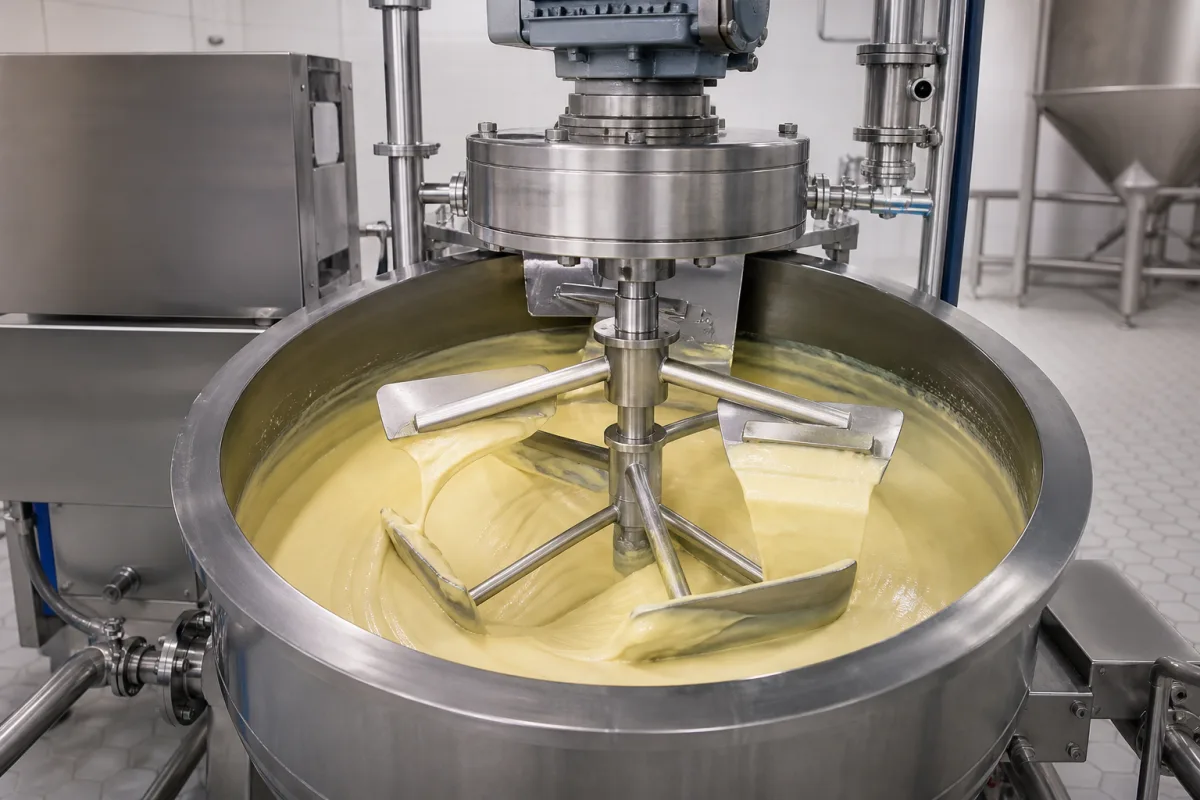
Hygienic tank agitators · Impeller size against viscosity, anchor-scraper and counter-rotating drives, seal, finish and food-grade gear oil
A top-entry agitator is the drive, shaft, seal and impeller set mounted on a tank lid or bridge to mix, suspend or heat-exchange a food product. Ask three things first: which impeller type and speed the supplier proposes for your product's highest viscosity, how the shaft is sealed and finished for CIP and SIP, and what lubricant sits in the gearbox above the product.
Top-mounted agitators sold as separate units for hygienic food, dairy and beverage tanks: axial-flow hydrofoil agitators, anchor agitators with wall scrapers and counter-rotating combinations, with their gear motors, shaft seals and bottom bearings. Complete jacketed yogurt incubation tanks with their temperature and pH control are covered on the Industrial-scale yogurt fermentation tank page. Air-sparging agitation for plating baths, high-shear rotor-stator mixers and inline mixers are outside this page.
CNFX editorial research · Sources checked October 12, 2026 · 3 sources
Size impeller, speed and power by viscosity and tank diameter
INOXPA's data sheet for its MCR counter-rotating agitator recommends an impeller diameter between one-third and one-half of the tank diameter, and publishes recommended configurations for products below 20,000 cP; above that it asks buyers to consult its technical department. [1]
Editorial calculation: tip speed is π × diameter × rpm / 60. The 400 mm central impellers of the MCR-4/500 at 109 rpm run at about 2.3 m/s, and the 800 mm impellers of the MCR-7/4000 at 66 rpm at about 2.8 m/s. Installed anchor power falls from 8 kW/m³ in the 500 L configuration (4.0 kW ÷ 0.5 m³) to 2.75 kW/m³ in the 4,000 L one (11 kW ÷ 4 m³), so power per volume is not held constant across the range. [1]
Alfa Laval's ALTB leaflet lists standard hydrofoil propeller diameters of Ø125–1,900 mm and states that motor size and speed are chosen as required for the duty. [2]
Give the supplier tank diameter, straight-side height and bottom shape, working and minimum volumes, product viscosity at each process stage and temperature, density, solids or powder additions, heating or cooling duty, and whether the tank is open, atmospheric or pressurised.
02
Specify seal, surface finish and gear oil for food contact
Alfa Laval's ALTB leaflet gives a hygienic polished finish of Ra < 0.8 µm on wetted parts (Ra < 3.2 µm shot-peened for industrial duty), AISI 316L steel, EPDM or FPM elastomers, carbon or silicon-carbide seal faces, and limits of 90 °C in operation, 95 °C for CIP and 150 °C for SIP, at full vacuum to 10 barg depending on configuration. [2]
INOXPA's MCR sheet offers Ra ≤ 0.8 µm as standard and Ra ≤ 0.4 µm for pharmaceutical duty, a SiC/C mechanical seal or PTFE lip seal with EPDM or FPM elastomers, working limits of −1 to 6 bar and −7 to 150 °C, and gear motors filled with H1 food-grade oil. [1]
Where a gearbox sits above the product, FDA's 21 CFR 178.3570 allows lubricants with incidental food contact only in the minimum amount needed, and for mineral oil limits addition to food to 10 parts per million. [3] Editorial calculation: in a 2,000 kg batch, 10 ppm is 20 g of mineral oil; ask how the oil trap or seal arrangement keeps gear oil out of the tank. [3]
03
Choose axial-flow, scraped-anchor or counter-rotating drives
The ALTB is a top-mounted agitator with a bottom steady bearing inside the tank and two- or three-blade hydrofoil impellers that give high flow at low shear; its wear bushings are PEEK and can be replaced without removing the drive. Drive options include a right-angle gear for low headroom and a parallel-shaft gearbox. [2]
INOXPA's MCR uses two coaxial shafts on separate gear motors turning in opposite directions: a faster central shaft with propellers for dispersion in low-viscosity phases, and an outer anchor with scrapers that clears product from the wall to improve heat transfer. The anchor can be flat or helical depending on viscosity; anchor torque rises from 370 Nm on the MCR-1 to 24,500 Nm on the MCR-8, and a lower ring or tripod supports larger anchors. [1]
04
Gear motor with H1 oil, seal and oil trap, 316L shaft, hydrofoils, scraped anchor and steady bearing
Power, speed, impeller-to-tank ratio, finish and CIP/SIP limits for a hygienic top-entry agitator
Give the product viscosity first: INOXPA publishes configurations only below 20,000 cP and sizes the impeller at one-third to one-half of the tank diameter. [1]
Explore company information and manufacturing capabilities, then discuss the scope of your project with a relevant supplier.
Share this page
Compiled and source-reviewed by the CNFX editorial team.
Each manufacturer above links to the page on that company's own website where the product is listed, with the date we checked it. How we source and review
· Page last updated 13 October 2026
Buyer questions
How large should the impeller be relative to the tank?
INOXPA's MCR data sheet recommends an impeller diameter between one-third and one-half of the tank diameter. [1]
What surface finish does a hygienic agitator need?
Alfa Laval's ALTB leaflet lists Ra < 0.8 µm polished for hygienic duty; INOXPA offers Ra ≤ 0.8 µm standard and Ra ≤ 0.4 µm for pharmaceutical duty. [2][1]
What lubricant may be used in a gearbox over food?
FDA's 21 CFR 178.3570 covers lubricants with incidental food contact; mineral oil may add no more than 10 ppm to food. [3]
Sources and what still needs a direct check
Sources checked 2026-10-12. INOXPA and Alfa Laval are makers of hygienic agitators; their data sheets describe their own products. FDA's regulation covers lubricants that may contact food.