Industry-Verified Manufacturing Data (2026)

Regenerative Section

Based on aggregated insights from multiple verified factory profiles within the CNFX directory, the standard Regenerative Section used in the Food Manufacturing sector typically supports operational capacities ranging from standard industrial configurations to heavy-duty production requirements.

Technical Definition & Core Assembly

A canonical Regenerative Section is characterized by the integration of Heat Exchange Plates and Gaskets/Seals. In industrial production environments, manufacturers listed on CNFX commonly emphasize Stainless Steel (AISI 316L) construction to support stable, high-cycle operation across diverse manufacturing scenarios.

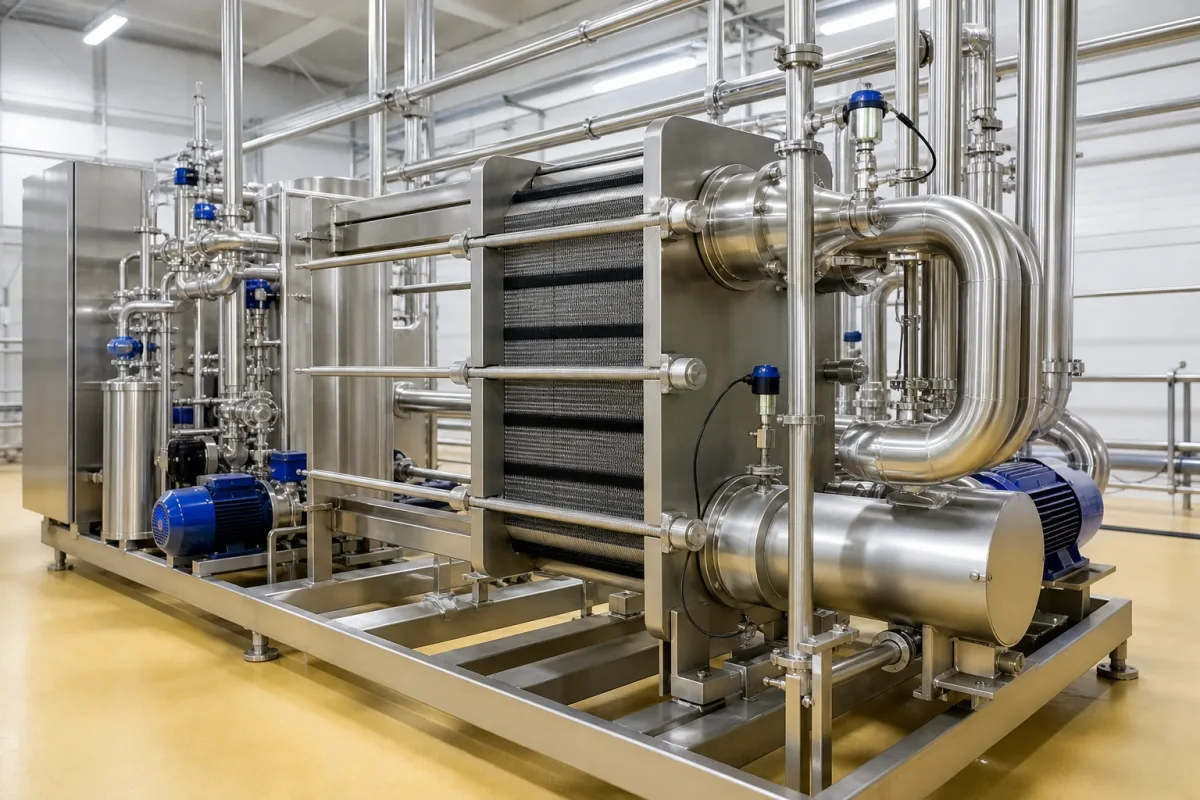
Heat exchange section in a pasteurization system where incoming cold product is preheated by outgoing hot product.
Product Specifications

Technical details and manufacturing context for Regenerative Section

Definition
The Regenerative Section is a critical component within a Continuous Flow Pasteurization System designed to maximize energy efficiency. It functions as a heat recovery zone where the cold, incoming product (e.g., milk, juice) is preheated by the hot, outgoing product that has just been pasteurized. This counter-current heat exchange process significantly reduces the energy required to bring the product up to pasteurization temperature in the subsequent heating section.
Working Principle
The section operates on the principle of counter-current heat exchange. Cold, raw product flows in one direction through a series of plates or tubes, while hot, pasteurized product flows in the opposite direction in adjacent channels. Heat transfers from the hot product to the cold product through the separating walls, preheating the incoming stream and simultaneously cooling the outgoing stream for safe storage or filling.
Common Materials
Stainless Steel (AISI 316L)
Technical Parameters
  • Plate pack thickness or overall length of the heat exchanger assembly. (mm) Per Request
Components / BOM
  • Heat Exchange Plates
    Provide the surface area for conductive heat transfer between the hot and cold product streams. Corrugated patterns create turbulent flow for efficient heat transfer.
    Material: Stainless Steel
  • Gaskets/Seals
    Ensure leak-proof separation between the alternating hot and cold product channels within the plate pack.
    Material: Food-grade elastomer (e.g., EPDM, Nitrile)
  • Frame/Support Structure
    Holds the plate pack under compression and provides structural integrity and mounting points for the section.
    Material: Stainless Steel
  • Inlet/Outlet Ports
    Connection points for piping to direct the cold product into and the hot product out of the heat exchange channels.
    Material: Stainless Steel
Engineering Reasoning
0.5-6.0 bar differential pressure, 2-85°C temperature gradient
Plate deflection exceeding 0.3 mm at 8.5 bar differential pressure or temperature differential surpassing 90°C
Design Rationale: Thermal stress-induced plate buckling due to coefficient of thermal expansion mismatch (stainless steel α=17.3×10⁻⁶/°C) exceeding yield strength of 205 MPa
Risk Mitigation (FMEA)
Trigger Calcium carbonate scaling accumulation exceeding 0.5 mm thickness
Mode: Flow restriction causing 40% reduction in heat transfer coefficient
Strategy: Integrated CIP system with 2% nitric acid solution at 75°C for 30-minute cycles
Trigger Gasket material degradation from cyclic thermal loading at 60-85°C
Mode: Product-to-coolant leakage exceeding 0.1% volume fraction
Strategy: EPDM gaskets with 70 Shore A hardness and 150°C continuous service temperature rating

Industry Taxonomies & Aliases

Commonly used trade names and technical identifiers for Regenerative Section.

Industrial Ecosystem & Supply Chain DNA

Complementary Systems
Downstream Applications
Specialized Tooling

Application Fit & Sizing Matrix

Operational Limits
pressure: Up to 10 bar (standard), 16 bar (high-pressure variants)
flow rate: 0.5 to 50 m³/h (depending on plate/configuration)
temperature: -10°C to 150°C (typical pasteurization range)
slurry concentration: Up to 40% solids by weight (requires specialized plate design)
Media Compatibility
✓ Dairy products (milk, cream) ✓ Juices and beverages ✓ Liquid food products with low viscosity
Unsuitable: Highly abrasive slurries or corrosive chemicals without specialized materials
Sizing Data Required
  • Product flow rate (m³/h)
  • Temperature difference between inlet and outlet (°C)
  • Required heat transfer efficiency (%)

Reliability & Engineering Risk Analysis

Failure Mode & Root Cause
Cavitation
Cause: Low inlet pressure or excessive suction lift causing vapor bubble formation and implosion, damaging impeller surfaces.
Bearing failure
Cause: Improper lubrication, misalignment, or contamination leading to overheating and premature wear of rotating components.
Maintenance Indicators
  • Excessive vibration or unusual noise during operation
  • Decreased flow rate or pressure output despite normal operating conditions
Engineering Tips
  • Maintain proper NPSH (Net Positive Suction Head) to prevent cavitation by ensuring adequate inlet pressure and minimizing suction line restrictions.
  • Implement regular alignment checks and precision balancing of rotating assemblies, along with scheduled lubrication analysis to detect contamination early.

Compliance & Manufacturing Standards

Reference Standards
ISO 9001:2015 Quality Management Systems ASTM A276/A276M-17 Standard Specification for Stainless Steel Bars and Shapes CE Marking for Pressure Equipment Directive 2014/68/EU
Manufacturing Precision
  • Bore Diameter: +/-0.025mm
  • Surface Flatness: 0.05mm per 100mm
Quality Inspection
  • Dye Penetrant Test for Surface Defects
  • Dimensional Verification with Coordinate Measuring Machine (CMM)

Factories Producing Regenerative Section

Verified manufacturers with capability to produce this product in China

✓ 96% Supplier Capability Match Found

S Sourcing Manager from Australia Jan 04, 2026
★★★★★
"Standard OEM quality for Food Manufacturing applications. The Regenerative Section arrived with full certification."
Technical Specifications Verified
P Procurement Specialist from Singapore Jan 01, 2026
★★★★☆
"Great transparency on the Regenerative Section components. Essential for our Food Manufacturing supply chain. (Delivery took slightly longer than expected, but technical support was excellent.)"
Technical Specifications Verified
T Technical Director from Germany Dec 29, 2025
★★★★★
"The Regenerative Section we sourced perfectly fits our Food Manufacturing production line requirements."
Technical Specifications Verified
Verification Protocol

“Feedback is collected from verified sourcing managers during RFQ (Request for Quote) and factory evaluation processes on CNFX. These reports represent historical performance data and technical audit summaries from our B2B manufacturing network.”

19 sourcing managers are analyzing this specification now. Last inquiry for Regenerative Section from Vietnam (1h ago).

Supply Chain Compatible Machinery & Devices

Automated Food Moisture Analyzer

Automated system for precise moisture content measurement in food products

Explore Specs →
Automated Food Color Consistency Analyzer

Automated inline system for real-time color measurement and consistency control in food processing.

Explore Specs →
Control Panel

A centralized interface for monitoring and controlling industrial equipment and processes

Explore Specs →
Industrial Vacuum Tumbler

Industrial machine for massaging and marinating meat under vacuum to enhance texture and flavor.

Explore Specs →

Frequently Asked Questions

What is the primary function of a regenerative section in food pasteurization?

The regenerative section preheats incoming cold product using the heat from outgoing hot pasteurized product, significantly reducing energy consumption and improving overall system efficiency in food processing.

Why is AISI 316L stainless steel used for regenerative sections in food manufacturing?

AISI 316L stainless steel offers superior corrosion resistance, excellent cleanability, and meets food-grade hygiene standards, making it ideal for maintaining product purity and durability in demanding pasteurization environments.

How does the regenerative section impact overall pasteurization system efficiency?

By recovering heat from pasteurized product to preheat incoming cold product, regenerative sections can reduce energy requirements by 70-90%, lowering operating costs and improving sustainability in food manufacturing operations.

Can I contact factories directly on CNFX?

CNFX is an open directory, not a transaction platform. Each factory profile provides direct contact information and production details to help you initiate direct inquiries with Chinese suppliers.

Get Quote for Regenerative Section

Request technical pricing, lead times, or customized specifications for Regenerative Section directly from verified manufacturing units.

Your business information is encrypted and only shared with verified Regenerative Section suppliers.

Thank you! Your message has been sent. We'll respond within 1–3 business days.

Need to Manufacture Regenerative Section?

Connect with verified factories specializing in this product category

Add Your Factory Contact Us
Previous Product
Product Trays/Conveyor
Next Product
Rotary Fruit and Vegetable Blanching Drum