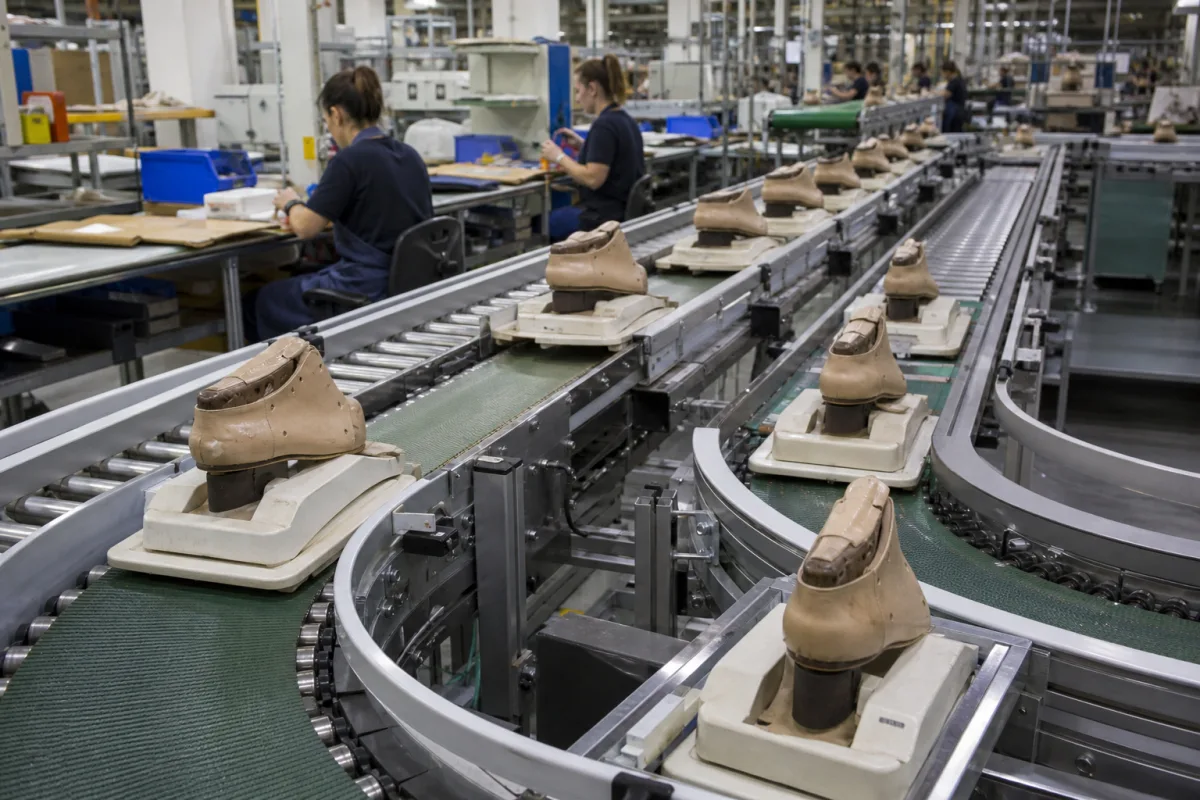
Lasting-room carrier conveyor for shoe assembly: a modular loop that moves shoes on lasts from operator to operator and returns the empty carriers
Footwear making rooms · the loop that carries shoes on their lasts past lasting, cementing and finishing operators, then brings the empty lasts back to the start
Once an upper has been pulled over its last, the shoe stays on that last through toe and seat lasting, heat setting, roughing, cementing, sole pressing, chilling and de-lasting. In a lasting and finishing room the conveyor is what keeps those lasts moving past a row of operators and machines and brings the empty ones back to the loading point. Its pace has to match the slowest station, its length decides how many lasts are tied up in work in progress, and its turn-arounds and return lanes decide how much floor it takes.
Modular loop conveyors for the lasting and finishing room of a shoe factory, attended by operators: belt, chain, swing-tray and pallet versions that carry lasted shoes and their soles from one operation to the next, with heat-setting or drying tunnels built into the loop, curved belt sections at the turn-arounds and a separate return line for empty carriers. Fully robotic sole-attaching cells are covered on the Automated sole-attaching line for cemented shoes page, programmable side and heel-seat lasting on the Programmable side and heel-seat lasting station page, and pulling-over and toe lasting on the Industrial footwear upper stretching machine page. Bulk troughed and unit-load belt conveyors are covered on the Belt conveyor page; heavy workpiece-carrier roller lines for switchgear on the Cabinet assembly transport line page; plastic flexible-chain small-part lines on the Automated small-part assembly conveyor page; beverage discharge runs on the Outfeed conveyor of a beverage filler page; JEDEC tray transport on the Conveyor mechanism for JEDEC component trays page; and freezer belts on the Variable-speed conveyor for freezing fish and seafood page.
CNFX editorial research · Sources checked October 13, 2026 · 6 sources
Setting the loop's pace from pairs per shift, and why one slow station sets the output
Melkamu's 2021 study of the lasting and finishing section at Anbessa Shoe Share Company in Addis Ababa gives the figures a conveyor pace has to be checked against: a plan of 700 pairs per day and a measured output of 463 pairs, from 35 stations and 52 workers with an available time of 28,800 s. [1]
The study describes work in the lasting and finishing section as being moved both by hand and on the conveyor, and the operators loading each pair of uppers together with its pair of soles on the upper and lower layers of the conveyor at the preparation stage. [1] Its proposed fix for the low efficiency was to rebalance operations around the high-cycle-time stations and to shorten the distance between consecutive operations and along the conveyor. [1] For the conveyor buyer, the editorial calculation in the table shows the point: a loop run to a 41 s pitch only delivers the plan if no station takes longer than that, so the station times have to be balanced before the drive speed is fixed.
A Spanish patent on automated footwear assembly describes the conventional lasted-shoe line it set out to replace as producing 90 pairs per hour with 8 to 10 operators. [4] Editorial calculation: 90 pairs per hour is one pair every 40 s, close to the 41.1 s implied by the Anbessa plan. The Czechoslovak leather research institute's flow-line patent leaves the drive speed open on purpose: it is to be set from the length of the conveyors and the capabilities of the workers. [2]
The number of lasts the loop holds is a cost of its own. The same patent claims that its layout cut the last requirement to 150 pairs, including 50 pairs held in reserve, for an output of up to 1,500 pairs in one shift. [2] Editorial calculation, assuming an eight-hour shift (the patent does not state one): 100 pairs in circulation each go round about 15 times, a circuit of about 32 minutes including heat setting and drying.
Before quoting a loop length and speed, a conveyor supplier needs the station list with measured cycle times, the planned pairs per shift, the heat-setting and drying dwell times, and how many last pairs the factory is prepared to keep in circulation.
02
Swing-trays, racks on a chain or pallets on a belt: how the lasts ride the loop, and how the empties come back
The carrier decides whether a shoe can wait at a station without holding up the ones behind it.
Torielli's patent application describes the swing-tray conveyor used to handle and transfer lasts in shoemaking: a track on a metal structure carrying multi-platform carriages hung one behind another from a chain driven by a gearmotor at slow speed. [3] It lists what follows from that: no tray can overtake another, so items that skip operations still move at the pace of the slow ones; the speed is kept low to reconcile buffer storage with different items; and operators walk a few metres to chase or anticipate the trays. Stopping the trays, or a handling unit able to track the moving tray, is needed before a machine can load or unload a last. [3]
The same document describes the alternative, palletised transfer with soft accumulation, in which a ribbed belt replaces the chain and the shoes travel on pallets. It allows buffer storage in front of each operator but needs each pallet identified by label, colour signal, bar code or transponder, stopped and located at each process, and it spreads out horizontally further than a tray conveyor that uses height. [3] Vilar's line runs lasts and soles on two independent pallet conveyor chains that cross where both need cement and again where sole and shoe are joined, and turns the last 90° to send it into a tunnel furnace. [4]
The flow-line patent of the Czechoslovak leather research institute puts the drying in the loop: an upper chain with racks runs between a row of lasting machines and a row of finishing machines, and a longer lower chain, with vertical pins that fit the thimble of each last and stop it turning, passes through a heating tunnel under the upper one. [2] It credits building the setting and drying units into the conveyor with shortening the whole flow line by about one third. [2] Chuang's patent separates the return: carriers slide on rails through the work stations, pushed together by a chain, then a lift shifts each one to a return line above, and the controller preferably runs the return trip in a shorter time than the trip through the stations. [5]
Ask which carrier the line uses (hanging tray, rack, pallet or bare last on a pin), whether a carrier can wait at a station while others pass, how lasts are located at machine stations, and where the empty carriers return.
03
Belt curves at the turn-arounds: zone loading, speed and width of a powered curve
A loop needs a curve at every end. Interroll's BM 8360 belt curve is one catalogued example of a zoned, accumulating curve built for small items that do not suit rollers.
Interroll notes that the maximum values cannot always be combined. [6] Two points follow for a lasting room. The 0.44 m/s ceiling is well above the 0.25 m/s implied by the Anbessa movement times (editorial calculation from 83 m in 332 s) [1], so curve speed is not the limit at operator pace. The 20 kg per zone, with two zones on a 90° curve, is the figure to check against the weight of a carrier with its last pairs when work queues on the curve. A curve that cannot reverse also fixes the direction of the loop at layout stage.
420 or 620 mm, others on request; module width is belt width plus 80 mm [6]
Belt and bed
Polyester belt with PVC coating on a bed of Series 1700 rollers [6]
Drive
24/48 V RollerDrive EC5000, one sensor per zone, zero-pressure accumulation [6]
Limits
Not suitable for reversing, incline or decline; ambient +5 to +40 °C [6]
For each curve on the loop, give the carrier footprint and loaded weight, how many carriers may queue on it, the radius the floor plan allows and the running direction.
04
Data to send with a lasting-room conveyor enquiry
Paste it into your enquiry below or into an email to a maker, then replace every bracket.
Output: [pairs per shift; shift length; number of models run at once]
Stations: [list in order with cycle times; operator or machine; which stations a shoe may skip]
Carrier: [swing-tray, rack, pallet or pin; pairs per carrier; loaded weight; footprint]
Lasts: [pairs available for circulation; size range]
Tunnels: [heat-setting, drying, chilling dwell times and temperatures]
Layout: [floor length and width; position of curves; return line above, beside or below]
Drive: [continuous or stop-and-go; speed range; accumulation in front of operators]
Explore company information and manufacturing capabilities, then discuss the scope of your project with a relevant supplier.
Share this page
Compiled and source-reviewed by the CNFX editorial team.
Each manufacturer above links to the page on that company's own website where the product is listed, with the date we checked it. How we source and review
· Page last updated 13 October 2026
Buyer questions
How fast should a lasting-room conveyor run?
The Czechoslovak flow-line patent sets the drive speed from the conveyor length and the capabilities of the workers. As an editorial check, a plan of 700 pairs in 28,800 s, the figures in the Anbessa study, needs one pair every 41.1 s, and no station may take longer than that. [2][1]
What happens when one station is slower than the conveyor pitch?
At Anbessa's lasting and finishing section the longest station took 69.478 s, line efficiency was 52.89 % and output was 463 pairs a day against a plan of 700; the proposed rebalancing raised it to 623 pairs at 75.50 %. [1]
What is wrong with a swing-tray conveyor?
Torielli's patent application notes that swing-trays hang one behind another from one chain, so none can overtake, the speed is kept slow to allow buffer storage, and machines need the trays stopped or a handling unit that tracks them. [3]
How many lasts does a line tie up?
The Czechoslovak flow-line patent claims 150 pairs of lasts, including 50 in reserve, for up to 1,500 pairs in one shift. [2]
Sources and what still needs a direct check
Sources checked 2026-10-13. Measured station times and line efficiency come from an Addis Ababa University thesis on a working shoe factory; four patents (Czechoslovak, Italian, Spanish and Taiwanese) describe flow lines, swing-tray and pallet transfer and carrier return lines; an Interroll data sheet gives the limits of a powered belt curve.