Industry-Verified Manufacturing Data (2026)

Casting Mold Thermal Management Plate

Based on aggregated insights from multiple verified factory profiles within the CNFX directory, the standard Casting Mold Thermal Management Plate used in the Foundries sector typically supports operational capacities ranging from standard industrial configurations to heavy-duty production requirements.

Technical Definition & Core Assembly

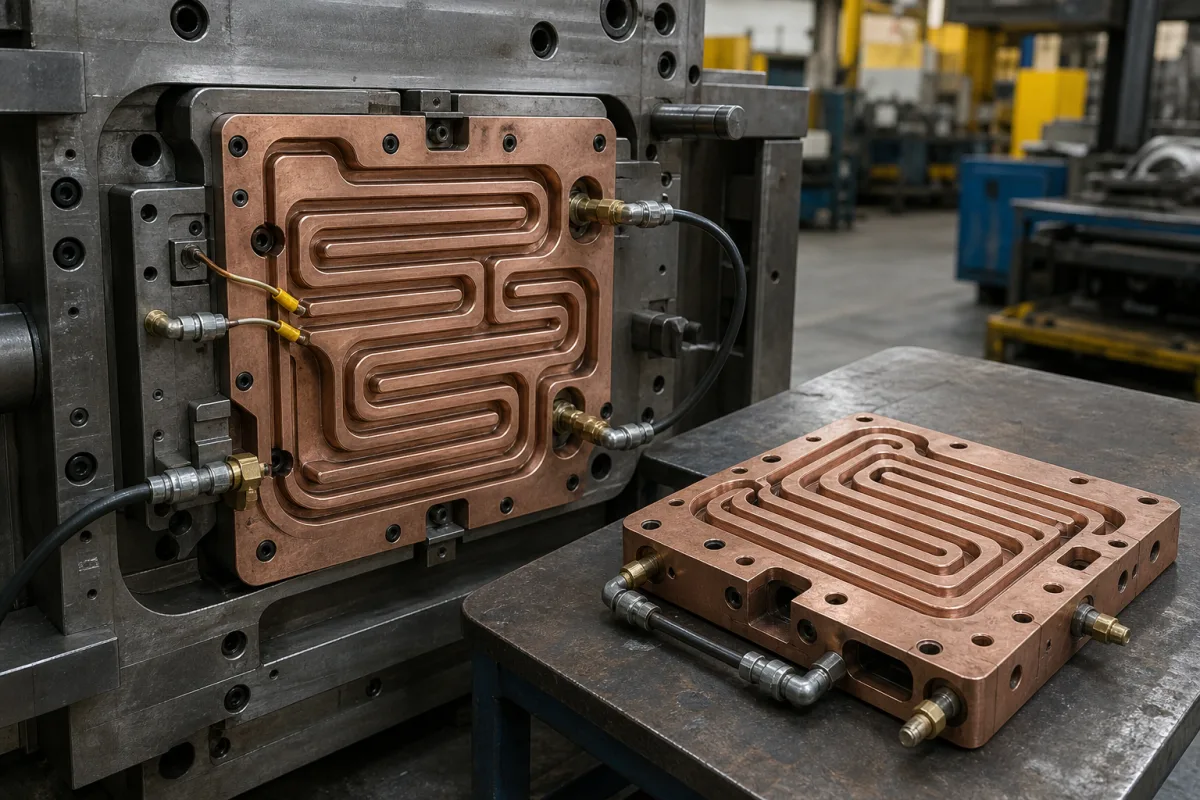
A canonical Casting Mold Thermal Management Plate is characterized by the integration of Thermal Plate Body and Fluid Port Connectors. In industrial production environments, manufacturers listed on CNFX commonly emphasize Copper Alloy C18150 construction to support stable, high-cycle operation across diverse manufacturing scenarios.

Temperature-regulating plate for casting molds

Product Specifications

Technical details and manufacturing context for Casting Mold Thermal Management Plate

Definition
A precision-engineered thermal management component installed within casting molds to regulate temperature distribution during metal solidification. It ensures uniform cooling rates, minimizes thermal stresses, and prevents casting defects like shrinkage porosity. This component is critical for achieving dimensional accuracy and metallurgical consistency in high-volume foundry operations.
Working Principle
Utilizes internal fluid channels or electrical heating elements to actively control mold surface temperature, maintaining optimal thermal gradients during casting cycles.
Common Materials
Copper Alloy C18150, Stainless Steel 316L
Technical Parameters
  • Standard plate thickness (mm) Standard Spec
  • Maximum operating temperature (°C) Standard Spec
Components / BOM
  • Thermal Plate Body
    Primary structural element with integrated channels
    Material: Copper Alloy C18150
  • Fluid Port Connectors
    Standardized connections for heating/cooling media
    Material: Stainless Steel 316L
  • Temperature Sensor Port Optional
    Integrated cavity for thermal monitoring devices
    Material: Stainless Steel 316L
  • Mounting Flange
    Precision-machined interface for mold installation
    Material: Tool Steel
Engineering Reasoning
20-350°C with thermal gradient ≤15°C/cm across plate surface
Thermal stress exceeds yield strength of H13 tool steel (1650 MPa at 350°C) or thermal cycling >10⁴ cycles at ΔT>200°C
Design Rationale: Thermal fatigue cracking due to cyclic plastic strain accumulation from repeated heating/cooling cycles, following Coffin-Manson relationship: ε_pl = C_f * N_f^(-β) where C_f=0.5, β=0.6 for H13 steel
Risk Mitigation (FMEA)
Trigger Coolant flow reduction below 2.5 m/s due to pump failure or clogged channels
Mode: Localized hot spot formation exceeding 400°C, causing austenitization and loss of temper in H13 steel
Strategy: Dual redundant cooling circuits with independent pumps and real-time thermal imaging with automatic mold ejection at 380°C
Trigger Non-uniform clamping force distribution exceeding 25 MPa variance across mounting points
Mode: Plate warpage >0.5 mm causing poor thermal contact with mold, reducing heat transfer coefficient from 2500 to <800 W/m²·K
Strategy: Hydraulic equalization system with pressure transducers at each mounting point and automatic force redistribution

Industry Taxonomies & Aliases

Commonly used trade names and technical identifiers for Casting Mold Thermal Management Plate.

Industrial Ecosystem & Supply Chain DNA

Complementary Systems
Downstream Applications
Specialized Tooling

Application Fit & Sizing Matrix

Operational Limits
pressure: 0-10 bar
flow rate: 5-50 L/min
temperature: -20°C to 300°C
slurry concentration: 0-30% solids by weight
Media Compatibility
✓ water-glycol mixtures ✓ thermal oils ✓ pressurized air
Unsuitable: corrosive chemical environments (e.g., strong acids, chlorides)
Sizing Data Required
  • mold thermal load (kW)
  • required temperature uniformity (±°C)
  • available coolant supply pressure (bar)

Reliability & Engineering Risk Analysis

Failure Mode & Root Cause
Thermal fatigue cracking
Cause: Cyclic heating/cooling stresses from casting cycles exceeding material endurance limits, often exacerbated by rapid temperature changes or poor thermal gradient management.
Corrosion and scaling
Cause: Exposure to cooling water impurities (e.g., chlorides, oxygen) or mold release agents, leading to pitting, reduced heat transfer efficiency, and eventual leakage or structural weakening.
Maintenance Indicators
  • Visible coolant leakage or moisture accumulation around plate connections, indicating seal degradation or corrosion penetration.
  • Abnormal temperature readings or hot spots on thermal imaging, suggesting fouling, scaling, or internal flow restriction impairing heat transfer.
Engineering Tips
  • Implement controlled heating/cooling ramps and uniform temperature distribution protocols to minimize thermal shock and stress concentrations.
  • Use treated, deionized cooling water with corrosion inhibitors and conduct regular descaling/cleaning of internal channels to maintain optimal heat transfer and prevent corrosive damage.

Compliance & Manufacturing Standards

Reference Standards
ISO 9001:2015 Quality Management Systems ASTM A703/A703M-22 Steel Castings, General Requirements EN 10204:2004 Metallic Products - Types of Inspection Documents
Manufacturing Precision
  • Flatness: ≤0.1mm per 300mm
  • Bore diameter: ±0.02mm
Quality Inspection
  • Dye Penetrant Testing (PT) for surface defects
  • Coordinate Measuring Machine (CMM) dimensional verification

Factories Producing Casting Mold Thermal Management Plate

Verified manufacturers with capability to produce this product in China

✓ 94% Supplier Capability Match Found

T Technical Director from United Arab Emirates Jan 14, 2026
★★★★★
"Great transparency on the Casting Mold Thermal Management Plate components. Essential for our Foundries supply chain."
Technical Specifications Verified
P Project Engineer from Australia Jan 11, 2026
★★★★☆
"The Casting Mold Thermal Management Plate we sourced perfectly fits our Foundries production line requirements. (Delivery took slightly longer than expected, but technical support was excellent.)"
Technical Specifications Verified
S Sourcing Manager from Singapore Jan 08, 2026
★★★★★
"Found 56+ suppliers for Casting Mold Thermal Management Plate on CNFX, but this spec remains the most cost-effective."
Technical Specifications Verified
Verification Protocol

“Feedback is collected from verified sourcing managers during RFQ (Request for Quote) and factory evaluation processes on CNFX. These reports represent historical performance data and technical audit summaries from our B2B manufacturing network.”

9 sourcing managers are analyzing this specification now. Last inquiry for Casting Mold Thermal Management Plate from Vietnam (1h ago).

Frequently Asked Questions

What are the benefits of using a thermal management plate in casting molds?

Thermal management plates maintain consistent mold temperatures, reducing casting defects like shrinkage porosity and improving dimensional accuracy, surface finish, and production cycle times in foundry operations.

How do I choose between copper alloy C18150 and stainless steel 316L for my thermal plate?

Copper alloy C18150 offers superior thermal conductivity (approx. 320 W/m·K) for rapid heat transfer, while stainless steel 316L provides better corrosion resistance in harsh foundry environments. Choose based on your cooling rate needs and operating conditions.

What maintenance is required for casting mold thermal plates?

Regular inspection for surface flatness, cleaning of fluid channels to prevent clogging, and checking for leaks at port connections. Proper maintenance ensures consistent thermal performance and extends plate lifespan in foundry applications.

Can I contact factories directly on CNFX?

CNFX is an open directory, not a transaction platform. Each factory profile provides direct contact information and production details to help you initiate direct inquiries with Chinese suppliers.

Get Quote for Casting Mold Thermal Management Plate

Request technical pricing, lead times, or customized specifications for Casting Mold Thermal Management Plate directly from verified manufacturing units.

Your business information is encrypted and only shared with verified Casting Mold Thermal Management Plate suppliers.

Thank you! Your message has been sent. We'll respond within 1–3 business days.

Need to Manufacture Casting Mold Thermal Management Plate?

Connect with verified factories specializing in this product category

Add Your Factory Contact Us
Previous Product
Casting Mold Temperature Control Cartridge Heater
Next Product
Continuous Casting Mold Oscillation Mechanism