Editorial Technical Reference

Continuous Casting Mold Oscillator

This page explains how Continuous Casting Mold Oscillator is classified within Foundries. Technical values and manufacturer relationships are research references; confirm the current specification and supplier evidence for each order.

Technical Definition & Core Assembly

Industrial machine that oscillates casting molds to prevent metal adhesion during continuous casting
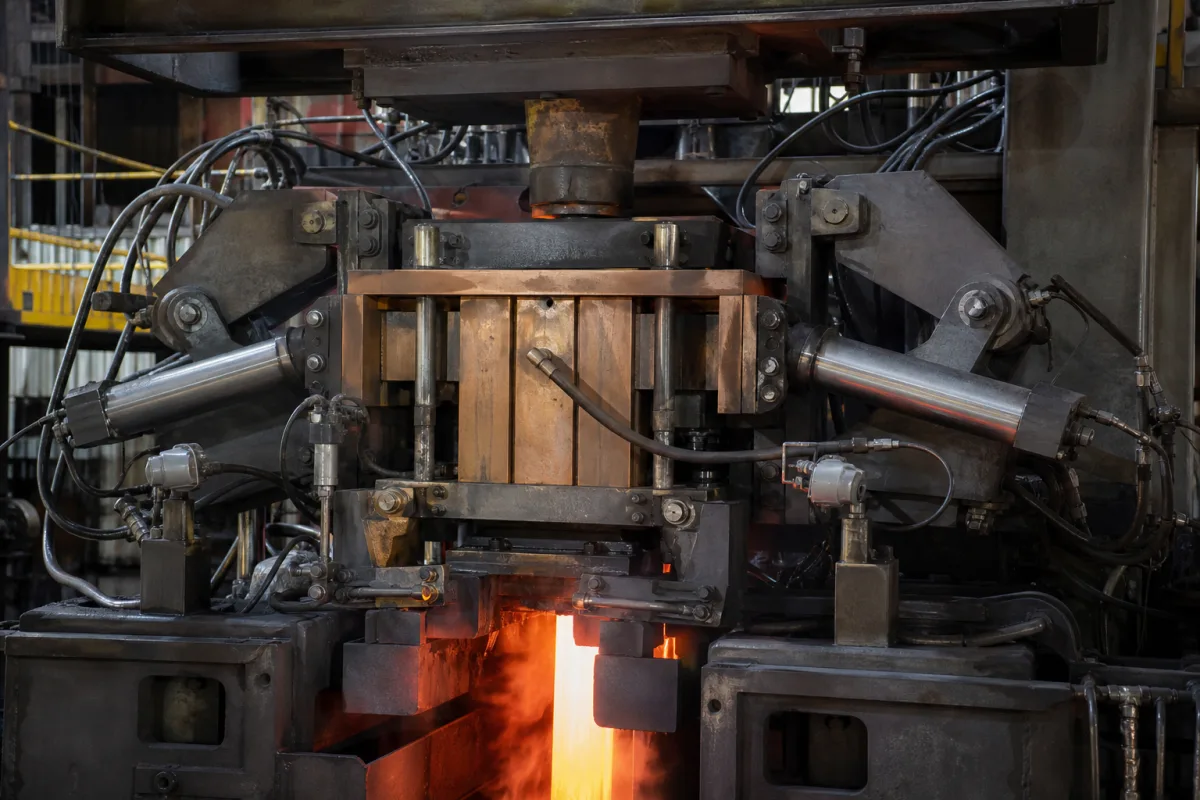
Representative product image. Confirm appearance and specifications with the manufacturer.

Product Specifications

Technical details and manufacturing context for Continuous Casting Mold Oscillator

Definition
A Continuous Casting Mold Oscillator is a critical industrial machine used in foundries during the continuous casting process. It provides controlled vertical oscillation to the casting mold to prevent the solidifying metal shell from sticking to the mold walls. This oscillation creates a controlled gap between the mold and the solidifying metal, allowing for smooth withdrawal of the cast strand. The machine ensures consistent casting quality by reducing surface defects and preventing breakouts in the continuous casting line. The oscillator is designed for heavy-duty operation, with a maximum load capacity ranging from 10 to 50 tons, and operates at oscillation frequencies between 50 and 200 Hz. The stroke amplitude can be adjusted from ±2 to ±10 mm, and the oscillation pattern can be sinusoidal or non-sinusoidal, depending on the specific casting requirements. The machine is powered by a 380–480 kW electrical supply, conforming to IEC 60038, and operates within an ambient temperature range of 0–60°C. The hydraulic system requires oil with a viscosity of 32–46 cSt (ISO 3448) and operates at a pressure of 1.0–1.6 MPa. The control accuracy for the oscillation stroke is ±0.1 mm, and the machine is protected against dust and water jets with an ingress protection rating of IP54–IP65 (IEC 60529). Critical components are made from high-strength alloy steels such as 42CrMo and 40Cr (GB/T 3077), and the total weight of the oscillator ranges from 2 to 8 tons. This equipment is intended for use in continuous casting lines and must be selected based on mold weight, required stroke, and casting speed. Verification of model-specific values and compliance with applicable standards should be confirmed with the legal manufacturer or supplier.
Working Principle
The oscillator uses hydraulic or electromechanical actuators to generate precise vertical motion patterns (typically sinusoidal or non-sinusoidal) that are transmitted to the casting mold through a rigid frame and linkage system. This motion creates a controlled separation between the mold and the solidifying metal, preventing adhesion and allowing for smooth strand withdrawal. The frequency and amplitude of oscillation are adjustable to suit different casting conditions, and the system is designed to maintain accurate positioning within ±0.1 mm.
Common Materials
High-Strength Steel Alloy, Hardened Tool Steel, Bronze Bearing Alloys
Technical Parameters
ParameterTypical rangeNotes & selection driver
Oscillation FrequencyRequired50–200 HzFrequency of vertical oscillation cycles
Stroke AmplitudeRequired±2–10 mmPeak-to-peak vertical displacement range
Maximum Load CapacityRequired10–50 tonMaximum mold weight the oscillator can support
Oscillation PatternRequiredSinusoidal, non-sinusoidal typeWaveform type (sinusoidal, non-sinusoidal)
Power RequirementRequired380–480 kWElectrical power consumptionIEC 60038
Operating Temperature0–60 °CMaximum ambient temperature for operation
Hydraulic Oil Viscosity32–46 cStAt 40°C; higher viscosity for high ambient temperature.ISO 3448
Control Accuracy±0.1 mmPositioning accuracy of oscillation stroke.
Ingress ProtectionIP54–IP65Protects against dust and water jets.IEC 60529
Material42CrMo, 40CrHigh-strength alloy steel for critical parts.GB/T 3077
Weight2–8 tDepends on load capacity and stroke.

Ranges are indicative industry figures for RFQ preparation, not a supplier commitment. Confirm every value and standard with the legal manufacturer before ordering.

Components / BOM
  • Oscillation Frame Part
    Provides rigid structure to transmit oscillation forces to mold
    Material: High-strength steel alloy
  • Hydraulic Actuator
    Generates controlled vertical motion through hydraulic pressure
    Material: Hardened steel with bronze bushings
  • Guide System
    Ensures precise vertical movement with minimal lateral play
    Material: Hardened tool steel with bronze guides
  • Control Panel
    Allows adjustment of oscillation parameters and monitoring
    Material: Stainless steel enclosure
  • Cooling System Optional
    Maintains optimal operating temperature of hydraulic components
    Material: Copper tubing with aluminum fins

Industry Taxonomies & Aliases

Commonly used trade names and technical identifiers for Continuous Casting Mold Oscillator.

Industrial Ecosystem & Supply Chain Structure

Complementary Systems
Downstream Applications
Specialized Tooling

Application Fit & Sizing Matrix

Operational Limits
pressure: Up to 10 bar hydraulic pressure
temperature: Ambient to 150°C (cooling water temperature)
stroke length: 0-20 mm
mold size range: 100-2000 mm square/round molds
oscillation frequency: 0-400 cycles per minute
Media Compatibility
✓ Steel continuous casting ✓ Copper continuous casting ✓ Aluminum continuous casting
Unsuitable: High-corrosive molten metals without proper mold coatings (e.g., titanium alloys)
Sizing Data Required
  • Mold dimensions and weight
  • Required oscillation frequency and stroke
  • Casting speed and metal type

Reliability & Engineering Risk Analysis

Failure Mode & Root Cause
Bearing fatigue and seizure
Cause: High cyclic loading from oscillation forces combined with inadequate lubrication or contamination ingress, leading to surface pitting, spalling, and eventual lock-up.
Hydraulic system leakage or pressure loss
Cause: Worn seals, hose degradation, or pump wear due to thermal cycling, fluid contamination, or sustained high-pressure operation, compromising oscillation control.
Maintenance Indicators
  • Irregular or jerky mold movement during oscillation, indicating potential drive or hydraulic issues.
  • Unusual grinding or knocking noises from the oscillator mechanism, suggesting bearing or gear wear.
Engineering Tips
  • Implement condition-based monitoring with vibration analysis on bearings and hydraulic pressure trending to detect early degradation.
  • Establish strict lubrication schedules using high-temperature, anti-wear greases and ensure seal integrity to prevent contamination ingress.

Indicative industry ranges for design and RFQ preparation. Confirm the exact figures and applicable standard with the manufacturer before specifying.

Compliance & Manufacturing Standards

Applicable Standards
ASTM A36/A36M Standard Specification for Carbon Structural Steel CE Machinery Directive 2006/42/EC

Quoted from the published standard.

Manufacturing Precision
  • Bore Diameter: +/-0.05mm
  • Parallelism of Guide Surfaces: 0.1mm per meter
Quality Inspection
  • Dye Penetrant Test for Surface Cracks
  • Dimensional Verification with CMM

Manufacturers of Continuous Casting Mold Oscillator

Manufacturer profiles associated with Continuous Casting Mold Oscillator.

Sourcing Continuous Casting Mold Oscillator from China?
Tell us your specification and target quantity — we will match it against manufacturer records and come back with the factories that fit.
Request manufacturers We manufacture this

Manufacturer listings support early research and capability understanding. They are not certification, ranking, or transaction guarantees.

Technical documentation
Request current drawings, revision history, and a signed specification sheet.
Manufacturing capability
Verify equipment lists, process limits, capacity, and representative production evidence.
Inspection readiness
Confirm test methods, calibrated equipment, sampling plans, and traceable reports.
Supplier transparency
Check the legal entity, factory address, ownership, certifications, and direct contacts.

CNFX does not score or rank suppliers. Buyers must verify all claims and documents with the legal manufacturer before ordering.

Frequently Asked Questions

What is the primary function of a continuous casting mold oscillator?

The primary function is to oscillate the casting mold vertically during continuous casting to prevent the solidifying metal shell from sticking to the mold walls, ensuring smooth withdrawal and reducing surface defects.

What are the typical oscillation frequency and stroke amplitude ranges?

Typical oscillation frequency ranges from 50 to 200 Hz, and stroke amplitude ranges from ±2 to ±10 mm. These values must be confirmed for the specific model and application.

What standards are referenced for the oscillator's electrical and hydraulic systems?

The electrical power requirement references IEC 60038, hydraulic oil viscosity references ISO 3448, and ingress protection references IEC 60529. These standards are for verification purposes only.

How should the oscillator be selected for a specific casting line?

Selection should consider the mold weight (within the 10–50 ton load capacity), required stroke amplitude, oscillation frequency, and casting speed. Always verify model-specific parameters with the legal manufacturer or supplier.

Data Basis

Editorial classification, named public sources where available, and source-reviewed manufacturer records.

Preliminary Technical Classification
This page supports structured research, RFQ preparation, and supplier evaluation. It does not replace buyer-led supplier qualification, standards review, or technical approval.
Buyer enquiry

Request manufacturing insight for Continuous Casting Mold Oscillator

Ask for use case, specification boundaries, supplier type, and RFQ preparation information for this product.

Where it goes
Straight to the CNFX editorial desk, and to the manufacturer if this product is linked to a claimed profile. Nothing is broadcast to a supplier list.
Your details stay here
We do not sell or rent enquiry data, and we do not add you to a mailing list. Used only to answer this request.
No commission, no middleman
CNFX is a directory. We take no cut of any order and never negotiate on a supplier's behalf.
What we don't claim
A listing is not an endorsement. Qualify every supplier and verify every figure yourself before ordering.

Your business information is used only to process this request.

Thank you! Your message has been sent. We'll respond within 1–3 business days.
Sorry, we couldn't send your message. Please try again, or email us at contact@cnfx.com.

Need to Manufacture Continuous Casting Mold Oscillator?

Compare manufacturer profiles with relevant product and process capability.

Previous Product
Vacuum Induction Degassing Unit
Last Product
Get QuotesChat