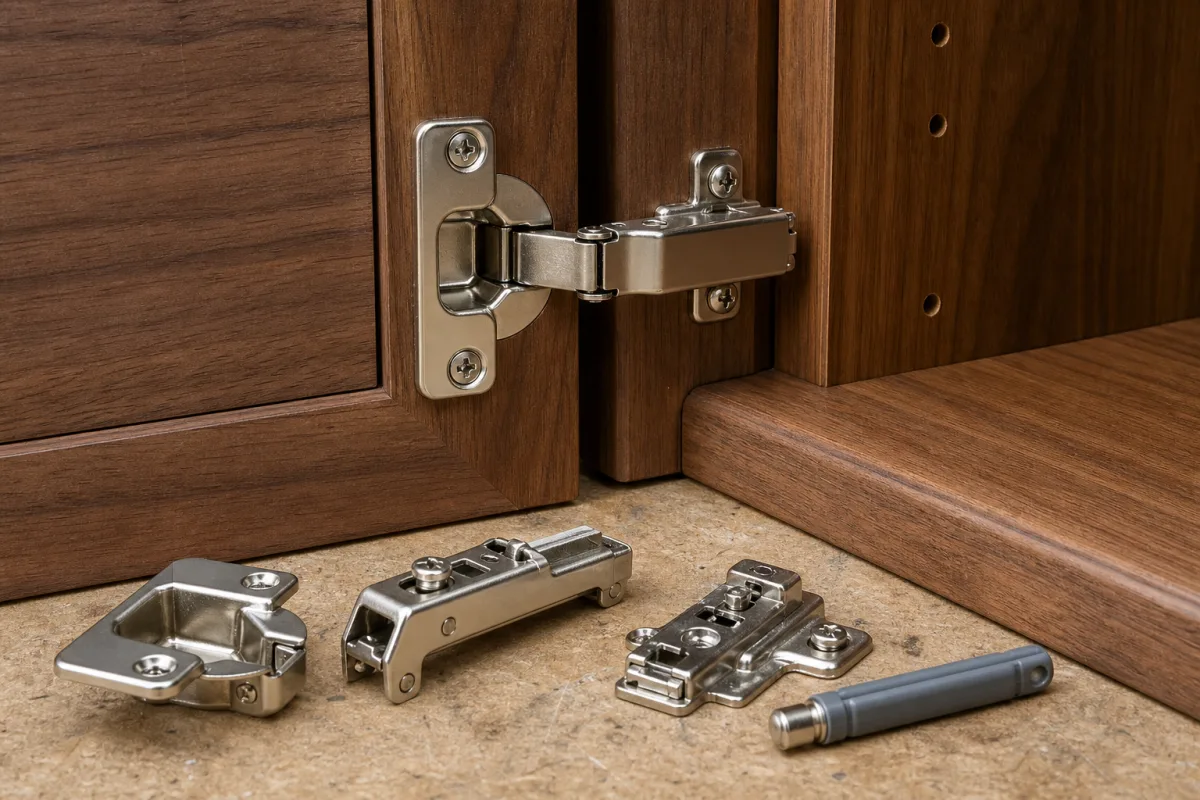
Furniture hardware · Overlay, drilling distance, door thickness, gap and adjustment
A concealed furniture hinge mounts in a 35 mm cup bored into the door and clips to a plate on the cabinet side. Ask three things first: is the door overlay, half overlay or inset, how thick is it and how close are neighbouring doors, and what opening angle, adjustment and closing action you need.
Concealed cup hinges for cabinet and furniture doors, with mounting plates and soft-close dampers, plus brass furniture butt hinges where suppliers list them. Building door hinges, gate hinges, invisible door hinges and industrial enclosure hinges are outside this page.
CNFX editorial research · Sources checked October 11, 2026 · 4 sources
Blum's technical data sheet for its CLIP top BLUMOTION 105° hinge lists separate hinges for overlay, half overlay and inset applications, with 3-dimensional front adjustment, tool-free clip-on assembly and an integrated soft-close mechanism. For inset fronts it tells fitters to move the mounting plate fixing position back by the front thickness plus 1.5 mm. [1]
Editorial calculation: for an 18 mm inset door, the mounting plate fixing position moves back 18 + 1.5 = 19.5 mm. [1] Check the figure on the sheet for the exact hinge you buy.
Häfele's Metalla 310 110° full-overlay set is another example: 35 mm cup, screw-fixed, for 14–22 mm doors, with integrated soft close, a closing spring, side adjustment of ±3 mm, height ±2 mm through the mounting plate and depth ±2 mm, and nickel-plated steel cup and arm. [2]
Give the supplier the door application, door thickness and material, door size and weight, cabinet side thickness, opening angle, soft close or push-to-open, mounting plate type and finish.
02
Check drilling distance, door thickness and gap
Both makers publish tables of minimum gap against door thickness and cup drilling distance, the distance from the door edge to the cup bore. Blum gives drilling distances of 3–7 mm; Häfele's table runs from 3 to 7 mm for 15–22 mm doors and notes that the values apply with the side-adjusting screw centred and that rounding the door edge reduces them. [1][2]
Reading Häfele's table, an 18 mm door needs a minimum gap of 0.7 mm at a 3 mm drilling distance and 4.6 mm at 7 mm; Blum's table for its 105° hinge, based on a 1 mm front radius, gives 0.8 mm for an 18 mm front at 3 mm. [2][1] The tables are for different hinges and conditions, so use the one for your hinge.
Häfele also tabulates full-overlay mounting with 0, 2 and 4 mm mounting plates for door overlays of 10–18 mm. [2]
03
Clip-on hydraulic, brass and lock-maker hinges among the listed suppliers
Baoertai lists clip-on hydraulic hinges with 3D adjustment, including 110° hinges, full-overlay, inset and larger-overlay types; Gaton lists custom brass furniture hardware including hinges; Make Locks lists hinges alongside furniture and cabinet locks. [3]
04
Ask for the EN 15570 level and door thickness range per hinge
Hettich's catalogue page for its Sensys 8645i 110° overlay hinge (article 9071205, screw-on, TH 52) gives a quality classification under EN 15570, Level 3, a door thickness of 15 to 24 mm, a 35 mm cup 12.8 mm deep, a 12.5 mm base, a TH 52 × 5.5 mm drilling pattern, integrated overlay adjustment of +2/−2 mm and depth adjustment of +3/−2 mm, height adjustment at the mounting plate, nickel-plated steel, and an integrated silent system with self-closing feature. It lists standard wooden doors and wood- or aluminium-framed doors with profile widths from 50 mm. [4]
Set this beside the Häfele set above, which takes 14–22 mm doors with ±3 mm side, ±2 mm height and ±2 mm depth adjustment. [2][4] Editorial calculation: a 24 mm door is inside Hettich's 15–24 mm range but 2 mm over Häfele's 22 mm limit (24 − 22), so check the range for the exact hinge quoted. Ask each supplier which EN 15570 level a hinge is classified to and for the test report; a level stated for one hinge does not carry over to another maker's hinge.
Closing spring; Blum also offers unsprung versions. [1][2]
Spring or unsprung.
06
Cup bore, plate height, adjustment range and opening angle for a hinge order
Häfele and Blum publish cup, plate, adjustment and angle values, but neither reviewed page gives a load capacity, so the door weight and hinges per door decide that row. [2][1]
Paste it into your enquiry below or into an email to a maker, then replace every bracket.
Door: [overlay, half overlay or inset; thickness; material; size; weight]
Cabinet: [side thickness; gap to next door]
Hinge: [opening angle; soft close; spring or push-to-open; clip-on or slide-on]
Mounting: [plate height; screw or dowel fixing; cup fixing]
Finish: [nickel, black nickel or other; corrosion test]
Documents: [drilling template; gap table; cycle test report]
12 companies list this product among what they make. Company figures are quoted from each
company's own website; every card states where the relationship came from.
Baoertai Hardware
Manufacturing site to be confirmed for the order
Lists clip-on hydraulic cabinet hinges, including 110°, full-overlay and inset types.
Explore company information and manufacturing capabilities, then discuss the scope of your project with a relevant supplier.
Share this page
Compiled and source-reviewed by the CNFX editorial team.
Each manufacturer above links to the page on that company's own website where the product is listed, with the date we checked it. How we source and review
· Page last updated 13 October 2026
Buyer questions
What is the difference between overlay, half overlay and inset hinges?
They are different hinges: one maker lists separate overlay, half-overlay and inset versions, and for inset doors moves the mounting plate back by the door thickness plus 1.5 mm. [1]
What size hole does a concealed hinge need?
The hinges reviewed here use a 35 mm cup; check the bore depth and drilling distance on the maker's sheet for your hinge. [2][1]
How do I find the gap between two doors?
Read the maker's table for your door thickness and drilling distance; one table gives 0.7 mm at 3 mm and 4.6 mm at 7 mm for an 18 mm door. [2]
What door thickness does a concealed hinge take?
It depends on the hinge: Hettich lists 15–24 mm for its Sensys 8645i, classified under EN 15570 Level 3, while the Häfele set on this page takes 14–22 mm. [4][2]
Sources and what still needs a direct check
Sources checked 2026-10-11. Blum and Häfele are furniture fitting makers; their sheets describe named hinges. Baoertai is a supplier listed on this page.