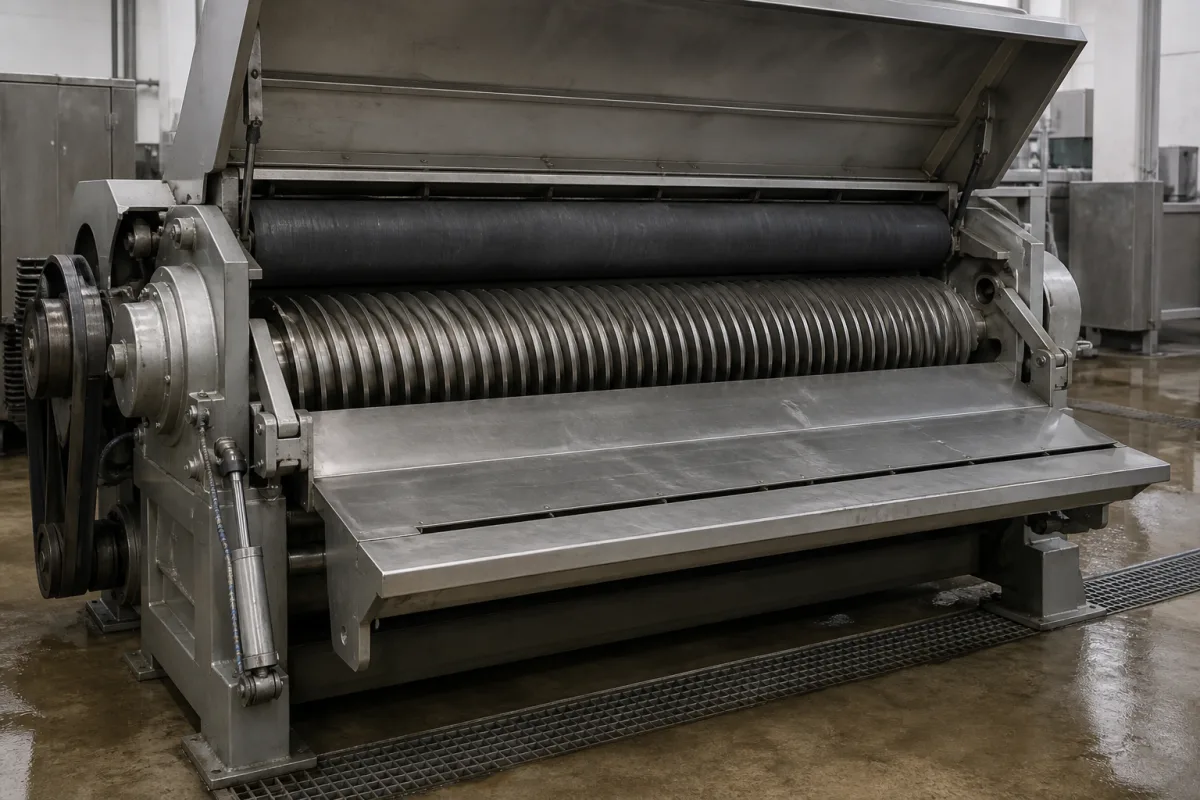
Fleshing machines that remove flesh, fat and membranes from hides and skins in the tannery beamhouse · Bladed cylinder design and speed, pressing and drawing rollers, single or two-stage processing, working width, drive power, feed and discharge, cleaning access
A fleshing machine removes flesh, fat and blood clots from the inner side of a hide or skin in the beamhouse, before tanning. It presses the hide against a fast-turning bladed cylinder while drawing it through. Ask three things first: what hides or skins and sizes the machine must take, whether it must flesh the whole hide in one automatic cycle, and what working width, throughput and cleaning the line needs.
Fleshing (defleshing) machines for cattle hides, sheep and goat skins and pelts in tanneries and fellmongeries, including through-feed and two-stage automatic machines. Splitting and shaving machines, skiving machines (see industrial leather skiving machine), tanning drums (see tanning drum system) and hide conveyors are outside this page.
CNFX editorial research · Sources checked October 12, 2026 · 4 sources
US patent 3,879,967 explains that defleshing shaves or cuts away clots of blood and projections of fat with rotating blades, which are mounted on a rotating roller, while the skin is kept under tension as it passes the blades. It describes linking two defleshing machines with a transfer conveyor so a skin fleshed in part by the first machine is raised to the feed opening of the second, noting that a normal skin may be 2 or 3 m long and heavy to turn by hand. [1]
US patent 4,559,794 describes an automatic machine with two parallel blade cylinders and two sliding heads carrying bearing, pressing and drawing rollers; the heads press the skin between the rollers and draw it first under one cylinder and then the other, fleshing it in two stages from the middle towards the head and from the middle towards the tail while keeping it pressed throughout the cycle. [2]
US patent 4,989,427, aimed at sheep pelts, notes that earlier machines with fixed helical blades could treat only half a pelt per pass and had trouble with uneven thickness, and instead fits knives in shaped cavities of a fixed-position roller so each knife can move a limited distance as it meets thicker areas; the roller can be removed for cleaning and replacing worn parts. [3]
Give the supplier the hide or skin type, largest size and thickness range, state (green, limed, pickled), required throughput, single-pass or two-stage processing, working width, blade type and spare blades, pressure control, feed and discharge conveyors, water and cleaning requirements, safety guarding and the electrical supply.
02
Size working width, drive power and handling
In the cavity-knife design of US patent 4,989,427, experiments gave good results with the roller turning at 1500 to 2500 r.p.m., and a 25 h.p. electric motor was needed to drive a roller about 1.5 m long at that speed. [3]
Editorial calculation: 25 h.p. is about 18.6 kW (× 0.7457); a wider cylinder or a two-cylinder machine needs correspondingly more installed power, so ask the supplier for blade-cylinder and pump motor ratings at your working width. [3]
Editorial note: the working width must exceed the widest hide presented across the machine; the transfer and turning of 2–3 m skins between stages is itself a handling task to include in the line design. [1]
03
Place fleshing in the beamhouse sequence
The US EPA's AP-42 emission-factor chapter on leather tanning (section 9.15, June 1997) lists trimming, soaking, fleshing and unhairing as the first steps of tanning, which together make up the beamhouse operations; bating, pickling, tanning, wringing and splitting follow as tanyard processes. It states that after soaking, hides are fleshed to remove excess tissue, to impart uniform thickness and to remove muscle or fat adhering to the hide, before dehairing, for which liming with calcium hydroxide liquors is described. The chapter puts chrome tanning at about 90 percent of US tanning production, notes that sulfide emissions can occur during liming and unhairing, and that alkaline sulfides in tannery wastewater can form hydrogen sulfide if the pH falls below 8.0. [4]
Where fleshing sits matters for the machine: a skin fleshed after soaking arrives wet and heavy, which fits the conveyor transfer and drive-power figures from the patents above. [1][2][3]
Editorial note: the AP-42 chapter dates from 1997 and describes process order and emissions, not machine ratings; take working width and cylinder data from the machine supplier.
AP-42 9.15 point
Value or step
Beamhouse steps
Trimming, soaking, fleshing, unhairing
Purpose of fleshing
Remove excess tissue, give uniform thickness, remove muscle and fat
Order
After soaking, before dehairing/liming
Chrome tanning share of US production
About 90%
Hydrogen sulfide risk
Alkaline sulfide wastewater below pH 8.0
Tell the supplier whether hides are fleshed green, after soaking or after liming, the hide weight and length, and how fleshings and wash water will be collected.
04
Bladed cylinder, pressing and drawing rollers, feed rolls, transfer conveyor, drives and removable roller
The transfer conveyor row comes from the two-machine installation of US 3,879,967, and the removable roller from the sheep-pelt machine of US 4,989,427. [1][3]
Working width, roller speed, motor power and pressing pressure for a fleshing machine order
The only machine figures here are roller speed and motor power, both from the patented sheep-pelt machine of US 4,989,427; the other rows are for the supplier to fill. [3]
Field
What it means and published values
Ask the supplier for
Working Width
Usable cylinder width; skins may be 2–3 m long. [1]
1 company lists this product among what they make. Company figures are quoted from each
company's own website; every card states where the relationship came from.
Jiangyin Brenu Industry Technology Co., Ltd.
Manufacturing site to be confirmed for the order
Lists fleshing machines with drums, splitting, shaving, sammying and other tannery machines.
Product scope checked 2026-10-11
Fleshing machines listed · profile compiled by CNFX from public sources
Explore company information and manufacturing capabilities, then discuss the scope of your project with a relevant supplier.
Share this page
Compiled and source-reviewed by the CNFX editorial team.
Each manufacturer above links to the page on that company's own website where the product is listed, with the date we checked it. How we source and review
· Page last updated 13 October 2026
Buyer questions
How does a fleshing machine remove flesh from hides?
Rotating blades on a cylinder shave off fat and flesh while the hide is held under tension and drawn past them. [1][2]
Can a fleshing machine process the whole hide automatically?
One patented design uses two blade cylinders and sliding heads to flesh from the middle towards head and tail in one cycle. [2]
How fast does a fleshing roller turn?
One patented sheep-pelt machine reports good results at 1500–2500 r.p.m. with a 25 h.p. motor for a 1.5 m roller. [3]
When are hides fleshed in tanning?
EPA's AP-42 chapter on leather tanning lists fleshing among the beamhouse steps, after trimming and soaking and before unhairing, to remove excess tissue and give uniform thickness. [4]
Sources and what still needs a direct check
Sources checked 2026-10-12. Three patents describe fleshing machine principles and examples, and the US EPA's AP-42 leather tanning chapter (1997) places fleshing in the beamhouse sequence; none is an endorsement of any supplier.