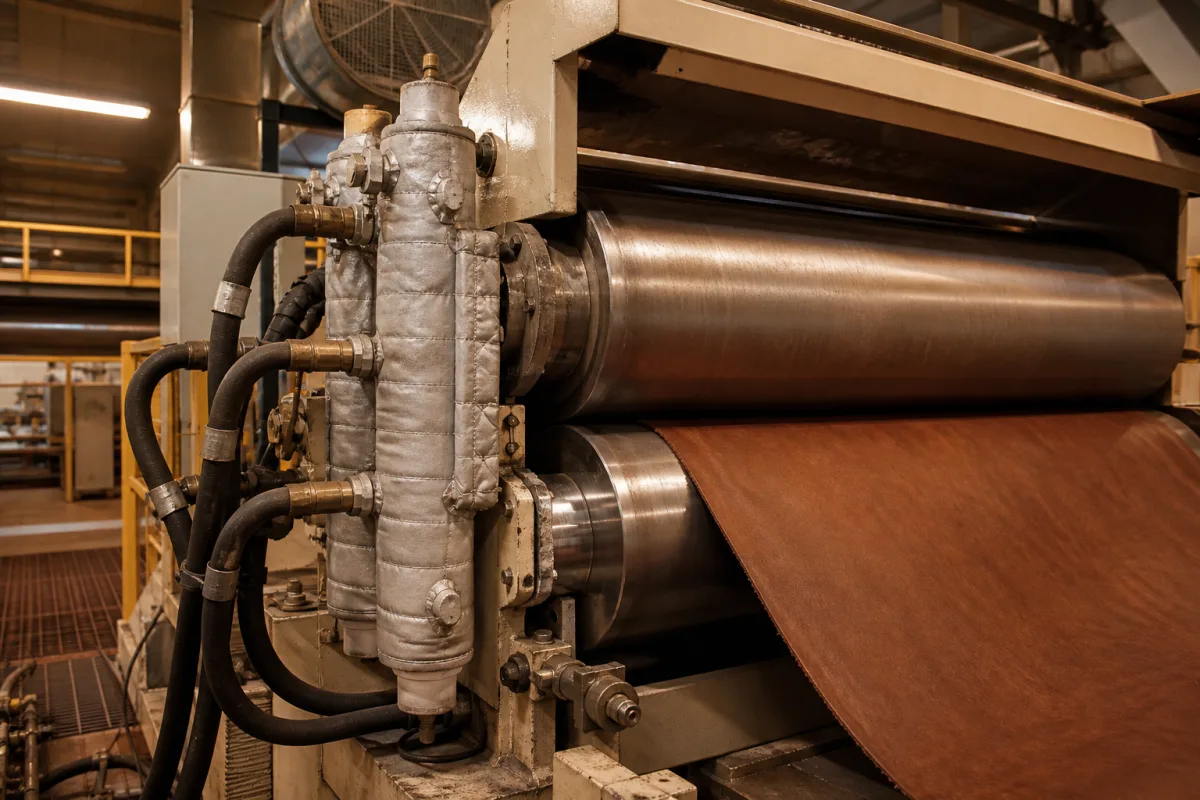
Heat transfer assembly for heated leather press rolls: thermal-oil circuit, rotary union and roll cooling
Leather finishing · the thermal-oil circuit that heats the operating roll of an ironing, smoothing or embossing roller press: oil in the roll, the rotary union it enters through, hoses, roll changes and cooling
On a leather roller press the hot part is the operating roll, and the heat reaches it through a small assembly: a thermal-oil unit with pump and controller, hoses, a rotary union on the roll journal that lets oil into a turning shaft, and passages inside the roll that spread the oil under the working face. In the picture the roll end carries insulated manifolds with hoses attached. Three things need fixing when this assembly is bought or replaced: the temperature range and evenness the leather needs, the rating of the rotary union and hoses against that temperature and pressure, and how rolls are changed, kept hot and cooled.
The heating circuit of the operating rolls on leather ironing, smoothing and embossing roller presses: thermal-oil supply and control, rotary unions, hoses and couplings, oil passages in the roll, and roll cooling. The complete embossing press, its grain plates and engraved rolls are covered on the Leather grain embossing system page and the Embossing rollers page; fired or electric hot-oil heater packages for general process heating are covered on the Thermal fluid (hot oil) heating system page.
CNFX editorial research · Sources checked October 12, 2026 · 4 sources
Thermal oil inside the operating roll: low-volume forced circulation up to 180 °C, and each roll held at its own temperature
Two Italian press builders describe the heating side of their rotary leather presses in comparable terms; the differences show what to ask for.
Rotopress's brochure pictures the thermal control unit beside the hydraulic unit and describes a patented feeder with dual antistatic conveyors that lays the hide flat before it passes under the heated cylinder. [1] Gozzini offers a lower-section displacement that retracts the back-up roller so that the leather is preheated before it reaches the pressure zone. [2]
Editorial calculation: Rotopress's average absorbed power is 27 kW against 47 kW installed on the RGM 15, about 57%, and 30 kW against 57 kW on the RGM 34, about 53%; the published data do not split how much of either figure goes to roll heating rather than drives and hydraulics. [1]
Automatic heating and pressure management for energy saving; no figure [2]
State the leather and finish, the roll surface temperatures you run and the tolerance across the face, roll diameter and face width, how many rolls must be kept hot at once, the warm-up and cool-down times you can accept, and whether cooling is needed between jobs.
02
Where the oil enters the turning roll: a rotary union rated 230 °C, 7 bar and 400 r/min, connected only by flexible hoses
Deublin's 9000-series operating manual gives the limits for its carbon-graphite-sealed rotary unions, which feed either steam or thermal oil into a machine shaft. [3]
The manual prohibits combustible media and hydrocarbons, with the exception of thermal oil within the admissible temperature range, and forbids hydraulic oils and running dry, because dry running damages the spherical seals. [3] Deublin lists the 9125-020-140400 as superseded on its product page, so a replacement will carry a different part number. [4]
Editorial calculation: against Rotopress's 180 °C maximum, the 230 °C manual rating leaves 50 °C of margin (52 °C against the 232 °C product page figure). [1][3][4] For speed, a roll surface moving at Rotopress's top 25 m/min would only reach the 400 r/min limit with a roll about 20 mm in diameter (25 ÷ (π × 400) ≈ 0.020 m), so on full-size press rolls the union's speed limit is far from the constraint; temperature, pressure and hose loads are.
Item
Deublin 9000 series
What follows for a leather press roll
Thermal oil limits
230 °C, 7 bar, 400 r/min for models 9075–9150; steam 185 °C, 10 bar [3]
Compare with the roll's highest oil temperature and pump pressure
Product page for model 9125-020-140400 (superseded)
Hot oil 232 °C (450 °F), 6.9 bar (100 psi); 1-1/4" NPT left-hand rotor thread [4]
The manual and product page round differently; confirm on the model drawing
Mono or Duo
One single-passage union at each shaft end, or a two-way union with a supply tube where oil goes in and returns at the same end [3]
Decides whether both journals need a union
Connection
Flexible hoses only; fixed pipes may make the union leak and damage its ball bearings; torque supports against rotation [3]
Hose rating for full system temperature and pressure
Carbon-graphite seals; a wear indicator on the rotor shows when seals must be replaced; daily visual checks [3]
Access to the union on the machine
Ask for the rotary union model and its installation drawing, its thermal-oil temperature, pressure and speed ratings, mono or duo arrangement, hose type and rating, the torque support, and the seal wear indicator position.
03
Changing heated rolls without losing the circuit: a 30-second revolver, a hoist and quick couplings
Pattern changes mean taking a hot roll out of its oil circuit, or keeping more than one roll hot.
Gozzini's SC mounts up to four rollers on a star that a gear motor rotates about a central axis, changing the working roller automatically in about 30 seconds, while its control keeps the idle rollers at their own set temperatures. [2] Rotopress lists a rapid coupling for cylinder change, a heated-cylinder change with a hoist, and the option of linking two machines to the hoist to park 10 or more cylinders and move them between machines. [1]
Editorial note: each of these arrangements adds connections to the hot-oil circuit, either a union and hose set per roll on a revolver, or couplings that are broken and remade at temperature on a hoist change. Ask how the oil is isolated and drained at each coupling, whether couplings are self-sealing, and what the procedure is for a roll changed while hot.
Ask how many rolls are kept heated at once and by which circuit, the coupling type, the expected time to bring a cold roll to temperature, and the safety procedure for hot roll changes.
04
Roll, oil and union details for the heating assembly
Paste it into your enquiry below or into an email to a maker, then replace every bracket.
Press: [maker and model; ironing, smoothing or embossing]
Rolls: [diameter; face width; number kept hot]
Temperature: [surface setpoints; tolerance across face; warm-up and cool-down times]
Oil: [thermal oil type; maximum temperature; pump pressure; flow]
Rotary union: [model; mono or duo; temperature, pressure and speed ratings]
Hoses and couplings: [type; rating; quick coupling or fixed]
Cooling: [water/oil exchanger; required cool-down]
Explore company information and manufacturing capabilities, then discuss the scope of your project with a relevant supplier.
Share this page
Compiled and source-reviewed by the CNFX editorial team.
Each manufacturer above links to the page on that company's own website where the product is listed, with the date we checked it. How we source and review
· Page last updated 13 October 2026
Buyer questions
How are leather press rolls heated?
Rotopress and Gozzini both heat the operating roll with thermal (diathermic) oil; Rotopress specifies low-volume forced circulation up to 180 °C, and Gozzini controls each roller's temperature separately. [1][2]
What limits the rotary union on a hot-oil roll?
Deublin's 9000-series manual rates its thermal-oil unions at 230 °C, 7 bar and 400 r/min, requires flexible hoses and warns against dry running and temperatures below 3 °C. [3]
Can a heated press roll be cooled quickly?
Gozzini offers cooling through a water/oil heat exchanger in the thermal-oil circuit, and Rotopress an optional cylinder cooling system for a rapid temperature drop. [2][1]
Sources and what still needs a direct check
Sources checked 2026-10-12. Rotopress and Gozzini 1906 are Italian builders of rotary leather presses describing their own machines; Deublin is a rotary union maker giving the ratings and installation rules for its thermal-oil unions.