Industry-Verified Manufacturing Data (2026)

Liming Vat

Based on aggregated insights from multiple verified factory profiles within the CNFX directory, the standard Liming Vat used in the Leather and Related Product Manufacturing sector typically supports operational capacities ranging from standard industrial configurations to heavy-duty production requirements.

Technical Definition & Core Assembly

A canonical Liming Vat is characterized by the integration of Agitation System and Heating/Cooling Jacket. In industrial production environments, manufacturers listed on CNFX commonly emphasize Stainless Steel (316L) construction to support stable, high-cycle operation across diverse manufacturing scenarios.

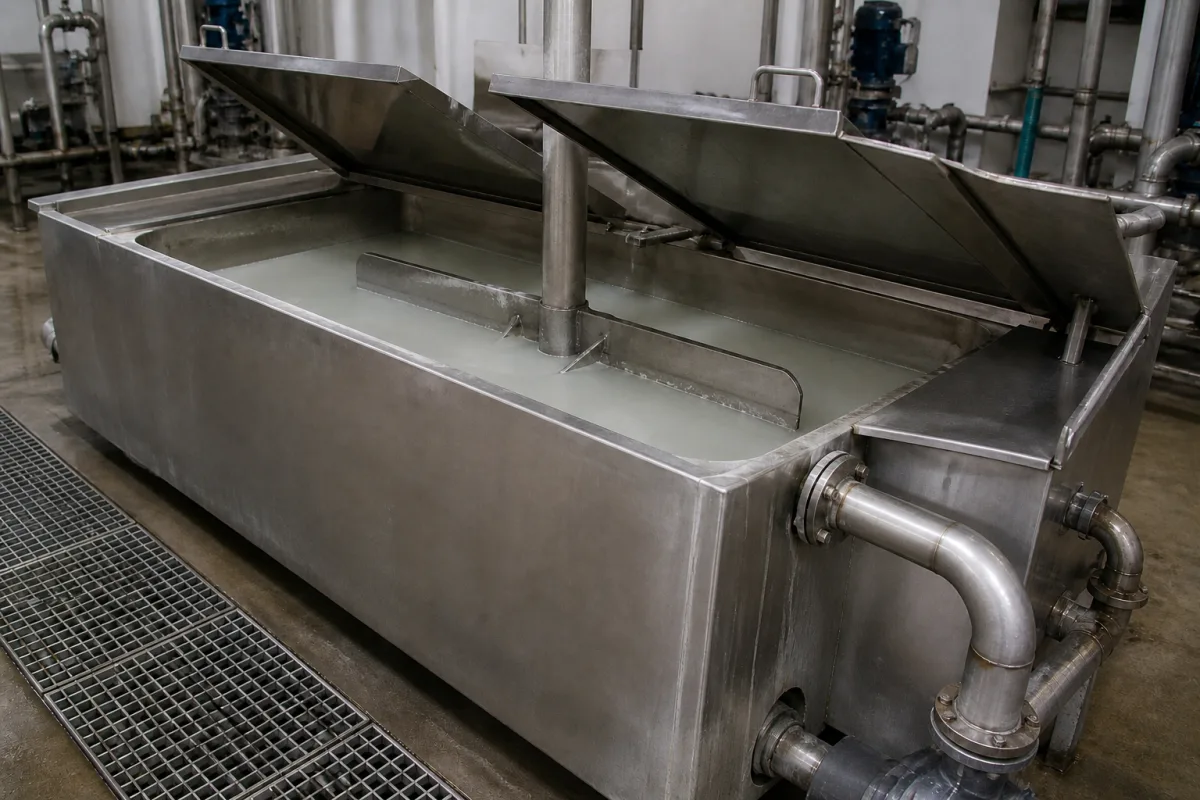
A specialized vessel used in leather processing for the liming operation, where hides are treated with lime solutions to remove hair, epidermis, and fats while swelling the collagen fibers.
Product Specifications

Technical details and manufacturing context for Liming Vat

Definition
The Liming Vat is a critical component within the Beamhouse Module of leather manufacturing facilities. It serves as the primary reaction vessel where raw hides undergo the liming process - a chemical treatment using calcium hydroxide (lime) solutions combined with sulfides or other chemicals. This process facilitates hair removal, degreasing, and fiber swelling, preparing the hides for subsequent beamhouse operations like deliming, bating, and pickling. The vat is designed to withstand corrosive alkaline environments while ensuring proper agitation and temperature control for uniform treatment.
Working Principle
The Liming Vat operates by containing hides submerged in a controlled alkaline solution (typically lime and sodium sulfide mixtures). Mechanical paddles or rotating drums provide agitation to ensure uniform chemical penetration. Temperature is maintained between 20-30°C through heating/cooling systems. The alkaline environment breaks down hair proteins (keratin) and epidermal tissues while swelling collagen fibers through pH elevation and osmotic effects. Process duration ranges from 12-48 hours depending on hide thickness and desired results.
Common Materials
Stainless Steel (316L), Fiberglass Reinforced Plastic, Rubber Lining
Technical Parameters
  • Working capacity ranging from 5,000 to 50,000 liters depending on production scale (L) Standard Spec
Components / BOM
  • Agitation System
    Provides mechanical movement to ensure uniform chemical penetration and prevent hide settling
    Material: Stainless Steel
  • Heating/Cooling Jacket
    Maintains optimal process temperature through thermal exchange
    Material: Stainless Steel
  • Drain Valve
    Controls solution discharge and vat emptying
    Material: PVC or Rubber-Coated Steel
  • Liquid Level Sensor
    Monitors solution volume and prevents overflow
    Material: Polypropylene with Stainless Steel Probe
Engineering Reasoning
0.8-1.2 bar (gauge pressure), 25-35°C, pH 12.0-12.5
Pressure > 1.5 bar causes seal failure, temperature > 45°C accelerates lime hydrolysis, pH < 11.5 reduces hair removal efficiency by 70%
Design Rationale: Caustic corrosion of stainless steel 316L at pH > 12.3, mechanical fatigue from cyclic pressure loading at 0.1-1.2 bar, lime scale deposition reducing heat transfer coefficient below 500 W/m²·K
Risk Mitigation (FMEA)
Trigger Lime slurry concentration > 15% w/w causing abrasive wear
Mode: Impeller erosion reducing pumping efficiency by 40%
Strategy: Hardened AISI 440C stainless steel impeller with 60 HRC hardness, maximum 10% w/w lime concentration control
Trigger Thermal cycling between 25-45°C at >3 cycles/hour
Mode: Weld fatigue cracking at agitator mounting points
Strategy: Stress-relieved welds with post-weld heat treatment at 1050°C, temperature stabilization within ±2°C

Industry Taxonomies & Aliases

Commonly used trade names and technical identifiers for Liming Vat.

Applied To / Applications

This component is essential for the following industrial systems and equipment:

Industrial Ecosystem & Supply Chain DNA

Complementary Systems
Downstream Applications
Specialized Tooling

Application Fit & Sizing Matrix

Operational Limits
pressure: Atmospheric (open vat) or up to 1.5 bar for closed systems
other spec: Slurry concentration: 5-15% lime by weight, typical agitation speed: 10-30 RPM
temperature: Ambient to 40°C (104°F)
Media Compatibility
✓ Lime slurry (calcium hydroxide solution) ✓ Sodium sulfide solutions ✓ Enzyme-based hair removal solutions
Unsuitable: Strong acids (e.g., sulfuric, hydrochloric) - causes rapid corrosion and hazardous reactions
Sizing Data Required
  • Daily hide processing capacity (kg/day)
  • Available floor space and ceiling height
  • Required processing time per batch (hours)

Reliability & Engineering Risk Analysis

Failure Mode & Root Cause
Corrosion and chemical attack
Cause: Exposure to acidic or alkaline lime slurry, leading to material degradation, pitting, and thinning of vat walls, especially at welds and seams.
Structural fatigue and cracking
Cause: Cyclic thermal and mechanical stresses from temperature variations, slurry agitation, and loading/unloading, resulting in stress corrosion cracking or weld failures.
Maintenance Indicators
  • Visible leaks, weeping, or damp spots around seams, welds, or outlets, indicating material failure or seal degradation.
  • Unusual vibrations, audible grinding, or knocking sounds during operation, suggesting agitator imbalance, bearing wear, or internal component failure.
Engineering Tips
  • Implement routine ultrasonic thickness testing and corrosion mapping to monitor wall thinning and schedule proactive repairs before failure occurs.
  • Use compatible, corrosion-resistant lining materials (e.g., rubber, polyurethane) and ensure proper agitator alignment to reduce wear and stress concentrations.

Compliance & Manufacturing Standards

Reference Standards
ISO 9001:2015 - Quality management systems ASTM A36/A36M-19 - Standard Specification for Carbon Structural Steel CE Marking - Directive 2006/42/EC (Machinery Directive)
Manufacturing Precision
  • Bore diameter: +/-0.05mm
  • Surface flatness: 0.2mm per meter
Quality Inspection
  • Dye Penetrant Testing (DPT)
  • Dimensional Verification with CMM

Factories Producing Liming Vat

Verified manufacturers with capability to produce this product in China

✓ 97% Supplier Capability Match Found

P Project Engineer from Canada Feb 10, 2026
★★★★★
"The technical documentation for this Liming Vat is very thorough, especially regarding technical reliability."
Technical Specifications Verified
S Sourcing Manager from United States Feb 07, 2026
★★★★★
"Reliable performance in harsh Leather and Related Product Manufacturing environments. No issues with the Liming Vat so far."
Technical Specifications Verified
P Procurement Specialist from United Arab Emirates Feb 04, 2026
★★★★★
"Testing the Liming Vat now; the technical reliability results are within 1% of the laboratory datasheet."
Technical Specifications Verified
Verification Protocol

“Feedback is collected from verified sourcing managers during RFQ (Request for Quote) and factory evaluation processes on CNFX. These reports represent historical performance data and technical audit summaries from our B2B manufacturing network.”

12 sourcing managers are analyzing this specification now. Last inquiry for Liming Vat from Thailand (42m ago).

Supply Chain Compatible Machinery & Devices

Edge Preparation Unit

A specialized component within an industrial system designed to prepare material edges for subsequent processing or assembly operations.

Explore Specs →
Pattern Processing Unit

A specialized component within an industrial system that analyzes, modifies, or generates patterns on materials or products during manufacturing processes.

Explore Specs →
Heat Transfer Assembly

A modular component within an industrial system designed to facilitate the controlled transfer of thermal energy between different media or process streams.

Explore Specs →
Integrated Leather Processing System

Complete industrial system for transforming raw hides into finished leather.

Explore Specs →

Frequently Asked Questions

What materials are best for a liming vat in leather manufacturing?

Stainless Steel 316L offers corrosion resistance for harsh chemicals, Fiberglass Reinforced Plastic provides durability at lower cost, and Rubber Lining protects against abrasion and chemical attack.

How does the agitation system improve the liming process?

The agitation system ensures uniform exposure of hides to lime solutions, preventing settling and promoting consistent hair removal, fat breakdown, and collagen swelling throughout the batch.

Why include a heating/cooling jacket in a liming vat?

Temperature control optimizes chemical reactions: heating accelerates liming for efficiency, while cooling maintains process stability and prevents overheating that could damage collagen fibers.

Can I contact factories directly on CNFX?

CNFX is an open directory, not a transaction platform. Each factory profile provides direct contact information and production details to help you initiate direct inquiries with Chinese suppliers.

Get Quote for Liming Vat

Request technical pricing, lead times, or customized specifications for Liming Vat directly from verified manufacturing units.

Your business information is encrypted and only shared with verified Liming Vat suppliers.

Thank you! Your message has been sent. We'll respond within 1–3 business days.

Need to Manufacture Liming Vat?

Connect with verified factories specializing in this product category

Add Your Factory Contact Us
Previous Product
Leather Surface Defect Detection System
Next Product
Loading/Unloading Door