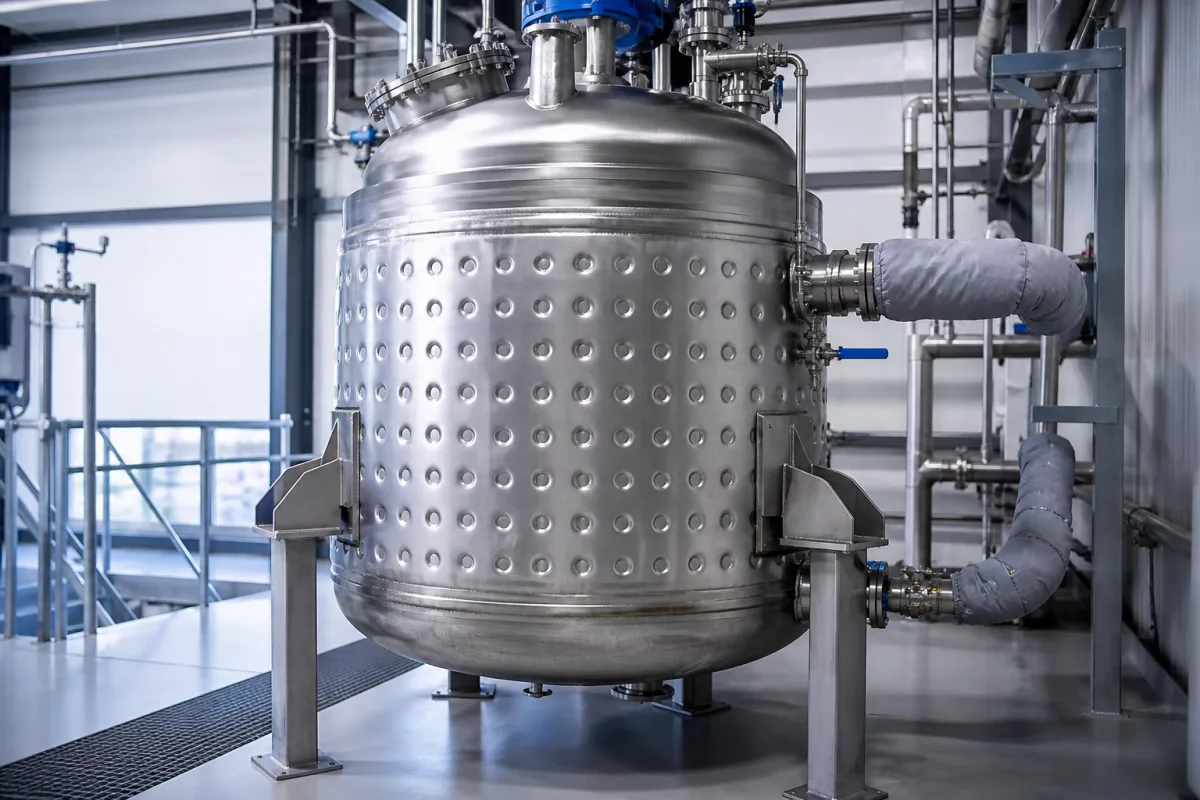
Heating/cooling jacket for a reactor vessel (conventional, dimple or half-pipe, and the pressure and cycling each will take)
Choosing the jacket welded around a reactor or process vessel · conventional annular jacket, dimple jacket plug-welded in a pattern, half-pipe coil, their pressure limits as different fabricators state them, thermal cycling, pressure drop and relative cost
Three external jacket types are welded to vessels: an open annular jacket, a thin dimpled sheet plug-welded to the shell, and a half-pipe wound around it. They differ in the pressure the jacket side can hold, how they take repeated heating and cooling, the pressure drop of the heat-transfer medium, and what they do to the vessel wall thickness and price. Fabricators state the limits differently, so the jacket is specified with its design pressure, medium and cycling written down.
External heating and cooling jackets for reactors and process vessels: conventional, dimple and half-pipe designs, with internal coils compared. Complete jacketed stirred reactors are covered on the Chemical reactor (jacketed stirred tank) page; reactor temperature control units on the Temperature control unit (TCU) for jacketed and flow reactors page; catalyst internals on the Reactor core (removable catalyst cartridge or basket assembly that holds the catalyst bed inside a reactor shell) page; fermenter jacket control on the Automated fermentation control system for brewery cylindroconical fermenters page.
CNFX editorial research · Sources checked October 13, 2026 · 3 sources
Conventional, dimple and half-pipe: pressure and cycling
Jessica Jacobson of Apache Stainless Equipment, writing in Process Heating (July 2018), says conventional jackets "are best used for low pressure applications below 50 psi" and give the lowest pressure drop; dimple jackets, a thin stainless layer plug welded to the shell in a regular pattern, provide a large transfer area "up to 200 psig"; and half-pipe jackets "can be rated up to 500 psig". [1]
Bendel, a tank fabricator, puts the dimple limit lower: dimpled jackets "are not recommended for pressures exceeding 100 psi or when the cycling of steam and cooling water is to be utilized in the process", while half-pipe jackets do not have those limitations. The two fabricators differ by a factor of two on dimple-jacket pressure, so the rating has to come from the fabricator's own design and test for the pattern offered. [2][1]
Apache adds that dimple jackets "are not, however, recommended for thermal cycling or when shocking is required", and that dimple patterns "should be validated and proof tested per ASME regulations". Ward Vessel and Exchanger notes that "the numerous welds on this type of reactor jacket can be labor intensive and may be more susceptible to leaking". [1][3]
Jacket type
Pressure stated
Other limits stated
Source
Conventional
Below 50 psi (best use)
Lowest pressure drop; thicker vessel wall for external pressure
Give the fabricator the jacket design pressure and temperature, the medium (steam, water, thermal oil, glycol), whether the jacket alternates between steam and cooling water, and the flow and allowable pressure drop.
02
Cost, wall thickness and where internal coils fit
Ward gives one cost comparison for a 90-in. OD, 316 stainless reactor: "a conventional jacket would cost about 30% more than a half pipe jacket", and a dimpled jacket about 10% less than half-pipe, "but would also only be viable at lower pressures and temperatures". Ward builds half-pipe reactors and calls that design the "sweet spot". [3]
Apache explains that a conventional jacket has no reinforcement, so "greater material thickness is required to accommodate the jacket’s external pressure requirements on the vessel wall", while the dimple pattern allows a thinner shell. On small vessels it ranks conventional jackets cheapest, then dimple and half-pipe; on large tanks half-pipe falls between dimple and conventional in cost and material thickness. [1]
Internal coils give high flow and high pressure ratings, but Apache warns that cleaning them can be an issue where sanitation matters and that the required heat transfer "may not be attainable with the internal coil" depending on the load. [1]
Ask for a price and shell thickness for each jacket type at your design pressure, and for the fabricator's heat-transfer area and pressure drop at your flow.
03
Reactor jacket details
Paste it into your enquiry below or into an email to a maker, then replace every bracket.
Explore company information and manufacturing capabilities, then discuss the scope of your project with a relevant supplier.
Share this page
Compiled and source-reviewed by the CNFX editorial team.
Each manufacturer above links to the page on that company's own website where the product is listed, with the date we checked it. How we source and review
· Page last updated 13 October 2026
Buyer questions
What pressure can a dimple jacket take?
Apache states up to 200 psig; Bendel does not recommend dimple jackets above 100 psi. Use the fabricator's tested rating. [1][2]
Which jacket suits steam and cooling water in turn?
Bendel and Apache both advise against dimple jackets for that cycling and point to half-pipe. [2][1]
On small vessels, per Apache; on a 90-in. reactor Ward found it about 30% dearer than half-pipe. [1][3]
Sources and what still needs a direct check
Sources checked 2026-10-13. Process Heating published Apache Stainless Equipment's article on ASME vessel heat transfer surfaces (2018); Bendel and Ward Vessel and Exchanger publish their own jacket comparisons as fabricators.