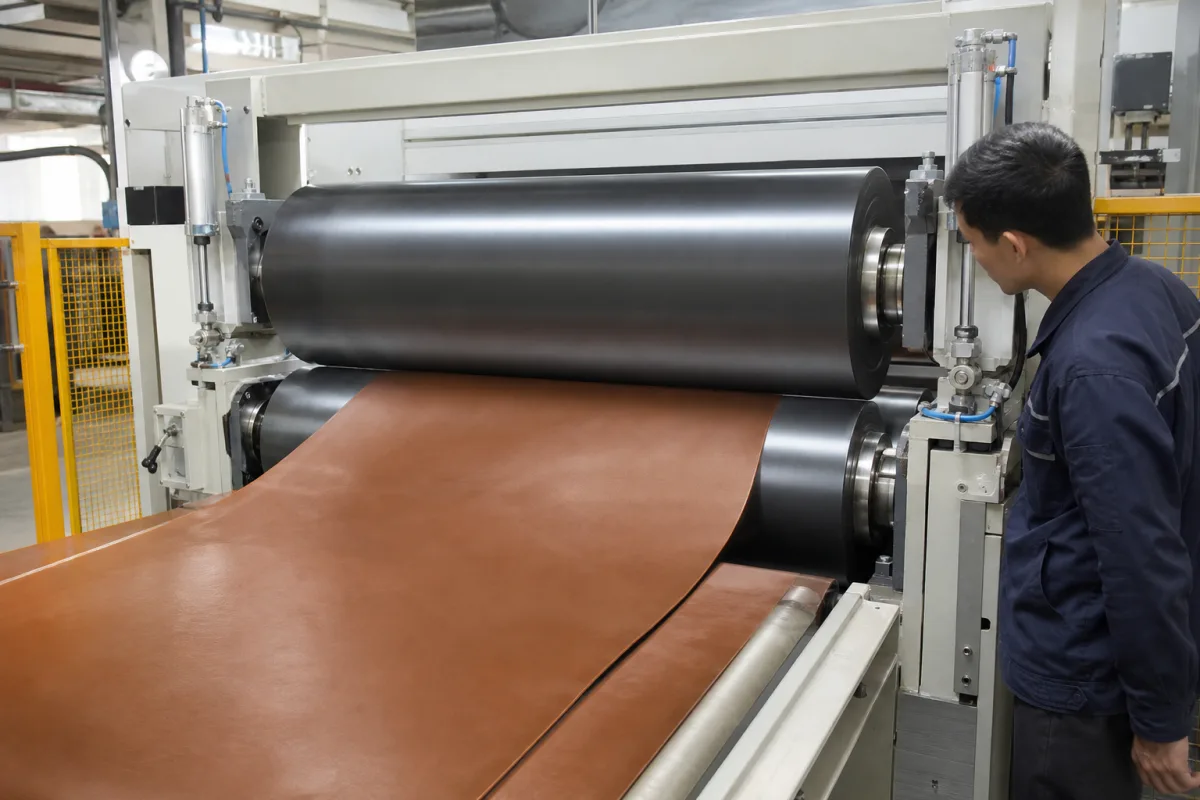
Pressure roller system of a band-knife splitting machine: gauge roller, sectional ring roller and rubber pressure roller that hold the grain to one thickness
Band-knife splitting · the gauge roller above the hide, the ring roller of narrow sections below it, and the rubber roller that presses the rings up so the grain comes off at one thickness while the split takes the natural variation
A band-knife splitting machine cuts a hide or a leather panel parallel to its surface. Above the knife, a driven gauge roller sits at a set height over the knife edge, so the layer passing between them comes out at one thickness. Below the hide, a roller made of narrow rings on one shaft, pressed upwards by a rubber-covered roller, lets each section of the hide rise or fall with its own thickness. Without that sectional pressure the knife would follow the hide's thick and thin areas instead of cutting a level grain.
The roller assemblies that feed and press leather against the band knife of splitting machines: driven upper gauge (transport) rollers, lower ring (section) rollers on a rubber pressure roller, their loading, the scraper or ring jaw that keeps the rings clean, retraction for cleaning and insertion, and the choice of presser roll or presser bar on narrow splitters for leather goods and shoe parts. Bell-knife edge skivers with their feed roll and presser foot are covered on the Leather edge skiving machine page; roller presser feeds on sewing machines on the Driven roller presser feed for leather sewing machines page; fleshing of raw hides on the Fleshing machine page; and heated press rolls on the Heat transfer assembly for heated leather press rolls page.
CNFX editorial research · Sources checked October 13, 2026 · 6 sources
Gauge roller, ring roller and rubber roller: the roll stack that keeps the grain level
Mance's patent on an automatic retraction system describes the band-knife splitting machine this stack belongs to: the hide is laid on an infeed table and fed into the rotating rollers, the vertical gap between the upper feed roller, or gauge roller, and the knife edge determines the thickness of the top split, so the grain comes out uniform while the flesh split below the knife carries the hide's natural thickness differences. [1]
The rings are the part that wears and fouls. Mance's ring-roller patent describes older section rings of brass, bronze and steel, driven by friction and held together on a round shaft only by end washers and adjustment nuts, and proposes outer rings of thermo-chemically hardened magnetic stainless steel driven by inner rings on a hollow bronze spline shaft, with pressurised water fed from inside the roller to keep lime solution, flesh, fat and grease out of the gaps between rings. [2] As an example of sizes, which it says vary with the make and model of splitting machine, it gives a complete ring roller of three metres plus or minus fifty percent, outer section rings of 50 mm diameter (±20 %) and 37.5 mm width (±35 %) and inner rings of 33 mm diameter (±20 %), and tightens the spacer length tolerance from +0.025/−0.000 mm on known spacers to +0.0127/−0.000 mm. [2]
Rizzi's patent, filed by Silvio Repetto in Modena, describes the same stack with an idle ring roller that can rock, supported by the rubber-coated roller and by lateral guides shaped as scrapers that remove threads of hide and shreds of flesh. Its fluid-pressure cylinder has three ports: one position withdraws the pressure roller fully to clean the scrapers and cutting region, an intermediate one withdraws it partly so that the hide can be inserted. [3]
Roller
What it does in the stack
Upper gauge (transport) roller
Driven; set to the distance from the band-knife edge that gives the grain thickness [2][3]
Lower ring (section) roller
A set of rings on a shaft, mounted resiliently so its surface can deviate from a straight line; pulls and spreads the hide towards the knife with the gauge roller [2]
Rubber pressure roller
Rubber-coated; supports the ring roller and turns it by friction, applying a pressure to the hide that stays constant whatever the hide thickness [3]
Ring jaw plate and insert
Lets the sections give way only at right angles to the knife edge; the bevelled insert scrapes the flesh split off the rings [1]
Ask for the ring roller length and section ring width, ring material and how the rings are driven, how the rubber roller is loaded and its cover hardness, and how the ring roller is withdrawn for cleaning and hide insertion.
02
Flesh build-up at the ring jaw, and taking the ring roller out of the knife zone
Mance's retraction patent explains why the stack has to be opened during production. Flesh and grease scraped off the hide collect where the ring jaw insert meets the ring roller, push individual section rings off their axis and up into the travelling band knife, and spoil splitting accuracy. [1]
Reversing the ring roller dislodges some of the debris, but when that fails the patent describes operators stopping the feed, stopping and retracting the band knife, retracting the infeed table and pulling the ring roller out, with two or three operators to avoid bending its shaft and safety hooks to draw it out of the space in front of the knife edge. [1] Its answer is a pair of pivot arms on the rubber-roller journals carrying the ring roller, so that linear actuators, pneumatic or hydraulic cylinders among them, swing the ring roller a preset distance away from the gauge roller and the knife along the rubber roller's circumference. [1] The ring-roller patent by the same inventor tackles the same debris from inside, with the water fed through the hollow shaft. [2]
On a new or rebuilt splitter, ask how the ring jaw insert is reached for cleaning: by reversing the rings, by retracting the ring roller or the pressure roller, or only by removing the ring roller.
03
Presser roll or presser bar on narrow band-knife splitters for leather goods and shoe parts
On splitters for cut leather parts, Fortuna offers a presser roll and a presser bar for the same machine, and states a different thinnest split for each.
The SPA 750 carries the presser bar and pressure roll on a swivelling carrier, has a pneumatically adjustable pretension on the feed roll, a knurled steel lower feed roll with a rubber lower feed roll as an option, and displays splitting and scrap thickness in steps of 0.05 mm; it draws 0.5 m³/h of compressed air at 6 bar. [6] The AB 320 E lists an upper driven presser roll, a rubber feed roll and a knurled steel feed roll, with a digital display of splitting and scrap thickness. [4] Editorial reading of the table: on all three machines the presser bar reaches a thinner split than the roll, by a factor of 2.5 on the 320 and 470 mm machines and 2.25 on the 750 mm machine, so the thinnest part in the order decides which presser is fitted.
Give the thinnest split and the thickest incoming part, the part width, and whether the material is leather, synthetic or a laminate, and ask which presser (roll or bar) and which lower feed roll (knurled steel or rubber) the supplier proposes for it.
04
Data to send with a splitting roller enquiry
Paste it into your enquiry below or into an email to a maker, then replace every bracket.
Machine: [maker; model; working width; band knife size]
Material: [hide or panel; tanned state; thickness range in; split thickness out]
Gauge roller: [diameter; drive; surface]
Ring roller: [length; section ring diameter and width; ring material; drive]
Pressure roller: [rubber cover hardness; loading by air or hydraulics; pressure]
Narrow splitter: [presser roll or bar; lower feed roll knurled steel or rubber]
Cleaning: [ring jaw insert access; retraction; water or air flushing]
Explore company information and manufacturing capabilities, then discuss the scope of your project with a relevant supplier.
Share this page
Compiled and source-reviewed by the CNFX editorial team.
Each manufacturer above links to the page on that company's own website where the product is listed, with the date we checked it. How we source and review
· Page last updated 13 October 2026
Buyer questions
What sets the grain thickness on a band-knife splitter?
Mance's patent states that the vertical gap between the upper gauge roller and the knife edge sets the thickness of the top split; the ring roller below yields so that the hide's thickness variation goes into the flesh split. [1]
Why is the lower roller made of rings?
So that it can deviate from a straight line: Mance describes a resilient ring roller resting on a rubber roller, and Rizzi a rubber-coated roller that applies a pressure that stays constant whatever the hide thickness. [2][3]
Can a presser roll split as thin as a presser bar?
Not on Fortuna's figures: the AB 320 E and NAF 470 list 0.2 mm with the presser bar and 0.5 mm with the presser roll, and the SPA 750 lists 0.4 and 0.9 mm. [4][5][6]
Why does a ring roller need cleaning during production?
Mance's retraction patent notes that flesh and grease collect at the ring jaw insert, push section rings off their axis and up into the band knife, and spoil splitting accuracy. [1]
Sources and what still needs a direct check
Sources checked 2026-10-13. Two ring-roller patents by Vitomir Mance and a Rizzi patent describe the gauge, ring and rubber rollers, their dimensions and cleaning; Fortuna's data sheets give the thinnest split with presser roll and presser bar on three band-knife splitters.