Editorial Technical Reference

Bearing Assembly

This page explains how Bearing Assembly is classified within Furniture Manufacturing. Technical values and manufacturer relationships are research references; confirm the current specification and supplier evidence for each order.

Technical Definition & Core Assembly

A mechanical assembly within a furniture hinge that facilitates smooth rotational movement and reduces friction between moving parts.

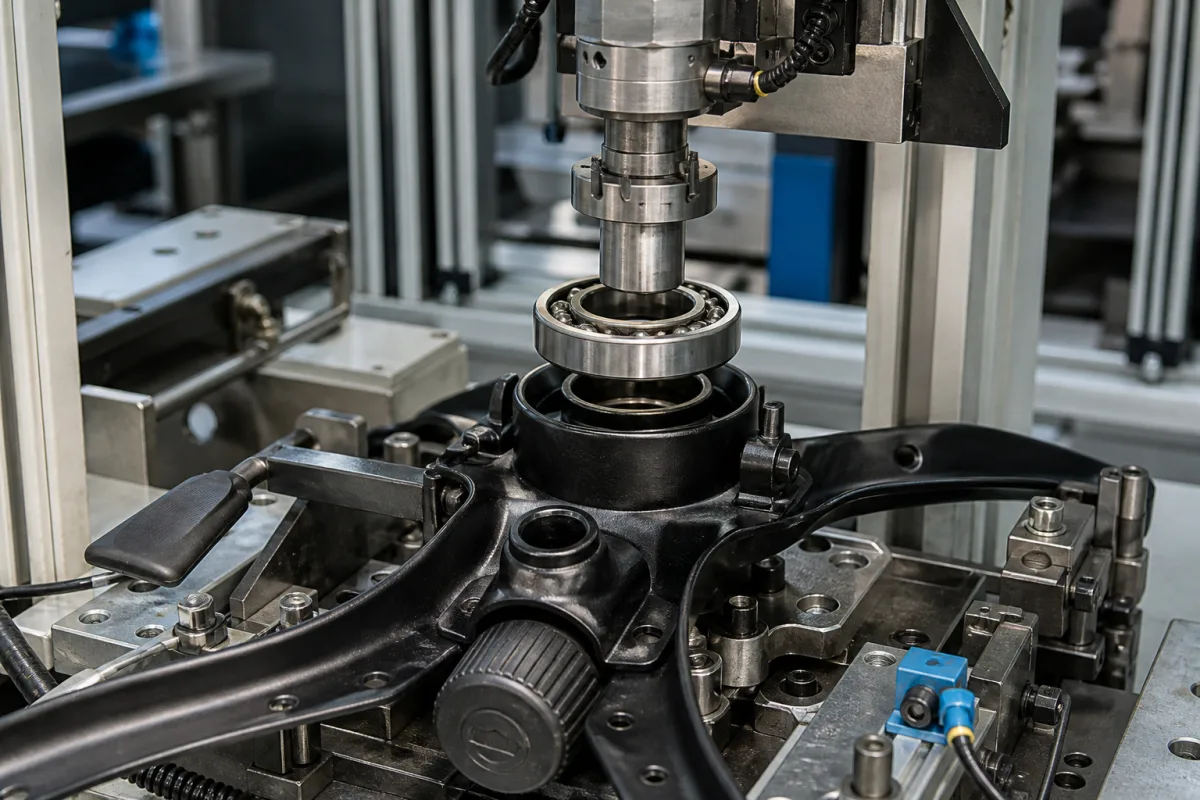
Representative product image. Confirm appearance and specifications with the manufacturer.

Product Specifications

Technical details and manufacturing context for Bearing Assembly

Definition
The bearing assembly is a critical sub-component of furniture hinges, specifically designed to enable controlled rotation of doors, cabinets, and other furniture elements. It consists of precision-engineered bearing elements housed within a structural frame, ensuring minimal friction, wear resistance, and consistent performance over the hinge's operational lifespan. This assembly directly contributes to the hinge's smooth opening/closing action, load-bearing capacity, and overall durability. The bearing assembly is typically used in residential and commercial furniture, including kitchen cabinets, wardrobes, and office furniture. It is available in various sizes and configurations to match different hinge designs and load requirements. The assembly may incorporate ball bearings or bushings, depending on the application and performance needs. Materials commonly used include stainless steel, carbon steel, brass, and polymers such as POM or nylon, each offering distinct properties in terms of corrosion resistance, strength, and friction. Key parameters for selection include bore diameter, outer diameter, width, dynamic and static load ratings, maximum rotational speed, radial clearance, operating temperature, material grade, lubrication type, and weight. These parameters are specified in accordance with relevant ISO standards, such as ISO 15 for dimensions, ISO 76 for load ratings, and ISO 5753 for radial clearance. It is important to note that the values provided are reference ranges and must be verified for the specific model and application. The bearing assembly operates on the principle of rolling or sliding contact to reduce friction, distributing mechanical stress evenly and preventing seizing. Proper installation and maintenance are essential to ensure optimal performance and longevity. Regular inspection for wear, noise, or play can help identify potential issues early. The assembly is designed for manual operation, with a maximum rotational speed typically between 100 and 500 rpm. Operating temperature range is -20 to 80 degrees Celsius, beyond which lubricant degradation may occur. Lubrication is typically grease, with lithium-based options standard and food-grade available if required. Always confirm model-specific values and standards with the legal manufacturer or supplier before procurement.
Working Principle
The bearing assembly operates on the principle of rolling or sliding contact to reduce friction. In furniture hinges, it typically contains ball bearings or bushings that rotate within races or sleeves. When torque is applied to the hinge (e.g., opening a door), the bearing elements roll or slide, converting direct metal-on-metal friction into smoother rotational motion. This distributes mechanical stress evenly, prevents seizing, and maintains alignment between hinge knuckles and leaves.
Common Materials
Stainless Steel, Carbon Steel, Brass, Polymer (e.g., POM, Nylon)
Technical Parameters
ParameterTypical rangeNotes & selection driver
Bore Diameter3–12 mmStandard sizes for furniture hingesISO 15
Outer Diameter8–30 mmMatches housing dimensionsISO 15
Width4–10 mmAffects load capacityISO 15
Dynamic Load Rating0.5–5 kNHigher for heavy doorsISO 76
Static Load Rating0.3–3 kNPrevents permanent deformationISO 76
Maximum Rotational Speed100–500 rpmFor manual operation only
Radial Clearance0.005–0.02 mmC2–CN range for quiet operationISO 5753
Operating Temperature-20–80 °CBeyond this, lubricant degrades
Material Grade100Cr6Bearing steel for rings and ballsDIN 17230
Lubrication TypeGreaseLithium-based, food-grade optionalISO 6743-9
Weight1–20 gDepends on size

Ranges are indicative industry figures for RFQ preparation, not a supplier commitment. Confirm every value and standard with the legal manufacturer before ordering.

Components / BOM
  • Outer Race Part
    Provides structural housing and mounting surface within hinge knuckle.
    Material: Stainless Steel
  • Inner Race Part
    Interfaces with hinge pin; rotates relative to outer race.
    Material: Carbon Steel
  • Rolling Elements Part
    Balls or rollers that facilitate smooth rotation by reducing friction between races.
    Material: Chrome Steel
  • Cage/Retainer Part
    Separates and maintains even spacing of rolling elements.
    Material: Brass or Polymer
  • Seal/Shield Part
    Protects internal components from dust, debris, and retains lubrication.
    Material: Rubber or Polymer

Applied To / Applications

This component is essential for the following industrial systems and equipment:

Industrial Ecosystem & Supply Chain Structure

Complementary Systems
Downstream Applications
Specialized Tooling

Application Fit & Sizing Matrix

Operational Limits
pressure: Max 5 MPa static load
other spec: Max rotational speed: 120 RPM
temperature: -20°C to 80°C
Media Compatibility
✓ Indoor air environments ✓ Wood furniture applications ✓ Light lubricated conditions
Unsuitable: High-moisture or corrosive chemical environments
Sizing Data Required
  • Door/panel weight (kg)
  • Hinge mounting hole diameter (mm)
  • Required angular rotation range (degrees)

Reliability & Engineering Risk Analysis

Failure Mode & Root Cause
Fatigue spalling
Cause: Cyclic loading exceeding material endurance limit, often from improper preload, misalignment, or contamination-induced stress concentrations
Lubrication failure
Cause: Insufficient or degraded lubricant leading to metal-to-metal contact, caused by incorrect viscosity, contamination, excessive temperature, or improper lubrication intervals
Maintenance Indicators
  • High-frequency vibration or ultrasonic emissions indicating early-stage surface degradation
  • Abnormal temperature rise (>15°C above ambient) detected via infrared thermography or embedded sensors
Engineering Tips
  • Implement precision alignment during installation using laser alignment tools to maintain angular and parallel misalignment below 0.002 inches per inch
  • Establish condition-based lubrication program using oil analysis to monitor viscosity, water content, and particle counts, replenishing only when parameters exceed OEM thresholds

Indicative industry ranges for design and RFQ preparation. Confirm the exact figures and applicable standard with the manufacturer before specifying.

Compliance & Manufacturing Standards

Applicable Standards
ISO 15:2011 (Rolling bearings - Radial bearings - Boundary dimensions, general plan) ANSI/ABMA 9:1990 (Load Ratings and Fatigue Life for Ball Bearings) DIN 620-1:2012 (Rolling bearings - Radial bearings - Boundary dimensions, general plan)

Quoted from the published standard.

Manufacturing Precision
  • Bore diameter: ±0.0025mm for P5 precision class
  • Radial runout: 0.003mm for ABEC 5 precision
Quality Inspection
  • Vibration analysis for noise and defect detection
  • Dimensional verification using coordinate measuring machine (CMM)

Manufacturers of Bearing Assembly

1 company lists this product among what they make. Company figures are quoted from each company's own website; every card states where the relationship came from.

Shanghai Trans-Power
Shanghai, CN
Listed on the company's own website · profile compiled by CNFX from public sources

Manufacturer listings support early research and capability understanding. They are not certification, ranking, or transaction guarantees.

Technical documentation
Request current drawings, revision history, and a signed specification sheet.
Manufacturing capability
Verify equipment lists, process limits, capacity, and representative production evidence.
Inspection readiness
Confirm test methods, calibrated equipment, sampling plans, and traceable reports.
Supplier transparency
Check the legal entity, factory address, ownership, certifications, and direct contacts.

CNFX does not score or rank suppliers. Buyers must verify all claims and documents with the legal manufacturer before ordering.

Supply Chain Compatible Machinery & Devices

Furniture Caster

A furniture caster is a wheeled component mounted to the base of furniture items to enable easy movement and repositioning.

Explore Specs →
Ergonomic Office Chair

Industrial-scale manufactured seating solution for workplace ergonomics and comfort.

Explore Specs →
Cold-Rolled Steel Sheet

Flat steel product manufactured by cold rolling for precise dimensions and surface finish.

Explore Specs →
Powder-Coated Steel Sheet

Steel sheet with electrostatic powder coating for durable metal furniture surfaces.

Explore Specs →

Frequently Asked Questions

What is the function of a bearing assembly in a furniture hinge?

The bearing assembly facilitates smooth rotational movement and reduces friction between moving parts, enabling controlled opening and closing of doors and cabinets.

What materials are commonly used for bearing assemblies?

Common materials include stainless steel, carbon steel, brass, and polymers such as POM or nylon. Each material offers different properties in terms of corrosion resistance, strength, and friction.

What parameters should be considered when selecting a bearing assembly?

Key parameters include bore diameter, outer diameter, width, dynamic and static load ratings, maximum rotational speed, radial clearance, operating temperature, material grade, lubrication type, and weight. These must be matched to the hinge design and application.

How should a bearing assembly be maintained?

Regular inspection for wear, noise, or play is recommended. Proper lubrication with the specified grease type is essential. If any abnormal signs appear, consult the manufacturer for guidance.

Data Basis

Editorial classification, named public sources where available, and source-reviewed manufacturer records.

Preliminary Technical Classification
This page supports structured research, RFQ preparation, and supplier evaluation. It does not replace buyer-led supplier qualification, standards review, or technical approval.
Buyer enquiry

Request manufacturing insight for Bearing Assembly

Ask for use case, specification boundaries, supplier type, and RFQ preparation information for this product.

Where it goes
Straight to the CNFX editorial desk, and to the manufacturer if this product is linked to a claimed profile. Nothing is broadcast to a supplier list.
Your details stay here
We do not sell or rent enquiry data, and we do not add you to a mailing list. Used only to answer this request.
No commission, no middleman
CNFX is a directory. We take no cut of any order and never negotiate on a supplier's behalf.
What we don't claim
A listing is not an endorsement. Qualify every supplier and verify every figure yourself before ordering.

Your business information is used only to process this request.

Thank you! Your message has been sent. We'll respond within 1–3 business days.
Sorry, we couldn't send your message. Please try again, or email us at contact@cnfx.com.

Need to Manufacture Bearing Assembly?

Compare manufacturer profiles with relevant product and process capability.

Previous Product
Soft-Close Damper
Last Product
Get QuotesChat