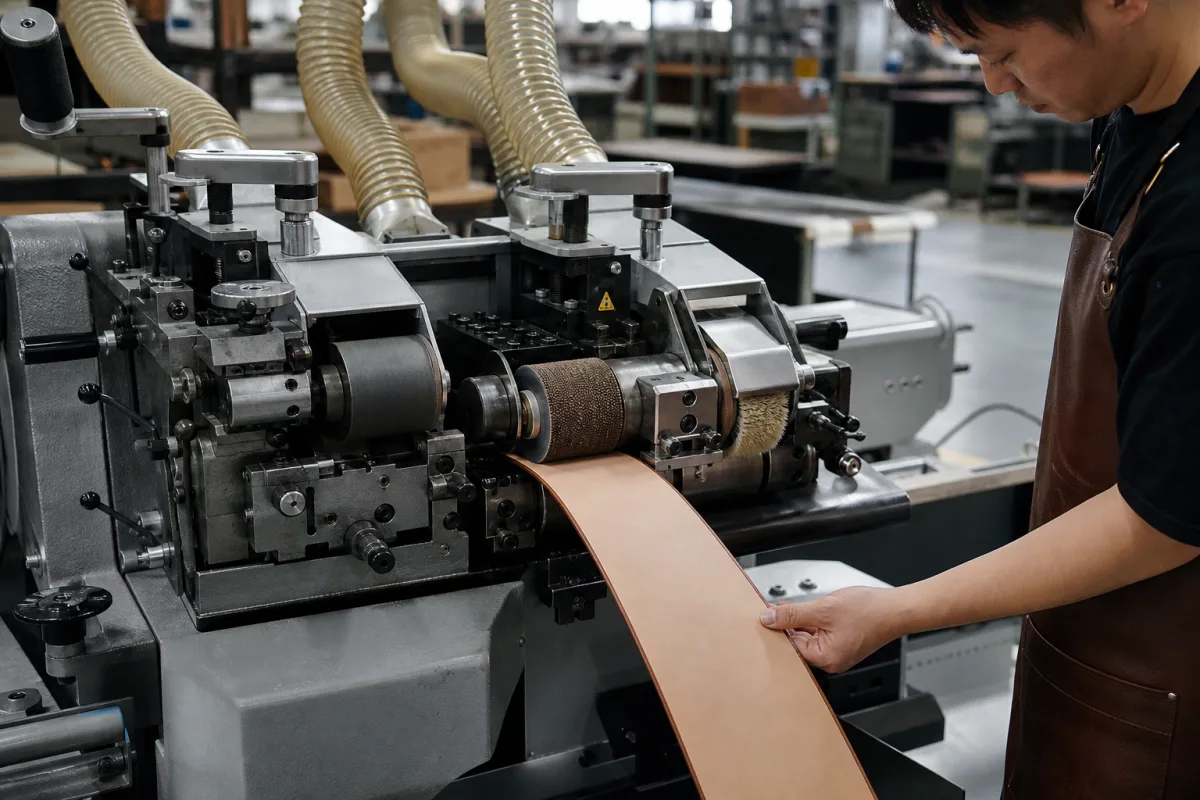
Edge preparation unit for leather: sanding wheel and brush heads that level a cut edge before painting, with dust extraction
Leather goods and belt making · the sanding wheels and brush that level a cut edge before it is painted, the wheel speeds on offer, and why the dust they raise needs extraction at the head
A cut leather edge shows layers, fibres and saw or knife marks. An edge preparation unit sands it flat with an abrasive wheel or drum and brushes off the loose fibres, so that edge paint can be laid on evenly afterwards. The unit in the picture does this on a belt strip fed by hand past two abrasive rollers and a brush, with an extraction hose over each head. Two things decide how it is specified: the abrasive head and its speed range against the leathers being run, and how the dust it makes is captured.
Sanding, grinding and brushing heads that prepare the cut edges of leather straps, belts and leather-goods parts before edge paint, from bench single-wheel units to heads on strip machines, and the extraction of the dust they produce. Automatic edge inking and painting machines, including integrated lines that trim, brush and colour strips in one pass, and their dryers are covered on the Leather edge coating application system page; thinning the edge margin is covered on the Leather edge skiving machine page, and extraction hoods for metal grinding on the Dust extraction hoods and duct network page.
CNFX editorial research · Sources checked October 12, 2026 · 3 sources
Sanding wheel, brush and positioning plate: a bench unit's Ø100–120 mm wheel at 100–3,000 r/min, and what that means at the rim
Zonesun's ZS-V05 is a single-wheel edge sanding and burnishing unit for handbags, small leather goods, shoe and sole edges, belts, watch straps and harness straps. Its published parameters show which variables a buyer actually has to fix on a preparation head. [1]
Editorial calculation: rim speed = π × diameter × r/min ÷ 60. A Ø120 mm wheel at 3,000 r/min runs at π × 0.12 × 3,000 ÷ 60 ≈ 18.8 m/s; a Ø100 mm wheel at the 100 r/min minimum runs at about 0.52 m/s. The adjustable range therefore spans roughly a 36-fold change in rim speed; the maker ties the setting to hard leather, soft leather and the finish required, without publishing recommended speeds for each. [1]
The unit pictured on this page is a different arrangement for straps: the strip passes two abrasive rollers and a rotary brush in line, each head under its own extraction hose. The same items apply to each head (wheel or drum size, speed, power, guide and extraction connection), multiplied by the number of heads.
For a quotation, state the leathers and thicknesses, the edge shape wanted (square or rounded), strip or part sizes, how parts are fed (by hand or on a strip machine), the abrasive type and grit sequence you use now, and the wheel diameter and speed range required.
02
Leather dust from sanding is a Group 1 carcinogen for the nasal sinuses: the shoe-industry risk figures behind extraction at the head
Edge sanding is a dust-making step. The cancer evidence on leather dust comes from boot and shoe finishing rooms, where sanding and buffing of the same material concentrated the exposure.
IARC concluded that nasal adenocarcinoma has been caused by employment in boot and shoe manufacture and repair, that the excess was almost totally confined to the preparation and finishing rooms where the dusty operations were, and that the pattern strongly suggests a role for leather dust; solvent exposure and smoking could not account for it. [2] Emanuelli and colleagues note that IARC Monograph 100 classifies leather dust, with wood dust, as a Group 1 carcinogen for the sinonasal mucosa. [3]
Their Padua study is small, 32 adenocarcinomas contrasted with 21 other epithelial tumours, so its confidence intervals are wide. Its authors report that in woodworking, respiratory protection and local exhaust ventilation reduced the risk, while in footwear manufacture, where such measures were seldom adopted, risk was significantly greater with high leather dust exposure. [3]
Zonesun describes the exhaust vent on its bench unit as removing heat, dust and sanding debris; it does not publish an airflow. [1] Editorial note: an outlet on the machine only helps if it is connected to an extractor sized for it, so ask for the outlet diameter and the airflow and suction the maker expects at that outlet, for each head.
Finding
Figure
Source
Light or uncertain leather dust exposure vs non-exposed
Sex-adjusted standardized odds ratio 7.5 for nasal cancer
Ask for the extraction connection size and design airflow per head, whether the hood encloses the wheel and brush, how the dust is collected and emptied, and any workplace dust measurements the maker or your own hygienist can provide for edge sanding of your leathers.
03
Leather, edge and dust details for an edge preparation unit
Paste it into your enquiry below or into an email to a maker, then replace every bracket.
Parts: [straps, belts, bag panels, shoe parts; thickness; length or size]
Leather: [tannage; hardness; finish]
Edge: [square or rounded; layers to level; paint system that follows]
Heads: [number; wheel, drum or brush; diameter; speed range; abrasive and grit]
Feed: [by hand or strip machine; speed]
Extraction: [outlet size per head; airflow; collector]
Supply: [voltage; power]
Explore company information and manufacturing capabilities, then discuss the scope of your project with a relevant supplier.
Share this page
Compiled and source-reviewed by the CNFX editorial team.
Each manufacturer above links to the page on that company's own website where the product is listed, with the date we checked it. How we source and review
· Page last updated 13 October 2026
Buyer questions
What speed does a leather edge sanding wheel run at?
Zonesun's bench unit adjusts from 100 to 3,000 r/min on a Ø100–120 mm wheel; by editorial calculation that is about 0.5 to 18.8 m/s at the rim. [1]
Is leather dust from edge sanding hazardous?
Yes: leather dust is classified by IARC as a Group 1 carcinogen for the nasal sinuses, and IARC reported an odds ratio of 121 for heavy leather dust exposure in shoe workers. [2][3]
Which shoe-industry jobs carried the nasal cancer risk?
IARC reports the excess was almost totally confined to the preparation and finishing rooms, with risk 4.5 times that of other operations. [2]
Sources and what still needs a direct check
Sources checked 2026-10-12. Zonesun publishes the parameters of its bench edge sanding unit; IARC's 1987 evaluation of boot and shoe manufacture and the Journal of Occupational Medicine and Toxicology study by Emanuelli and colleagues give the health evidence on leather dust.