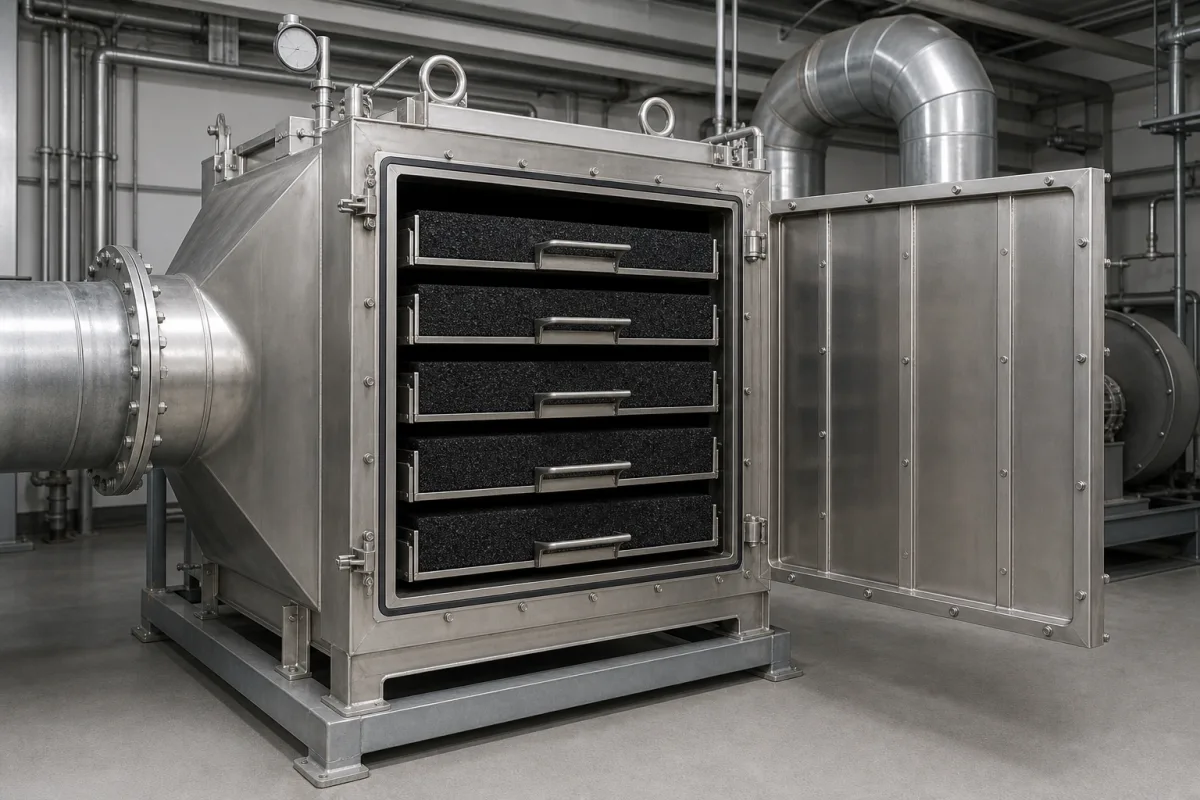
Air and exhaust treatment · VOCs, odour, humidity, bed velocity and carbon life
An activated carbon filter removes VOCs and odours from air by adsorption. Ask three things first: which compounds and at what concentration, what airflow, humidity and temperature, and how breakthrough will be detected and the carbon replaced.
Activated carbon filters for air and exhaust gas: carbon panels, pleated, pocket and V-bank filters, honeycomb media, tray boxes and canister or fixed-bed adsorbers. Activated carbon filter tanks for water treatment are a different product and are outside this page.
CNFX editorial research · Sources checked October 12, 2026 · 4 sources
The US EPA's cost manual chapter on carbon adsorbers says they suit dilute VOC streams, below about 100 ppmv, at moderate flow, and when properly designed can remove 95–99% of VOCs at 500–2,000 ppm inlet, and more than 98% for dilute streams. [1]
The same chapter warns that carbon is less effective for highly polar, volatile or small molecules such as vinyl chloride, methanol and formaldehyde, and in humid gas: some studies show about 30% lower removal above 75% relative humidity, and moisture can encourage biological growth. Oxygen-bearing compounds such as peroxides, ketones, organic acids, aldehydes and organic sulfur compounds can react exothermically on carbon and cause bed fires. [1]
EPA describes a particulate filter ahead of the carbon bed in fixed-bed systems, and Clean-Link recommends upstream particulate filtration to protect the carbon media. [1][2]
Give the supplier the compounds and concentrations, airflow, temperature, relative humidity, dust load, operating hours, outlet limit, space available and how carbon will be replaced or regenerated.
02
Size the bed and plan carbon replacement
EPA explains that bed cross-section follows from the airflow and an empirically chosen superficial velocity: one adsorber vendor uses 85 ft/min, another 65 ft/min, and a carbon maker cautions against exceeding 60 ft/min at one atmosphere. [1]
Editorial calculation: 60 ft/min ≈ 0.30 m/s and 85 ft/min ≈ 0.43 m/s. For 10,000 m³/h, that is 10,000 ÷ 3,600 ≈ 2.78 m³/s, needing about 2.78 ÷ 0.30 ≈ 9.1 m² of bed face at 60 ft/min or 2.78 ÷ 0.43 ≈ 6.5 m² at 85 ft/min. [1] Panel and V-bank filters for HVAC use their own rated face velocities; ask the supplier for them.
For canisters, EPA describes two or more units in series so breakthrough from the first is caught by the second, with sampling between them; the saturated unit is removed and a fresh one added at the clean end. Carbon charge follows from the VOC inlet load, the carbon's working capacity, which is a fraction of its equilibrium capacity, and the time between changes. [1]
The carbon tetrachloride (CTC) figure quoted on media data sheets comes from ASTM D3467, which defines CCl₄ activity as the weight of CCl₄ adsorbed by a carbon sample, as a percentage of the sample's weight, when the carbon is saturated under the method's conditions. ASTM describes it as a measure of the activation level and a quality-control check for gas-phase carbons, and notes that the number does not necessarily show how well the carbon will remove other compounds or perform under other conditions. [3]
Editorial note: use the CTC value to compare carbon grades and check deliveries, but ask the supplier for adsorption or breakthrough data on your own compounds at your humidity and temperature to size the bed and the change interval. [3][1]
03
Ask for ISO 10121 test data on the media and the complete filter
ISO 10121 sets test methods for gas-phase air cleaning in what it calls "general ventilation". Part 1 (2014) gives a laboratory challenge test for three media configurations: GPACM-LF (loose fill particles), GPACM-FL (flat sheet fabric for flat, pleated or bag devices) and GPACM-TS (three-dimensional structures used as finished elements). Part 2 (2013) tests full-size gas filtration devices (GPACDs) "regardless of media or technique used in the device". Part 3 (2022) classifies GPACDs for single-pass outdoor air using four reference pollutants — ozone, sulphur dioxide, nitrogen dioxide and toluene — at three duty levels each. [4]
Part 1 warns that its elevated challenge concentrations mean test data "should be used to compare GPACM within the same configuration and not for the purpose of predicting performance in a real situation" [4]. That fits the caution this page already gives for the CTC value, which ASTM D3467 treats as a quality index rather than a measure for your compounds [3]. Ask a supplier of pleated or V-bank carbon filters for ISO 10121-2 device data at your airflow, and for media data only within the same configuration.
The classification in Part 3 covers outdoor-air intake filters, not process exhaust; for exhaust adsorbers the EPA cost manual's design guidance on face velocity, humidity and bed sizing remains the reference this page uses [1]. Clean-Link's honeycomb media lists a CTC value of 30–45% and resistance of 250 Pa or less [2]; ask whether those figures come from an ISO 10121 test or the maker's own method.
Editorial calculation: Part 3 sets 4 reference pollutants with 3 duty levels each, 12 pollutant–duty combinations in total; Part 1 defines 3 media configurations. [4]
Part
Tests or classifies
Limits stated in the abstract
ISO 10121-1:2014
Media: GPACM-LF, GPACM-FL, GPACM-TS under steady-state test gas challenge
Results compare like configurations; not for predicting real performance
ISO 10121-2:2013
Complete gas-phase air cleaning devices
"general ventilation applications"; nuclear and military excluded
ISO 10121-3:2022
Classification of devices for single-pass outdoor air
4 reference pollutants × 3 duty levels; recirculation, indoor sources, pharmaceutical, microelectronic, nuclear, homeland security and military excluded
Values are from the Standard Norge catalogue pages for ISO 10121-1:2014, ISO 10121-2:2013 and ISO 10121-3:2022; the full standards were not reviewed.
04
Compare what suppliers offer
Suppliers linked to this page list activated carbon filters and media for air treatment. [2]
Clean-Link lists carbon media, honeycomb media, pleated panel, pocket, V-bank and compact carbon filters; its honeycomb media lists a carbon tetrachloride adsorption value of 30–45% and filter resistance of 250 Pa or less. Airy Filter lists activated carbon filters alongside panel and paint-booth filters; Compo lists activated carbon air filters and carbon fabric; Koin and Hifine list carbon filters for air purifiers. [2]
05
Trace the filter components
This is a functional reference built from the sources cited; it is not one maker's parts list.
Part
Role
Fix in the order
Carbon media
Adsorbs VOCs and odours; granular, honeycomb or fabric; activity by CTC test. [2][1][3]
Fill the specification fields with values for your exhaust
An activated carbon filter quotation needs values for your gas stream. The table explains each field, gives published values where a reviewed source states them, and says what to obtain from the supplier.
Explore company information and manufacturing capabilities, then discuss the scope of your project with a relevant supplier.
Share this page
Compiled and source-reviewed by the CNFX editorial team.
Published product pages show what a company offers, not tested performance. Confirm the legal seller, factory and scope for your order. How we source and review
· Page last updated 13 October 2026
Buyer questions
Does humidity affect an activated carbon filter?
Yes; water competes for adsorption sites, and EPA cites studies showing about 30% lower removal above 75% relative humidity. [1]
Which gases does activated carbon remove poorly?
Highly polar, volatile or small molecules such as vinyl chloride, methanol and formaldehyde. [1]
How large should a carbon bed be?
Divide the airflow by the chosen superficial velocity; at about 0.30 m/s, 10,000 m³/h needs about 9 m² of bed face. [1]
What does the CTC value of activated carbon mean?
Under ASTM D3467 it is the weight of carbon tetrachloride adsorbed at saturation as a percentage of the carbon's weight; ASTM treats it as a quality-control index of activation, not a direct measure for other compounds. [3]
Is there a standard test for activated carbon air filters?
ISO 10121 covers gas-phase air cleaning for "general ventilation": Part 1 tests media in three configurations, Part 2 tests complete devices, and Part 3 (2022) classifies outdoor-air devices against ozone, sulphur dioxide, nitrogen dioxide and toluene at three duty levels. [4]
Sources and what still needs a direct check
Sources checked 2026-10-12. The EPA chapter is part of the US EPA Air Pollution Control Cost Manual. Clean-Link is a supplier listed on this page; its values are catalogue figures.